MCQ
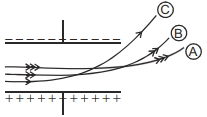
Three particles are projected in a uniform electric field with same velocity perpendicular to the field as shown. Which particle has highest charge to mass ratio?
  • A
    $A$
  • B
    $B$
  • $C$
  • D
    All have same charge to mass ratio

Answer

Correct option: C.
$C$
c
(c)

Charge with maximum curved path has highest charge to mass ratio.

Need a full question paper?

Generate a complete, print-ready paper with questions like this in minutes — across 16+ boards, with answer keys.
Start Generating Free

Similar questions

A narrow but tall cabin is falling freely near the earth's surface. Inside the cabin, two small stones $A$ and $B$ are released from rest (relative to the cabin). Initially $A$ is much above the centre of mass and $B$ much below the centre of mass of the cabin. A close observation of the motion of $A$ and $B$ will reveal that
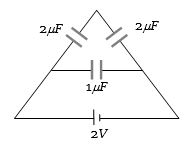
The charge on any one of the $2\,\mu \,F$ capacitors and $1\,\mu \,F$ capacitor will be given respectively (in $\mu \,C$) as
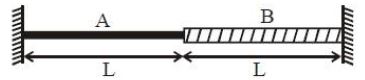
A wire of length $2\,L$ is made by joining two wires $A$ and $B$ of same lengths but different radii $r$ and $2r$ and made of the same material. It is vibrating at a frequency such that the joint of the two wires forms a node. If the number of antinodes in wire $A$ is $p$ and that in $B$ is $q$ then the ratio $p : q$ is
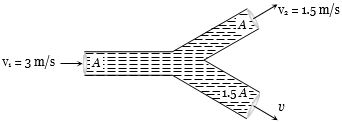
An incompressible liquid flows through a horizontal tube as shown in the following fig. Then the velocity $ v$ of the fluid is .......$m/s$
The equations of two waves acting in perpendicular directions are given as $x=a \cos (\omega t+\delta)$ and $y=a \cos (\omega t+\alpha)$, where $\delta=\alpha+\frac{\pi}{2}$, the resultant wave represents
An electron and a proton are moving on straight parallel paths with same velocity. They enter a semi-infinite region of uniform magnetic field perpendicular to the velocity. Which of the following statement$(s)$ is/are true?

$(A)$ They will never come out of the magnetic field region.

$(B)$ They will come out travelling along parallel paths.

$(C)$ They will come out at the same time.

$(D)$ They will come out at different times.

If the potential at the centre of a uniformly charged hollow sphere of radius $R$ is $V$ then electric field at a distance $r$ from the centre of the sphere is $(r > R)$
An unpolarised light beam of intensity $2 I _{0}$ is passed through a polaroid $P$ and then through another polaroid $Q$ which is oriented in such a way that its passing axis makes an angle of $30^{\circ}$ relative to that of $P$. The intensity of the emergent light is.
particle moves with simple harmonic motion in a straight line. In first $\tau\ s$, after starting from rest it travels a distance $a$, and in next $\tau\ s$ it travels $2a$, in same direction, then
A pellet carrying charge of $0.5\, coulombs$ is accelerated through a potential of $2,000\, volts$. It attains a kinetic energy equal to