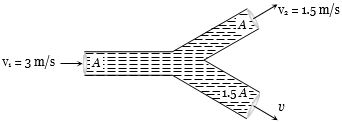
An incompressible liquid flows through a horizontal tube as shown in the following fig. Then the velocity $ v$ of the fluid is .......$m/s$
Medium
Download our app for free and get started
(c)If the liquid is incompressible then mass of liquid entering through left end, should be equal to mass of liquid coming out from the right end.
$\therefore \;M = {m_1} + {m_2}$ ==> $A{v_1} = A{v_2} + 1.5A\,.\,v$
==> $A \times 3 = A \times 1.5 + 1.5A\,.\,v$ ==> $v = 1\;m/s$
$\therefore \;M = {m_1} + {m_2}$ ==> $A{v_1} = A{v_2} + 1.5A\,.\,v$
==> $A \times 3 = A \times 1.5 + 1.5A\,.\,v$ ==> $v = 1\;m/s$

Download our appand get started for free
Experience the future of education. Simply download our apps or reach out to us for more information. Let's shape the future of learning together!No signup needed.*
Similar Questions
- 1Equal masses of water and a liquid of density $ 2$ are mixed together, then the mixture has a density of ........ $ g / cm^3$View Solution
- 2A vessel of area of cross-section A has liquid to a height $H$ . There is a hole at the bottom of vessel having area of cross-section a. The time taken to decrease the level from ${H_1}$ to ${H_2}$ will beView Solution
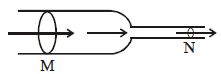
- 3Horizontal tube of non-uniform cross-section has radii of $0.1\,m$ and $0.05\,m$ respectively at $M$ and $N.$ For a stream-line flow of liquid the rate of liquid flow isView Solution
- 4A barometer kept in an elevator reads $76 \,cm$ when it is at rest. If the elevator goes up with some acceleration, the reading will be .......... $cm$View Solution
- 5A bucket contains water filled upto a height $=$ $15 cm$. The bucket is tied to a rope which is passed over a frictionless light pulley and the other end of the rope is tied to a weight of mass which is half of that of the (bucket $+$ water). The water pressure above atmosphere pressure at the bottom is ....... $kPa$View Solution
- 6A liquid of mass $1$ $kg$ is filled in a flask as shown in figure. The force exerted by the flask on the liquid is $(g = 10\ m/s^2)$[Neglect atmospheric pressure]:View Solution
- 7View SolutionSelect incorrect statement regarding turbulent flow
- 8A capillary tube is attached horizontally to a constant head arrangement. If the radius of the capillary tube is increased by $10\%$ then the rate of flow of liquid will change nearly by ......... $\%$View Solution
- 9The cross sectional area of a horizontal tube increases along its length linearly, as we move in the direction of flow. The variation of pressure, as we move along its length in the direction of flow ($x-$ direction), is best depicted by which of the following graphsView Solution
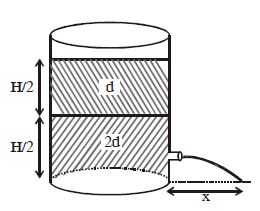
- 10A container of large uniform cross-sectional area $A$ is resting on a horizontal surface holds two immiscible, non-viscous and incompressible liquids of densities $d$ and $2d$ each of height $\frac{H}{2}$ as shown. The lower density of liquid is open to atmosphere. A small hole is made on the wall of container at height $h\left( {h < \frac{H}{2}} \right)$. The initial speed of efflux of the liquid at the hole isView Solution