MCQ
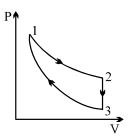
Three processes form a thermodynamic cycle as shown on $P-V$ diagram for an ideal gas. Process $1 \rightarrow 2$ takes place at constant temperature $(300K$). Process $2 \rightarrow 3$ takes place at constant volume. During this process $40J$ of heat leaves the system. Process $3 \rightarrow 1$ is adiabatic and temperature $T_3$ is $275K$. Work done by the gas during the process $3 \rightarrow 1$ is ..... $J$
  • $-40$
  • B
    $-20$
  • C
    $+40$
  • D
    $+20$

Answer

Correct option: A.
$-40$
a
In the process $1 \rightarrow 2, \Delta Q_{1 \rightarrow 2}=\Delta W_{1 \rightarrow 2}$

In the process $2 \rightarrow 3, \Delta W_{2 \rightarrow 3}=0$

In the process $3 \rightarrow 1, \Delta Q_{3 \rightarrow 1}=0$

The complete process being cyclic, $\Delta U=0$

Hence $\Delta Q=\Delta W \Rightarrow \Delta Q_{1 \rightarrow 2}+\Delta Q_{2 \rightarrow 3}+\Delta Q_{3 \rightarrow 1}=\Delta W_{1 \rightarrow 2}+\Delta W_{2 \rightarrow 3}+\Delta W_{3 \rightarrow 1} \Rightarrow$

$\Delta Q_{2 \rightarrow 3}=\Delta W_{3 \rightarrow 1}=-40 J$

Need a full question paper?

Generate a complete, print-ready paper with questions like this in minutes — across 16+ boards, with answer keys.

Start Generating Free

Similar questions

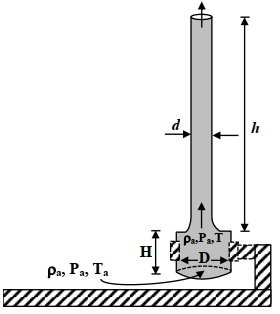
A cylindrical furnace has height $(H)$ and diameter $(D)$ both $1 \mathrm{~m}$. It is maintained at temperature $360 \mathrm{~K}$. The air gets heated inside the furnace at constant pressure $P_a$ and its temperature becomes $T=360 \mathrm{~K}$. The hot air with density $\rho$ rises up a vertical chimney of diameter $d=0.1 \mathrm{~m}$ and height $h=9 \mathrm{~m}$ above the furnace and exits the chimney (see the figure). As a result, atmospheric air of density $\rho_a=1.2 \mathrm{~kg} \mathrm{~m}^{-3}$, pressure $P_a$ and temperature $T_a=300 \mathrm{~K}$ enters the furnace. Assume air as an ideal gas, neglect the variations in $\rho$ and $T$ inside the chimney and the furnace. Also ignore the viscous effects.

[Given: The acceleration due to gravity $g=10 \mathrm{~ms}^{-2}$ and $\pi=3.14$ ]

(image)

($1$) Considering the air flow to be streamline, the steady mass flow rate of air exiting the chimney is

. . . . .$\mathrm{gm} \mathrm{s}^{-1}$.

($2$) When the chimney is closed using a cap at the top, a pressure difference $\Delta P$ develops between the top and the bottom surfaces of the cap. If the changes in the temperature and density of the hot air, due to the stoppage of air flow, are negligible then the value of $\Delta P$ is. . . . .$\mathrm{Nm}^{-2}$.

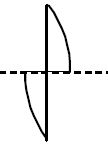
An equiconvex lens of focal length $f$ is cut into four equal parts and two parts are placed as shown in figure. The focal length of system shown in figure is :-
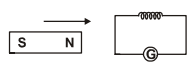
As shown in the figure, a magnet is moved with a fast speed towards a coil at rest. Due to this induced electromotive force, induced current and induced charge in the coil is E, I and Q respectively. If the speed of the magnet is doubled, the incorrect statement is:
Image
A policeman on duty detects a drop of $10\%$ in the pitch of the horn of a moving car as it crosses him. If the velocity of sound is $330 \,m/s,$ the speed of the car will be ..... $m/s$
A metal surface is illuminated by light of two different wavelengths $248 \ nm$ and $310 \ nm$. The maximum speeds of the photoelectrons corresponding to these wavelengths are $u_1$ and $u_2$, respectively. If the ratio $u_1: u_2=2: 1$ and $hc =1240 \ eV \ nm$, the work function of the metal is nearly
A white light is falling on a bi-convex lens. Which of the following options represents the correct qualitative behaviour of the focussing of this light?
An iron bar of length $L$ has magnetic moment $M$. It is bent at the middle of its length such that the two arms make an angle $60^{\circ}$ with each other. The magnetic moment of this new magnet is :
The angular width of the central maximum in a single slit diffraction pattern is $60^o $ . The width of the slit is $1\ \mu m$. The slit is illuminated by monochromatic plane waves. If another slit of same width is made near it, Young's fringes can be observed on a screen placed at  distance $50\ cm$ from the slits. If the observed fringe width is $1\ cm$, what is slit separation distance?.........$\mu m$
(i.e. distance between the centres of each slit. )
If a ferromagnetic material is inserted in a current carrying solenoid, the magnetic field of solenoid
A square loop of side $2.0\,cm$ is placed inside a long solenoid that has $50$ turns per centimetre and carries a sinusoidally varying current of amplitude $2.5\,A$ and angular frequency $700\,rad\,s ^{-1}$. The central axes of the loop and solenoid coincide. The amplitude of the emf induced in the loop is $x \times 10^{-4} V$. The value of $x$ is $.........$(Take, $\pi=\frac{22}{7}$)