A cylindrical furnace has height $(H)$ and diameter $(D)$ both $1 \mathrm{~m}$. It is maintained at temperature $360 \mathrm{~K}$. The air gets heated inside the furnace at constant pressure $P_a$ and its temperature becomes $T=360 \mathrm{~K}$. The hot air with density $\rho$ rises up a vertical chimney of diameter $d=0.1 \mathrm{~m}$ and height $h=9 \mathrm{~m}$ above the furnace and exits the chimney (see the figure). As a result, atmospheric air of density $\rho_a=1.2 \mathrm{~kg} \mathrm{~m}^{-3}$, pressure $P_a$ and temperature $T_a=300 \mathrm{~K}$ enters the furnace. Assume air as an ideal gas, neglect the variations in $\rho$ and $T$ inside the chimney and the furnace. Also ignore the viscous effects.
[Given: The acceleration due to gravity $g=10 \mathrm{~ms}^{-2}$ and $\pi=3.14$ ]
(image)
($1$) Considering the air flow to be streamline, the steady mass flow rate of air exiting the chimney is
. . . . .$\mathrm{gm} \mathrm{s}^{-1}$.
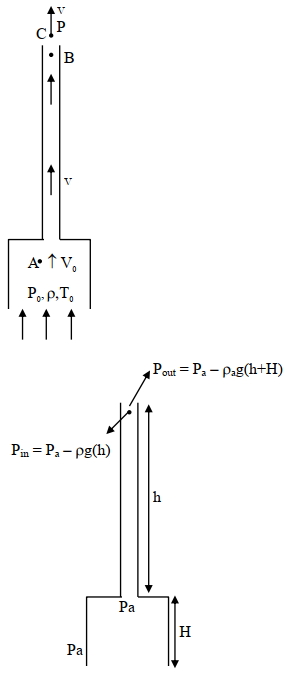
($2$) When the chimney is closed using a cap at the top, a pressure difference $\Delta P$ develops between the top and the bottom surfaces of the cap. If the changes in the temperature and density of the hot air, due to the stoppage of air flow, are negligible then the value of $\Delta P$ is. . . . .$\mathrm{Nm}^{-2}$.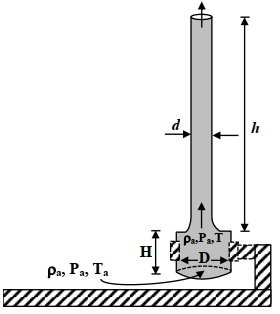
IIT 2023, Diffcult


Download our appand get started for free
Experience the future of education. Simply download our apps or reach out to us for more information. Let's shape the future of learning together!No signup needed.*
Similar Questions
- 1A liquid of density $750\,kgm ^{-3}$ flows smoothly through a horizontal pipe that tapers in crosssectional area from $A _{1}=1.2 \times 10^{-2}\,m ^{2}$ to $A_{2}=\frac{A_{1}}{2}$. The pressure difference between the wide and narrow sections of the pipe is $4500\,Pa$. The rate of flow of liquid is________$\times 10^{-3}\,m ^{3} s ^{-1}$View Solution
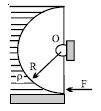
- 2A light semi cylindrical gate of radius $R$ is piovted at its mid point $O$, of the diameter as shown in the figure holding liquid of density $\rho $. The force $F$ required to prevent the rotation of the gate is equal toView Solution
- 3A table tennis ball has radius $(3 / 2) \times 10^{-2} m$ and mass $(22 / 7) \times 10^{-3} kg$. It is slowly pushed down into a swimming pool to a depth of $d=0.7 m$ below the water surface and then released from rest. It emerges from the water surface at speed $v$, without getting wet, and rises up to a height $H$. Which of the following option(s) is (are) correct?View Solution
[Given: $\pi=22 / 7, g=10 ms ^{-2}$, density of water $=1 \times 10^3 kg m ^{-3}$, viscosity of water $=1 \times 10^{-3} Pa$-s.]
$(A)$ The work done in pushing the ball to the depth $d$ is $0.077 J$.
$(B)$ If we neglect the viscous force in water, then the speed $v=7 m / s$.
$(C)$ If we neglect the viscous force in water, then the height $H=1.4 m$.
$(D)$ The ratio of the magnitudes of the net force excluding the viscous force to the maximum viscous force in water is $500 / 9$.
- 4The weight of an empty balloon on a spring balance is $w_1$. The weight becomes $w_2$ when the balloon is filled with air. Let the weight of the air itself be $w$ .Neglect the thickness of the balloon when it is filled with air. Also neglect the difference in the densities of air inside $\&$ outside the balloon. Then :View Solution
- 5The reading of pressure metre attached with a closed pipe is $4.5 \times 10^4 \mathrm{~N} / \mathrm{m}^2$. On opening the valve, water starts flowing and the reading of pressure metre falls to $2.0 \times 10^4 \mathrm{~N} / \mathrm{m}^2$. The velocity of water is found to be $\sqrt{\mathrm{V}} \mathrm{m} / \mathrm{s}$. The value of $\mathrm{V}$ is__________View Solution
- 6Pressure at the bottom of a tank of water is $3P$, where $P$ is atmospheric pressure. If water is drawn out till the level of water is lowered by one fifth, then the pressure at the bottom of the tank isView Solution
- 7A boy has $60\, kg$ weight. He wants to swim in a river with the help of a wooden log. If relative density of wood is $0.6$, what is the minimum volume of wooden log? (density of river water is $1000\, kg/m^3$)View Solution
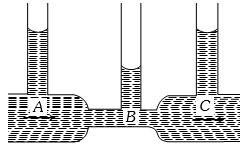
- 8In the following fig. is shown the flow of liquid through a horizontal pipe. Three tubes $A, B$ and $ C$ are connected to the pipe. The radii of the tubes $A, B $ and $C$ at the junction are respectively $ 2 cm, 1 cm$ and $2 cm.$ It can be said that theView Solution
- 9A cubical block of steel of each side equal to $l$ is floating on mercury in a vessel. The densities of steel and mercury ar $\rho _s$ and $\rho _m$ . The height of the block above the mercury level is given byView Solution
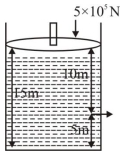
- 10Consider a cylindrical tank of radius $1 m$ is filled with water. The top surface of water is at $15\,m$ from the bottom of the cylinder. There is a hole on the wall of cylinder at a height of $5\,m$ from the bottom. A force of $5 \times 10^{5} N$ is applied an the top surface of water using a piston. The speed of efflux from the hole will be.View Solution
(given atmospheric pressure $P_{A}=1.01 \times 10^{5}\,Pa$, density of water $\rho_{ w }=1000\,kg / m ^{3}$ and gravitational acceleration $g=10\,m / s ^{2}$ )