Three resistances of one ohm each are connected in parallel. Such connection is again connected with $\frac{2}{3}\,\Omega $ resistor in series. The resultant resistance will be ........... $\Omega$
Medium


Download our appand get started for free
Experience the future of education. Simply download our apps or reach out to us for more information. Let's shape the future of learning together!No signup needed.*
Similar Questions
- 1The energy dissipated by a resistor is $10 \,mJ$ in $1\,s$ when an electric current of $2\, mA$ flows through it. The resistance is $....... \Omega$View Solution
(Round off to the Nearest Integer)
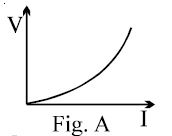
- 2The variation of current $(I)$ and voltage $(V)$ is as shown in figure $A$. The variation of power $P$ with current $I$ is best shown by which of the following graphView Solution
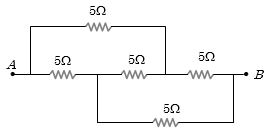
- 3Effective resistance between $A$ and $B$ is ........... $\Omega$View Solution
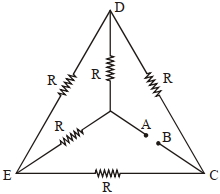
- 4Five equal resistances are connected in a network as shown in figure. The net resistance between the points $A$ and $B$ isView Solution
- 5Resistance of tungsten wire at $150\,^oC$ is $133\,\Omega $. Its resistance temperature coefficient is $0.0045\,^oC$. The resistance of this wire at $500\,^oC$ will be .............. $\Omega$View Solution
- 6In a wire of cross section radius $r,$ free electrons travel with drift velocity $v$ when a current $I$ flows through the wire. What is the current in another wire of half the radius and of the same material when the drift velocity is $2v$ ?View Solution
- 7A $220\, volt$ and $800\, watt$ electric kettle and three $220\, volt$ and $100\, watt$ bulbs are connected in parallel. On connecting this combination with $220\, volt$ electric supply, the total current will be ................ $ampere$View Solution
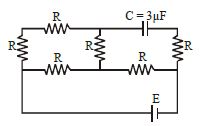
- 8In steady state the potential difference across the capacitor is $10\,\, V.$ Each resistance is of $3\,\Omega $. The cell is ideal. The $emf$ of the cell is .............. $\mathrm{V}$View Solution
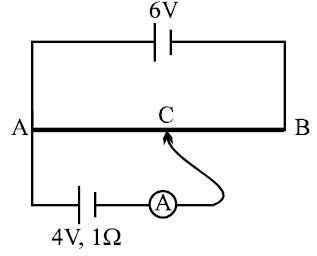
- 9$A \,6 \,V$ battery of negligible internal resistance is connected across a uniform wire of length $1\, m$. The positive terminal of another battery of emf $4\,V$ and internal resistance $1\, \Omega$ is joined to the point $A$ as shown in figure. The ammeter shows zero deflection when the jockey touches the wire at the point $C$. The $AC$ is equal toView Solution
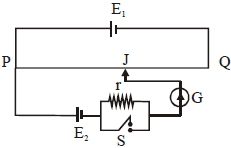
- 10A potentiometer wire $PQ$ of $1\,m$ length is connected to a standard cell $E _{1}$. Another cell $E _{2}$ of emf $1.02\, V$ is connected with a resistance $'r'$ and switch $S$ (as shown in figure). With switch $S$ open, the null position is obtained at a distance of $49\, cm$ from $Q$. The potential gradient in the potentiometer wire is.......$V/cm$View Solution