MCQ
Three resistances of one ohm each are connected in parallel. Such connection is again connected with $\frac{2}{3}\,\Omega $ resistor in series. The resultant resistance will be ........... $\Omega$
- A$\frac{5}{3}$
- B$1.5$
- ✓$1$
- D$\frac{2}{3}$
This is in series with $\frac{2}{3}\,\Omega $ resistor.
$\therefore $Total resistance $ = \frac{2}{3} + \frac{1}{3} = \frac{3}{3}\,\Omega = 1\,\Omega $
Generate a complete, print-ready paper with questions like this in minutes — across 16+ boards, with answer keys.
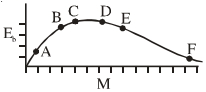
$(i)\;A+B\;\to\; C \;+\;\varepsilon $
$(ii)\;C\;\to \;A\;+\;B\;+\;\varepsilon $
$(iii)\;D\;+\;E\;\to \; F\;+$$\;\varepsilon $
$(iv)\;F\;\to \; D\;+\;E\;+\;\varepsilon $
$\;\varepsilon $ is the energy released? In which reactions is $\;\varepsilon $ positive?