Question
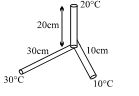
Three rods made of the same material and having same cross-sectional area but different lengths $10\,\,cm$, $\,\,20 cm$ and $30\,\,cm$ are joined as shown. The temperature of the joint is  ....... $^oC$ 
Answer

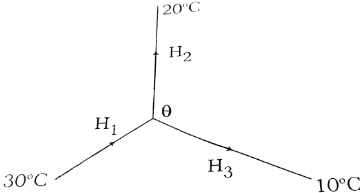
Let $\theta$ be the temperature of junction and $H_{1}, H_{2}$ and $H_{3}$ the heat currents.

Then

$H_{1}=H_2+H_{3}$

$\frac{30-\theta}{\left(\frac{30}{K A}\right)}=\frac{\theta-20}{\left(\frac{20}{K A}\right)}+\frac{\theta-10}{\left(\frac{30}{K A}\right)}$

or $2(30-\theta)=3(\theta-20)+3(2 \theta-20)$

or $\theta=16.36^{\circ} \mathrm{C} \approx 16.4^{\circ} \mathrm{C}$
Need a full question paper?

Generate a complete, print-ready paper with questions like this in minutes — across 16+ boards, with answer keys.
Start Generating Free

Similar questions

The force acting between proton and proton inside the nucleus is
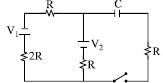
In the transient shown the time constant of the circuit is : 
Stationary waves are produced in $10\,m$  long stretched string. If the string Vibrates in $5$ segments and wave velocity  $20\,m/s$ the frequency is ..... $Hz$
A Newtonian fluid fills the clearance between a shaft and a sleeve. When a force of $800$ $N$ is applied to the shaft, parallel to the sleeve, the shaft attains a speed of $1.5$ $cm/sec$. If a force of $2.4$ $kN$ is applied instead, the shaft would move with a speed of ......... $ cm/sec$
A light balloon filled with helium of density $\rho_{ He }$ is tied to a long light string of length $l$ and the string is attached to the ground. If the balloon is displaced slightly in the horizontal direction from the equilibrium and released. Then,
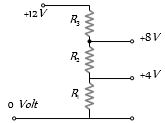
A potential divider is used to give outputs of $4\, V$ and $8\, V$ from a $12\, V$ source. Which combination of resistances, $(R_1, R_2, R_3)$ gives the correct voltages ? $R_1 : R_2 : R_3$
Two spherical nuclei have mass numbers $216$ and $64$ with their radii $R_1$ and $R _2$ respectively. The ratio, $\frac{R_1}{R_2}$ is equal to
Frequency of a wave is $6 \times {10^{15}}Hz.$ The wave is
The vapour of a substance behaves as a gas
Two coaxial discs, having moments of inertia $I_1$ and $\frac{I_1}{2}$ are a rotating with respectively angular velocities $\omega_1$ and $\frac{\omega_1}{2}$, about their common axes. They are brought in contact with each other and thereafter they rotate with a common angular velocity. If $E_f$ and $E_i$ are the final and initial total energies, then $(E_f -E_i)$ is