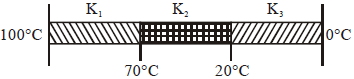
Three rods of identical cross-section and lengths are made of three different materials of thermal conductivity $K _{1}, K _{2},$ and $K _{3}$, respectively. They are joined together at their ends to make a long rod (see figure). One end of the long rod is maintained at $100^{\circ} C$ and the ther at $0^{\circ} C$ (see figure). If the joints of the rod are at $70^{\circ} C$ and $20^{\circ} C$ in steady state and there is no loss of energy from the surface of the rod, the correct relationship between $K _{1}, K _{2}$ and $K _{3}$ is
JEE MAIN 2020, Diffcult
Download our app for free and get started
Rods are identical have same length ( $\ell$ ) and area of cross-section $(A)$
Combination are in series, so heat current is same for all Rods
$\left(\frac{\Delta Q }{\Delta t }\right)_{ AB }=\left(\frac{\Delta Q }{\Delta t }\right)_{ BC }=\left(\frac{\Delta Q }{\Delta t }\right)_{ CD }=$ Heat current
$\frac{(100-70) K _{1} A }{\ell}=\frac{(70-20) K _{2} A }{\ell}=\frac{(20-0) K _{3} A }{\ell}$
$30 K _{1}=50 K _{2}=20 K _{3}$
$3 K _{1}=2 K _{3}$
$\frac{K_{1}}{K_{3}}=\frac{2}{3}=2: 3$
$5 K _{2}=2 K _{3}$
$\frac{ K _{2}}{ K _{3}}=\frac{2}{5}=2: 5$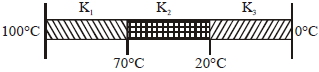

Download our appand get started for free
Experience the future of education. Simply download our apps or reach out to us for more information. Let's shape the future of learning together!No signup needed.*
Similar Questions
- 1A wall has two layers $A$ and $B$, each made of a different material. Both the layers have the same thickness. The thermal conductivity of the material of $A$ is twice that of $B$. Under thermal equilibrium, the temperature difference across the wall is $36\,^oC$. The temperature difference across the layer $A$ is ......... $^oC$View Solution
- 2One end of a copper rod of length $1.0\;m$ and area of cross-section ${10^{ - 3}}$ is immersed in boiling water and the other end in ice. If the coefficient of thermal conductivity of copper is $92\;cal/m{\rm{ - }}s{{\rm{ - }}^o}C$ and the latent heat of ice is $8 \times {10^4}cal/kg$, then the amount of ice which will melt in one minute isView Solution
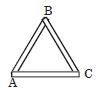
- 3Three rods $AB, BC$ and $AC$ having thermal resistances of $10\, units, \,10 \,units$ and $20 \,units,$ respectively, are connected as shown in the figure. Ends $A$ and $C$ are maintained at constant temperatures of $100^o C$ and $0^o C,$ respectively. The rate at which the heat is crossing junction $B$ is ........ $ \mathrm{units}$View Solution
- 4rod of $40\, cm$ in length and temperature difference of ${80^o}C$ at its two ends. $A$ nother rod $B$ of length $60\, cm$ and of temperature difference ${90^o}C$, having the same area of cross-section. If the rate of flow of heat is the same, then the ratio of their thermal conductivities will beView Solution
- 5If the absorption and reflection co-efficients of a surface of a body are $0.4$ and $0.6$ respectively, thenView Solution
- 6Two walls of thicknesses $d_1$ and $d_2$ and thermal conductivities $k_1$ and $k_2$ are in contact. In the steady state, if the temperatures at the outer surfaces are ${T_1}$ and ${T_2}$, the temperature at the common wall isView Solution
- 7Two spheres made of same material have radii in the ratio $1: 2$ Both are at same temperature. Ratio of heat radiation energy emitted per second by them isView Solution
- 8View SolutionFrom Kirchoff’s law the ratio of emissive power and absorption power of all bodies
- 9A metallic rod of cross-sectional area $9.0\,\,cm^2$ and length $0.54 \,\,m$, with the surface insulated to prevent heat loss, has one end immersed in boiling water and the other in ice-water mixture. The heat conducted through the rod melts the ice at the rate of $1 \,\,gm$ for every $33 \,\,sec$. The thermal conductivity of the rod is ....... $ Wm^{-1} K^{-1}$View Solution
- 10Two bodies $A$and $B$ have thermal emissivities of $0.01$ and $0.81$ respectively. The outer surface areas of the two bodies are the same. The two bodies emit total radiant power at the same rate. The wavelength ${\lambda _B}$ corresponding to maximum spectral radiancy in the radiation from $B$ is shifted from the wavelength corresponding to maximum spectral radiancy in the radiation from $A$, by $1.00\mu m$. If the temperature of $A$ is $5802\;K$View Solution