Three similar wires of frequency $n_1, n_2$ and $n_3$ are joined to make one wire. Its frequency will be
AIPMT 2000, Medium
Download our app for free and get started
(b) $n = \frac{1}{{2l}}\sqrt {\frac{T}{m}} $
==> ${n_1}{l_1} = {n_2}{l_2} = {n_3}{l_3} = k$
${l_1} + {l_2} + {l_3} = l$
==>$\frac{k}{{{n_1}}} + \frac{k}{{{n_2}}} + \frac{k}{{{n_3}}} = \frac{k}{n}$
==> $\frac{1}{n} = \frac{1}{{{n_1}}} + \frac{1}{{{n_2}}} + \frac{1}{{{n_3}}} + ........$

Download our appand get started for free
Experience the future of education. Simply download our apps or reach out to us for more information. Let's shape the future of learning together!No signup needed.*
Similar Questions
- 1$50$ tuning forks are arranged in increasing order of their frequencies such that each gives $4 \,beats/sec$ with its previous tuning fork. If the frequency of the last fork is octave of the first, then the frequency of the first tuning fork is ... $Hz$View Solution
- 2View SolutionVelocity of sound is maximum in
- 3When two sound waves with a phase difference of $\pi /2$, and each having amplitude $A$ and frequency $\omega $, are superimposed on each other, then the maximum amplitude and frequency of resultant wave isView Solution
- 4Two trains $A$ and $B$ are moving with speeds $20 \mathrm{~m} / \mathrm{s}$ and $30 \mathrm{~m} / \mathrm{s}$ respectively in the same direction on the same straight track, with $B$ ahead of $A$. The engines are at the front ends. The engine of train $A$ blows a long whistle.View Solution
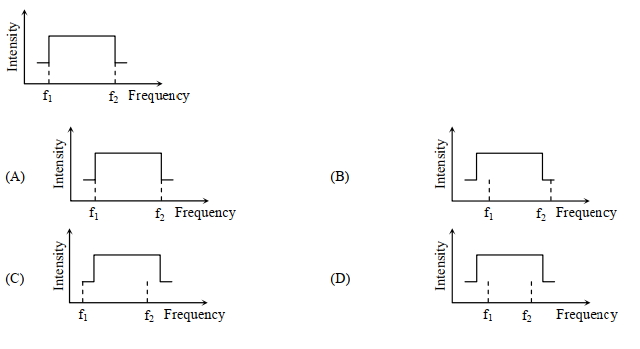
Assume that the sound of the whistle is composed of components varying in frequency from $f_1=800 \mathrm{~Hz}$ to $f_2=1120 \mathrm{~Hz}$, as shown in the figure. The spread in the frequency (highest frequency - lowest frequency) is thus $320 \mathrm{~Hz}$. The speed of sound in still air is $340 \mathrm{~m} / \mathrm{s}$.
$1.$ The speed of sound of the whistle is
$(A)$ $340 \mathrm{~m} / \mathrm{s}$ for passengers in $A$ and $310 \mathrm{~m} / \mathrm{s}$ for passengers in $B$
$(B)$ $360 \mathrm{~m} / \mathrm{s}$ for passengers in $A$ and $310 \mathrm{~m} / \mathrm{s}$ for passengers in $B$
$(C)$ $310 \mathrm{~m} / \mathrm{s}$ for passengers in $A$ and $360 \mathrm{~m} / \mathrm{s}$ for passengers in $B$
$(D)$ $340 \mathrm{~m} / \mathrm{s}$ for passengers in both the trains
$2.$ The distribution of the sound intensity of the whistle as observed by the passengers in train $\mathrm{A}$ is best represented by
$Image$
$3.$ The spread of frequency as observed by the passengers in train $B$ is
$(A)$ $310 \mathrm{~Hz}$ $(B)$ $330 \mathrm{~Hz}$ $(C)$ $350 \mathrm{~Hz}$ $(D)$ $290 \mathrm{~Hz}$
Give the answer question $1,2$ and $3.$
- 5At what temperature velocity of sound is double than that of at $0°C$View Solution
- 6A composition string is made up by joining two strings of different masses per unit length $\rightarrow \mu$ and $4\mu$ . The composite string is under the same tension. A transverse wave pulse $: Y = (6 mm) \,\,sin\,\,(5t + 40x),$ where $‘t’$ is in seconds and $‘x’$ in meters, is sent along the lighter string towards the joint. The joint is at $x = 0$. The equation of the wave pulse reflected from the joint isView Solution
- 7Two waves are propagating along a taut string that coincides with the $x-$axis. The first wave has the wave function $y_1 = A cos [k(x - vt)]$ and the second has the wave function $y = A cos [k(x + vt) + \phi ]$.View Solution
- 8A transverse wave is described by the equation $y = A \,\,sin\,[2\pi (f t - x/\lambda ) ]$.The maximum particle velocity is equal to four times the wave velocity if:View Solution
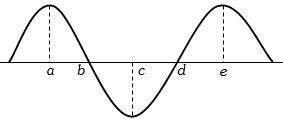
- 9The rope shown at an instant is carrying a wave travelling towards right, created by a source vibrating at a frequency $n$. Consider the following statementsView Solution
$I.$ The speed of the wave is $4n \times ab$
$II.$ The medium at $a$ will be in the same phase as $d$ after $\frac{4}{{3n}}s$
$III.$ The phase difference between $b$ and $e$ is $\frac{{3\pi }}{2}$
Which of these statements are correct
- 10View SolutionStationary waves are formed when