Three sound waves of equal amplitudes have frequencies $(n - 1 ), n, (n + 1 ).$ They superimpose to give beats. The number of beats produced per second will be
NEET 2016,AIEEE 2009, Medium
Download our app for free and get started
net beat frequency $=LCM$ of individual beat frequencies
$=LCM\; of $[$(n,n-1),(n,n+1)$,$(n-1,n+1)]$$[(n,n-1),(n,n+1),(n-1,n+1)]$
$=LCM \;of $$(1,1,2)(1,1,2) $$=2\;Hz$
So, no. of beats per second $=2$

Download our appand get started for free
Experience the future of education. Simply download our apps or reach out to us for more information. Let's shape the future of learning together!No signup needed.*
Similar Questions
- 1A motor car blowing a horn of frequency $124\,vib/sec$ moves with a velocity $72\, km/hr$ towards a tall wall. The frequency of the reflected sound heard by the driver will be .... $vib/sec$ (velocity of sound in air is $330\, m/s$)View Solution
- 2View SolutionOne Mach number is equal to
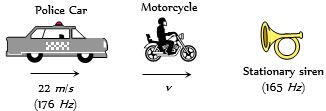
- 3A police car moving at $22 m/s$, chases a motorcyclist. The police man sounds his horn at $176 Hz$, while both of them move towards a stationary siren of frequency $165 Hz$. Calculate the speed of the motorcycle, if it is given that he does not observes any beats .... $m/s$View Solution
- 4A man $x$ can hear only upto $10 kHz$ and another man $y$ upto $20 kHz$. A note of frequency $500 Hz$ is produced before them from a stretched string. ThenView Solution
- 5Suppose that the speed of sound in air at a given temperature is $400 m/sec$. An engine blows a whistle at $1200 Hz$ frequency. It is approaching an observer at the speed of $100 m/sec$. What is the apparent frequency as heard by the observer .... $Hz$View Solution
- 6View SolutionTwo waves having sinusoidal waveforms have different wavelengths and different amplitude. They will be having
- 7Two closed pipe produce $10$ beats per second when emitting their fundamental nodes. If their length are in ratio of $25 : 26$. Then their fundamental frequency in $Hz$, areView Solution
- 8$5\, beats/ second$ are heard when a turning fork is sounded with a sonometer wire under tension, when the length of the sonometer wire is either $0.95\,m$ or $1\,m$ . The frequency of the fork will be ... $Hz$View Solution
- 9An open pipe is in resonance in its $2^{nd}$ harmonic with tuning fork of frequency ${f_1}$. Now it is closed at one end. If the frequency of the tuning fork is increased slowly from ${f_1}$ then again a resonance is obtained with a frequency ${f_2}$. If in this case the pipe vibrates ${n^{th}}$ harmonics thenView Solution
- 10A tuning fork $A$ of unknown frequency produces $5\, beats/s$ with a fork of known frequency $340\, Hz$. When fork $A$ is filed, the beat frequency decreases to $2\, beats/s.$ What is the frequency of fork $A$ ? (in $Hz$)View Solution