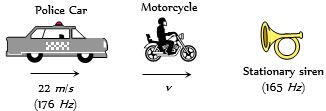
A police car moving at $22 m/s$, chases a motorcyclist. The police man sounds his horn at $176 Hz$, while both of them move towards a stationary siren of frequency $165 Hz$. Calculate the speed of the motorcycle, if it is given that he does not observes any beats .... $m/s$
IIT 2003, Diffcult
Download our app for free and get started
(b) ${n_1}$ = Frequency of the police car horn observer heard by motorcyclist
${n_2}$ = Frequency of the siren heard by motorcyclist.
$v_2$ = Speed of motor cyclist
${n_1}$ = $\frac{{330 - v}}{{330 - 22}} \times 176\,\,;\,\,{n_2} = \frac{{330 + v}}{{330}} \times 165$
$\because {n_1} - {n_2} = 0 \Rightarrow v = 22 m/s$.
${n_2}$ = Frequency of the siren heard by motorcyclist.
$v_2$ = Speed of motor cyclist
${n_1}$ = $\frac{{330 - v}}{{330 - 22}} \times 176\,\,;\,\,{n_2} = \frac{{330 + v}}{{330}} \times 165$
$\because {n_1} - {n_2} = 0 \Rightarrow v = 22 m/s$.

Download our appand get started for free
Experience the future of education. Simply download our apps or reach out to us for more information. Let's shape the future of learning together!No signup needed.*
Similar Questions
- 1The sound intensity level at a point $4 \,m$ from the point source is $10 \,dB$, then the sound level at a distance $2 \,m$ from the same source will be ........ $dB$View Solution
- 2View SolutionThe distance between the nearest node and antinode in a stationary wave is
- 3The resultant amplitude due to superposition of two waves $y_1 = 5\,\,sin (wt - kx)$ and $y_2 = -5 \,\,cos (wt - kx - 150^o)$View Solution
- 4A speeding motorcyclist sees traffic jam ahead him. He slows down to $36\,\, km\,\,hour^{-1}$ He finds that traffic has eased and a car moving ahead of him at $18 \,\, km\,\,hour^{-1}$ is honking at a frequency of $1392\,\, Hz.$ If the speed of sound is $343\, m s^{-1}$, the frequency of the honk as heard by him will be .... $Hz$View Solution
- 5A man is watching two trains, one leaving and the other coming in with equal speeds of $4\, m/sec$. If they sound their whistles, each of frequency $240 Hz$, the number of beats heard by the man (velocity of sound in air $= 320 m/sec$) will be equal toView Solution
- 6An earthquake generates both transverse $(S)$ and longitudinal $(P)$ sound waves in the earth. The speed of $S$ waves is about $4.5 \,km/s$ and that of $P$ waves is about $8.0 \,km/s.$ A seismograph records $P$ and $S$ waves from an earthquake. The first $P$ wave arrives $4.0\, min$ before the first $S$ wave. The epicenter of the earthquake is located at a distance about .... $km$View Solution
- 7The standing wave in a medium is expressed as $y=0.2 \sin (0.8 x) \cos (3000 t) \,m$. The distance between any two consecutive points of minimum or maximum displacement isView Solution
- 8If velocity of a galaxy relative to earth is $1.2 \times 10^6 \,ms^{-1}$ then $\%$ increase in wavelength of light from galaxy as compared to the similar source on earth will be ...............$\%$View Solution
- 9A standing wave $y = A sin \left( {\frac{{20}}{3}\pi \,x} \right) cos (1000\pi t)$ is maintained in a taut string where y and $x$ are expressed in meters. The distance between the successive points oscillating with the amplitude $A/2$ across a node is equal to ... $cm$View Solution
- 10View SolutionAn observer is moving towards the stationary source of sound, then