MCQ
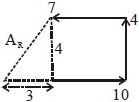
Three waves of equal frequency having amplitudes $10\, \mu m, 4\, \mu m$ and $7\, \mu m$ arrive at a given point with successive phase difference of $\pi/2$. The amplitude of  the resulting wave in $\mu m$ is given by
  • A
    $7$
  • B
    $6$
  • $5$
  • D
    $4$

Answer

Correct option: C.
$5$
c
Phase difference between $I$ and $III$ wave is $\pi$ rad

so resulting is $10\, \mu \mathrm{m}-7\, \mu \mathrm{m}=3\, \mu \mathrm{m}$ then amplitude of resultant wave is

$\sqrt{(4)^{2}+(3)^{2}}=5\, \mu m$

$O R$

$\Rightarrow A_{r}=\sqrt{(3)^{2}+(4)^{2}}=5$
Need a full question paper?

Generate a complete, print-ready paper with questions like this in minutes — across 16+ boards, with answer keys.

Start Generating Free

Similar questions

According to Hook’s law force is proportional to
Identify the pair whose dimensions are equal
A body of weight $200 \mathrm{~N}$ is suspended form a tree branch thought a chain of mass $10 \mathrm{~kg}$. The branch pulls the chain by a force equal to (if $g=10 \mathrm{~m} / \mathrm{s}^2$ ):
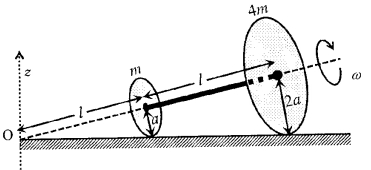
Two thin circular discs of mass $m$ and $4 m$, having radii of $a$ and $2 a$, respectively, are rigidly fixed by a massless, rigid rod of length $l=\sqrt{24} a$ through their centers. This assembly is laid on a firm and flat surface, and set rolling without slipping on the surface so that the angular speed about the axis of the rod is $\omega$. The angular momentum of the entire assembly about the point ' $O$ ' is $\vec{L}$ (see the figure). Which of the following statement($s$) is(are) true?

($A$) The center of mass of the assembly rotates about the $z$-axis with an angular speed of $\omega / 5$

($B$) The magnitude of angular momentum of center of mass of the assembly about the point $O$ is $81 m a^2 \omega$

($C$) The magnitude of angular momentum of the assembly about its center of mass is $17 \mathrm{ma}^2 \mathrm{\omega} / 2$

($D$) The magnitude of the $z$-component of $\vec{L}$ is $55 \mathrm{ma}^2 \omega$
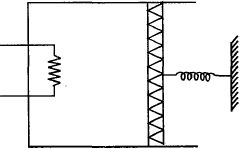
An ideal monoatomic gas is confined in a cylinder by a spring loaded piston of cross section $8.0\times10^{-3}\, m^2$ . Initially the gas is at $300\, K$ and occupies a volume of $2.4\times10^{-3}\, m^3$ and the spring is in its relaxed state as shown in figure. The gas is heated by a small heater until the piston moves out slowly by $0.1\, m$. The force constant of the spring is $8000\, N/m$ and the atmospheric pressure is $1.0\times10^5\, N/m^2$ . The cylinder and the piston are thermally insulated. The piston and the spring are massless and there is no friction between the piston and the cylinder. The final temperature of the gas will be: (Neglect the heat loss through the lead wires of the heater . The heat capacity of the heater coil is also negligible)
An aircraft is moving with a velocity of $300\,m{s^{ - 1}}.$ If all the forces acting on it are balanced, then
What is the path followed by a moving body, on which a constant force acts in a direction other than initial velocity (i.e. excluding parallel and antiparallel direction)?
A source of sound of frequency $450$ cycles/sec is moving towards a stationary observer with $34\, m/sec$ speed. If the speed of sound is $340\, m/sec,$ then the apparent frequency will be ..... $cycles/sec$
A system of particles is called a rigid body when:
A vehicle of mass $m$ is moving on a rough horizontal road with momentum $P$. If the coefficient of friction between the tyres and the road be $\mu$, then the stopping distance is