Question
A lady cannot see objects closer than 40cm from the left eye and closer than 100cm from the right eye. While on a mountaineering trip, she is lost from her team. She tries to make an astronomical telscope from her reading glasses to look for her teammates.
  1. Which glass should she use as the eyepiece?
  2. What magnification can she get with relaxed eye?
Answer

The lady can not see objects closer than 40cm from the left eye and 100cm from the right eye.For the left glass lens,
v = -40cm,
u = -25cm
$\therefore \frac{1}{\text{f}}=\frac{1}{\text{v}}-\frac{1}{\text{u}}=\frac{1}{-40}-\frac{1}{-25}=\frac{1}{25}-\frac{1}{40}=\frac{3}{200}$
$\Rightarrow \text{f}=\frac{200}{3}\text{cm}$
For the right glass lens,
v = -100cm,
u = -25cm
$\frac{1}{\text{f}}=\frac{1}{\text{v}}-\frac{1}{\text{u}}=\frac{1}{-100}-\frac{1}{-25}=\frac{1}{100}=\frac{3}{100}$
$\Rightarrow\text{f}=\frac{100}{3}\text{cm}$
  1. For an astronomical telescope, the eye piece lens should have smaller focal length. So, she should
use the right lens $\big(\text{f}=\frac{100}{3}\text{cm}\big)$ as the eye piece lens.
  1. With relaxed eye, (normal adjustment)
$\text{f}_0=\frac{200}{3}\text{cm}$
$\text{f}_\text{e}=\frac{100}{3}\text{cm}$
magnification $=\text{m}=\frac{\text{f}_0}{\text{f}_\text{e}}=\frac{\big(\frac{200}{3}\big)}{\big( \frac{100}{3}\big)}=2$

Need a full question paper?

Generate a complete, print-ready paper with questions like this in minutes — across 16+ boards, with answer keys.

Start Generating Free

Similar questions

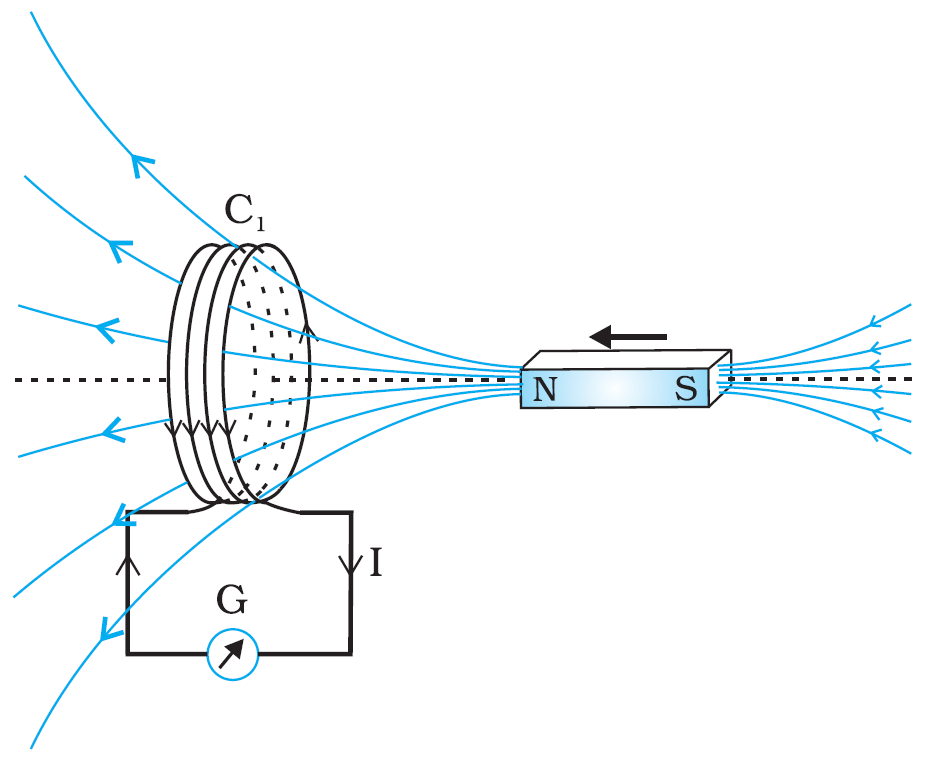
In year 1820 Oersted discovered the magnetic effect of current. Faraday gave the thought that reverse of this phenomenon is also possible i.e., current can also be produced by magnetic field. Faraday showed that when we move a magnet towards the coil which is connected by a sensitive galvanometer. The galvanometer gives instantaneous deflection showing that there is an electric current in the loop. Whenever relative motion between coil and magnet takes place an emf induced in coil. If coil is in closed circuit then current is also induced in the circuit. This phenomenon is called electromagnetic induction.
  1. The north pole of a long bar magnet was pushed slowly into a short solenoid connected to a galvanometer. The magnet was held stationary for a few seconds with the north pole in the middle of the solenoid and then withdrawn rapidly. The maximum deflection of the galvanometer was observed when the magnet was:
  1. Moving towards the solenoid.
  2. Moving into the solenoid.
  3. At rest inside the solenoid.
  4. Moving out of the solenoid.
  1. Two similar circular loops carry equal currents in the same direction. On moving the coils further apart, the electric current will.
  1. Remain unaltered.
  2. Increases in one and decreases in the second.
  3. Increase in both.
  4. Decrease in both.
  1. A closed iron ring is held horizontally and a bar magnet is dropped through the ring with its length along the axis of the ring. The acceleration of the falling magnet is.
  1. Equal to g.
  2. Less than g.
  3. More than g.
  4. Depends on the diameter of the ring and length of magnet.
  1. Whenever there is a relative motion between a coil and a magnet, the magnitude of induced emf set up in the coil does not depend upon the:
  1. Relative speed between the coil and magnet.
  2. Magnetic moment of the coil.
  3. Resistance of the coil.
  4. Number of turns in the coil.
  1. A coil of metal wire is kept stationary in a non-uniform magnetic field:
  1. A n emf and current both are induced in the coil.
  2. A current but no emf is induced in the coil.
  3. An emf but no current is induced in the coil.
  4. Neither emf nor current is induced in the coil.
When a ferromagnetic material goes through a hysteresis loop, its thermal energy is increased. Where does this energy come from?
The electron mobility characterises how quickly an electron can move through a metal of semiconductor when pulled by an electric field. There is an analogous quality for holes, called hole mobility. A block of pure silicon at 300K has a length of 10cm and an area of $1.0cm^2.$ A battery of emf 2V is connected across it. The mobility of electron is $0.14m^2 V^{-1}s^{-1}$ and their number density is $1.5 \times 10^{16}m^{-3}.$ The mobility of holes is $0.05m^2 V^{-1}s^{-1}.$
  1. The electron current is:
  1. $6.72 \times 10^{-4}A$
  2. $6.72 \times 10^{-5}A$
  3. $6.72 \times 10^{-6}A$
  4. $6.72 \times 10^{-7}A$
  1. The hole current is:
  1. $2.0 \times 10^{-7}A$
  2. $2.2 \times 10^{-7}A$
  3. $2.4 \times 10^{-7}A$
  4. $2.6 \times 10^{-7}A$
  1. The number density of donor atoms which are to be added up to pure silicon semiconductor to produce an n-type semiconductor of conductivity $6.4\Omega^{-1}\text{cm}^{-1}$ is approximately (neglect the contribution of holes to conductivity).
  1. $3 \times 10^{22}m^{-3}$
  2. $3 \times 10^{23}m^{-3}$
  3. $3 \times 10^{24}m^{-3}$
  4. $3 \times 10^{21}m^{-3}$
  1. When the given silicon semiconductor is doped with indium, the hole concentration increases to $4.5 \times 10^{23}m^{-3}.$ The electron concentration in doped silicon is:
  1. $3 \times 10^9m^{-3}$
  2. $4 \times 10^9m^{-3}$
  3. $5 \times 10^9m^{-3}$
  4. $6 \times 10^9m^{-3}$
  1. Pick out the statement which is not correct.
  1. At a low temperature, the resistance of a semiconductor is very high.
  2. Movement of holes is restricted to the valence band only.
  3. Width of the depletion region increases as the forward bias voltage increases in case of a p-n junction diode.
  4. ln a forward bias condition, the diode heavily conducts.
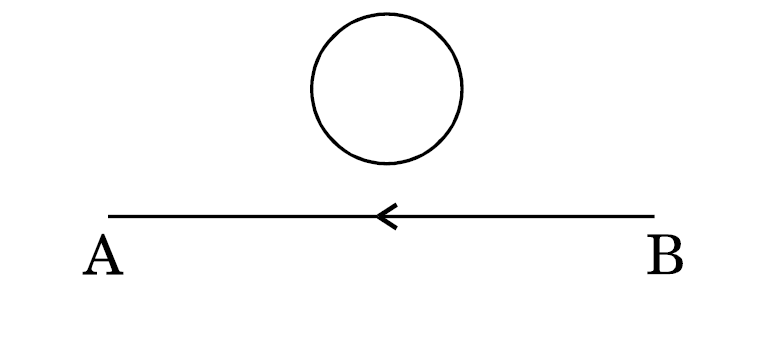
The electric current flowing in a wire in the direction from B to A is decreasing. Find out the direction of the induced current in the metallic loop kept above the wire as shown.
Cloudy nights are warmer than the nights with clean sky. Explain.
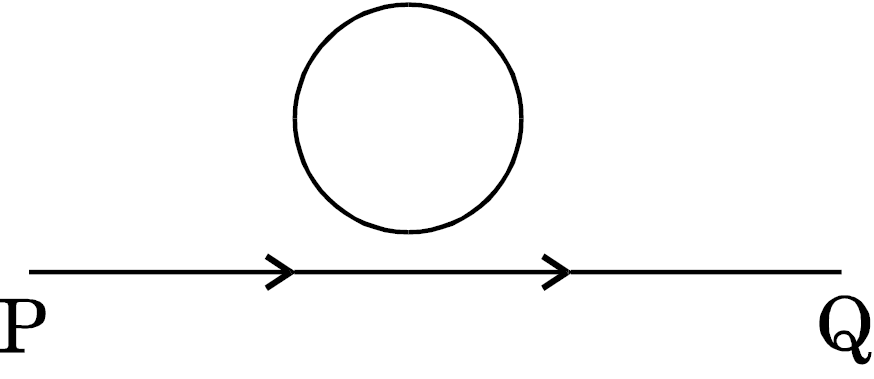
A conducting loop is held above a current carrying wire ‘PQ’ as shown in the figure. Depict the direction of the current induced in the loop when the current in the wire PQ is constantly increasing.
The entering flux from a closed surface is $2 \times 10^3$ Newton-metre ${ }^2 /$ Coulomb and the emerging flux is $8 \times 10^3$ Newton-metre ${ }^2 /$ Coulomb. Find the value of charge enclosed in the surface.
A slide projector has to project a 35mm slide (35mm × 23mm) on a 2m × 2m screen at a distance of 10m from the lens. What should be the focal length of the lens in the projector?
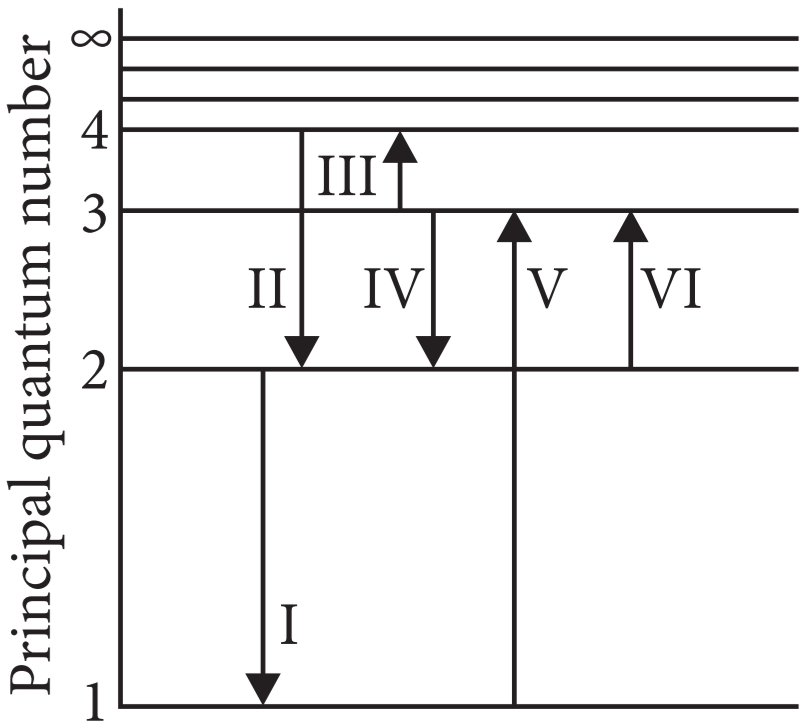
Bohr's model explains the spectral lines of hydrogen atomic emission spectrum. While the electron of the atom remains in the ground state, its energy is unchanged. When the atom absorbs one or more quanta of energy, the electrons moves from the ground state orbit to an excited state orbit that is further away.

The given figure shows an energy level diagram of the hydrogen atom. Several transitions are marked as I, II, III and so on. The diagram is only indicative and not to scale.
  1. In which transition is a Balmer series photon absorbed?
  1. II
  2. III
  3. IV
  4. VI
  1. The wavelength of the radiation involved in transition II is
  1. 291nm
  2. 364nm
  3. 487nm
  4. 652nm
  1. Which transition will occur when a hydrogen atom is irradiated with radiation of wavelength 103nm?
  1. I
  2. II
  3. IV
  4. V
  1. The electron in a hydrogen atom makes a transition from $n = n_1$ to $n = n_2$ state. The time period of the electron in the initial state is eight times that in the final state. The possible values of $n_1$ and $n_2$ are.
  1. $n_1 = 4,n_2 = 2$
  2. $n_1 = 8,n_2 = 2$
  3. $n_1 = 8,n_2 = 3$
  4. $n_1 = 6,n_2 = 2$
  1. The Balmer series for the H-atom can be observed
  1. If we measure the frequencies of light emitted when an excited atom falls to the ground state.
  2. If we measure the frequencies of light emitted due to transitions between excited states and the first excited state.
  3. In any transition in a H-atom.
  4. None of these.
The reduction factor K of a tangent galvanometer is written on the instrument. The manual says that the current is obtained by multiplying this factor to tane. The procedure works well at Bhuwaneshwar. Will the procedure work if the instrument is taken to Nepal? If there is some error, can it be corrected by correcting the manual or the instrument will have to be taken back to the factory?