To double the length of a iron wire having $0.5\,c{m^2}$ area of cross-section, the required force will be $(Y = {10^{12}}\,dyne/c{m^2})$
Easy


Download our appand get started for free
Experience the future of education. Simply download our apps or reach out to us for more information. Let's shape the future of learning together!No signup needed.*
Similar Questions
- 1A meter scale of mass $m$ , Young modulus $Y$ and cross section area $A$ is hanged vertically from ceiling at zero mark. Then separation between $30\ cm$ and $70\ cm$ mark will be :-( $\frac{{mg}}{{AY}}$ is dimensionless)View Solution
- 2View SolutionThe force constant of a wire does not depend on
- 3View SolutionBulk modulus was first defined by
- 4Two wires of same length and radius are joined end to end and loaded. The Young's modulii of the materials of the two wires are $Y_{1}$ and $Y_{2}$. The combination behaves as a single wire then its Young's modulus is:View Solution
- 5The diameter of a brass rod is 4 mm and Young's modulus of brass is $9 \times {10^{10}}\,N/{m^2}$. The force required to stretch by $0.1\%$ of its length isView Solution
- 6The area of a cross-section of steel wire is $0.1\,\,cm^2$ and Young's modulus of steel is $2\,\times \,10^{11}\,\,N\,\,m^{-2}.$ The force required to stretch by $0.1\%$ of its length is ......... $N$.View Solution
- 7The relation between $\gamma ,\,\eta $ and $K$ for a elastic material isView Solution
- 8Two exactly similar wires of steel and copper are stretched by equal forces. If the difference in their elongations is $0.5$ cm, the elongation $(l)$ of each wire is ${Y_s}({\rm{steel}}) = 2.0 \times {10^{11}}\,N/{m^2}$${Y_c}({\rm{copper}}) = 1.2 \times {10^{11}}\,N/{m^2}$View Solution
- 9A copper wire of length $1.0\, m$ and a steel wire of length $0.5\, m$ having equal cross-sectional areas are joined end to end. The composite wire is stretched by a certain load which stretches the copper wire by $1\, mm$. If the Young's modulii of copper and steel are respectively $1.0\times10^{11}\, Nm^{-2}$ and $2.0\times10^{11}\, Nm^{- 2}$, the total extension of the composite wire is ........ $mm$View Solution
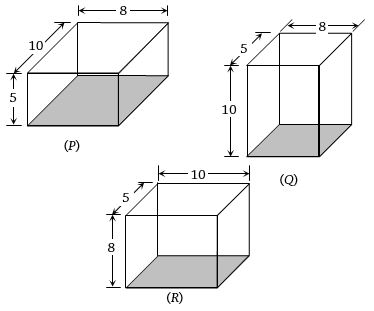
- 10A rectangular block of size $10\,cm \times 8\,cm \times 5\,cm$ is kept in three different positions $P, Q$ and $R$ in turn as shown in the figure. In each case, the shaded area is rigidly fixed and a definite force $F$ is applied tangentially to the opposite face to deform the block. The displacement of the upper face will beView Solution