MCQ
To increase the angular magnification of a simple microscope, one should increase:
  • A
    The focal length of the lens.
  • The power of the lens.
  • C
    The aperture of the lens.
  • D
    The object size.

Answer

Correct option: B.
The power of the lens.
For a simple microscope in normal adjustment, the object is placed at a distance equal to $f ($the ​focal length$)$ from the lens, And the angular magnification is given by the relation
$\text{m}=\frac{\text{D}}{\text{f}}$
for $\text{u}<\text{f},\text{m}=\frac{\text{D}}{\text{f}}+1$
power of lens $=\frac{1}{\text{f}}$
Angular magnification depends on power.

Need a full question paper?

Generate a complete, print-ready paper with questions like this in minutes — across 16+ boards, with answer keys.
Start Generating Free

Similar questions

When a $_4B{e^9}$ atom is bombarded with $\alpha - $ particles, one of the product of nuclear transmutation is $_6{C^{12}}$. The other is
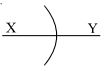
$A$ concave spherical surface of radius of curvature $10cm$ separates two medium $x$ & $y$ of refractive index $4/3$ & $3/2$ respectively. If the object is placed along principal axis in medium $X$ then
A thin rectangular magnet suspended freely has a period of oscillation equal to $T$. Now it is broken into two equal halves (each having half of the original length) and one piece is made to oscillate freely in the same field. If its period of oscillation is $T'$, the ratio $T'/T$ is :-
Two coils have a mutual inductance $0.005\,H$ . The current changes in the first coil The current changes in the first coil according to the equation $I = I_0 sin\,\omega t$ , where $I_0 = 10\,A$ and $\omega  = 100\pi \,rad/s$ . The maximum value of $emf$ in the second coil will be
A rectangular coil 20 cm × 20 cm has 100 turns and carries a current of 1 A. It is placed in a uniform magnetic field B = 0.5 T with the direction of magnetic field parallel to the plane of the coil. The magnitude of the torque required to hold this coil in this position is
${H^ + },\,H{e^ + }$ and ${O^{ + + }}$ ions having same kinetic energy pass through a region of space filled with uniform magnetic field $B$ directed perpendicular to the velocity of ions. The masses of the ions ${H^ + },\,H{e^ + }$and ${O^{ + + }}$ are respectively in the ratio $1:4:16$. As a result
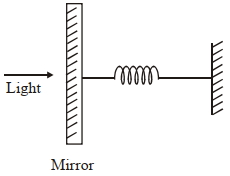
A perfectly reflecting mirror of mass $M$ mounted on a spring constitutes a spring-mass system of angular

frequency $\Omega$ such that $\frac{4 \pi M \Omega}{ h }=10^{24} m ^{-2}$ with $h$ as Planck's constant. $N$ photons of wavelength $\lambda=8 \pi \times 10^{-6} m$ strike the mirror simultaneously at normal incidence such that the mirror gets displaced by $1 \mu m$. If the value of $N$ is $x \times 10^{12}$, then the value of $x$ is. . . . . . . .[Consider the spring as massless]
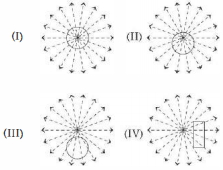
The black shapes in the figure below are closed surfaces. The electric field lines are in red. For which case, the net flux through the surfaces is non-zero?
Rate of change of torque $\tau $ with deflection $\theta $ is maximum for a magnet suspended freely in a uniform magnetic field of induction $ B,$  when $\theta =........ ^o$
If a charge is shifted from a low potential region to high potential region, the electric potential energy