Question
To make the field radial in a moving coil galvanometer

Answer

In order to obtain the radial magnetic field in a moving coil galvanometer, the poles of the magnet are cut cylindrical.

Need a full question paper?

Generate a complete, print-ready paper with questions like this in minutes — across 16+ boards, with answer keys.
Start Generating Free

Similar questions

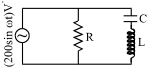
In the circuit diagram shown, $X_C = 100 \Omega$ ,$ X_L = 200 \Omega$ and $R = 100 \Omega $. The effective current through the source is.....$A$
One mole of a monoatomic ideal gas is expanded by a process described by $p V^3=C$, where $C$ is a constant. The heat capacity of the gas during the process is given by ( $R$ is the gas constant)
Two trains $A$ and $B$ are running in the same direction on parallel rails such that $A$ is faster than $B$ . Packets of equal weight are transferred between them. What will happen due to this
The half life of radioactive Radon is $3.8$ days. The time at the end of which $1/{20^{th}}$ of the Radon sample will remain undecayed is ........... $day$ (Given ${\log _{10}}e = 0.4343$)
A circular disc of radius $R$ carries surface charge density $\sigma(r)=\sigma_0\left(1-\frac{r}{R}\right)$, where $\sigma_0$ is a constant and $r$ is the distance from the center of the disc. Electric flux through a large spherical surface that encloses the charged disc completely is $\phi_0$. Electric flux through another spherical surface of radius $\frac{R}{4}$ and concentric with the disc is $\phi$. Then the ratio $\frac{\phi_0}{\phi}$ is. . . . . .
At a height $0.4\, m$ from the ground, the velocity of a projectile in vector form is $\vec v = \left( {6\hat i + 2\hat j} \right)\,m/{s}$. The angle of projection is ...... $^o$ $(g = 10\, m/s^2)$ 
A ray of light passing through a prism $(\mu=\sqrt{3})$ suffers minimum deviation. It is found that the angle of incidence is double the angle of refraction within the prism. Then, the angle of prism is ..... . (in degrees)
Lens used to remove long sightedness (hypermetropia) is
$540$ calories of heat converts $1$ cubic centimeter of water at $100\,^oC$ into $1671$ cubic centimeter of steam at $100\,^oC$ at a pressure of one atmosphere. Then the work done against the atmospheric pressure is nearly .......... $cal$
A light wave is incident normally over a slit of width $24 \times {10^{ - 5}}cm$. The angular position of second dark fringe from the central maxima is $30^{o}$. What is the wavelength of light............$\mathop A\limits^o $