MCQ
A ray of light passing through a prism $(\mu=\sqrt{3})$ suffers minimum deviation. It is found that the angle of incidence is double the angle of refraction within the prism. Then, the angle of prism is ..... . (in degrees)
  • A
    $50$
  • B
    $80$
  • C
    $30$
  • $60$

Answer

Correct option: D.
$60$
d
At minimum deviation $r_{1}=r_{2}=\frac{A}{2}$

Also given ${i}=2 {r}_{1}={A}$

Now $1 \sin i =\sqrt{3} \sin r_{1}$

$1 \sin A=\sqrt{3} \sin \frac{A}{2}$

$2 \sin \frac{A}{2} \cos \frac{A}{2}=\sqrt{3} \sin \frac{A}{2}$

$\cos \frac{A}{2}=\frac{\sqrt{3}}{2} \Rightarrow \frac{A}{2}=30^{\circ}$

$A=60^{\circ}$

Need a full question paper?

Generate a complete, print-ready paper with questions like this in minutes — across 16+ boards, with answer keys.

Start Generating Free

Similar questions

The cross sectional area of a horizontal tube increases along its length linearly, as we move in the direction of flow. The variation of pressure, as we move along its length in the direction of flow ($x-$ direction), is best depicted by which of the following graphs
which of the Following have output $1$?
The resistances of a wire at temperatures $t\,^oC$ and $0\,^oC$ are related by
A single slit of width $0.1\, mm$ is illuminated by a parallel beam of light of wavelength $6000\,\mathop A\limits^o $ and diffraction bands are observed on a screen $0.5\, m$ from the slit. The distance of the third dark band from the central bright band is........$mm$
To break a wire of one meter length, minimum $40 \,kg \,wt$. is required. Then the wire of the same material of double radius and $6 \,m$ length will require breaking weight ....... $kg \,wt$
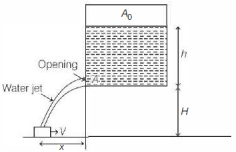
Consider the configuration of a stationary water tank of cross-section area $A_{0}$ and a small bucket as shown in figure below; the speed $v$ is .......... $m/s$ of the bucket, so that the water leaking out of a hole of cross-section area $A$ (as shown) from the water tank does not fall outside the bucket? (Take, $h=5 \,m , H=5 \,m , g=10 \,m / s ^{2}, A=5 \,cm ^{2}$ and $\left.A_{0}=500 \,cm ^{2}\right)$.
Among the four graph shown in the figure there is only one graph for which average velocity over the time interval $(0, T)$ can vanish for a suitably chosen $T$. Which one is it?
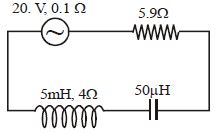
In the circuit of fig, the source frequency is $\omega  = 2000\,rad/s$. The current in the circuit will be....$A$
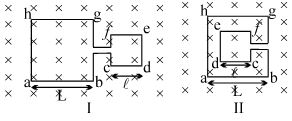
The adjoining figure shows two different arrangements in which two square wire frames are placed in a uniform constantly decreasing magnetic field $B.$ If $I_1$ and $I_2$ are the magnitudes of induced current in the cases $I$ and $II$, respectively, then
A charged particle with charge $q$ and mass $m$ starts with an initial kinetic energy $K$ at the middle of a uniformly charged spherical region of total charge $Q$ and radius $R$ . $q$ and $Q$ have opposite signs. The spherically charged region is not free to move . The value of $K_0$ is such that the particle will just reach the boundary of the spherically charged region. How much time does it take for the particle to reach the boundary of the region.