Question

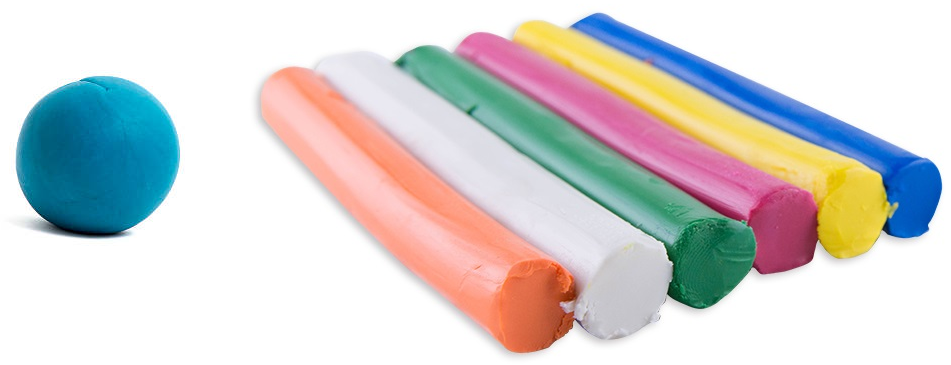
To make the learning process more interesting, creative and innovative, Amayras' class teacher brings clay in the classroom, to teach the topic-Surface Areas and Volumes. With clay, she forms a cylinder of radius 6cm and height 8cm. Then she moulds the cylinder into a sphere and asks some questions to students.
  1. During the conversion of a solid from one shape to another the volume of new shape will be Increase, Decrease or Remain unaltered?
  2. The radius of the sphere so fanned is:
  3. The volume of the sphere so formed is:
    Or
    Find the ratio of the volume of sphere to the volume of cylinder.
Answer

1.Remain unaltered2. 6cm
$3.905.14cm^3$​​​​​​​
Or
1:1

Need a full question paper?

Generate a complete, print-ready paper with questions like this in minutes — across 16+ boards, with answer keys.

Start Generating Free

Similar questions

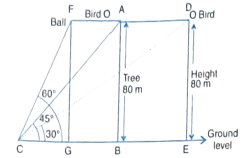
One evening, Kaushik was in a park: Children wre playing cricket Birds were singing on a neurby trec of height 80 m . He obseried a bird on the trec at an angle of clevaton of $45^{\circ}$. When a sixcer was hin, a ball flew through the three frightening the bird to fly away. In 2 seconds, he observed the bird flying at the same height at an angle of clevations of $30^{\circ}$ and the ball flying touards him at the same height at an angle of elevation of $60^{\circ}$.
Image
(i) At what distance from the foot of the tree was he observing the bird sitting on the tree?
(ii) How far did the bird fly in the mentoned time?
(iii) After hitting the tree, how far did the ball travel in the sky when Kaushik saw the ball?
(iv) What is the specd of the bird in $m / min$ of it had flown $20(\sqrt{3}+1) m$ ?
Read the text carefully and answer the questions:
Deepa has to buy a scooty.
She can buy scooty either making cashdown payment of $₹ 25,000$ or by making $15$ monthly instalments as below.
Ist month $- ₹ 3425, II^{nd}$ month $- ₹ 3225, III^{rd}$ month $- ₹ 3025, IV^{th}$ month $ - ₹ 2825$ and so on

Image

$(a)$ Find the amount of $6^{th}$ instalment.
$(b)$ Total amount paid in $15$ instalments.
OR
If Deepa pays $₹ 2625$ then find the number of instalment.
$(c)$ Deepa paid $10^{th}$ and $11^{th}$ instalment together find the amount paid that month.

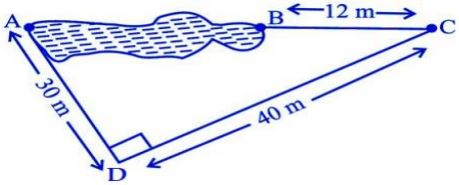
Rohan wants to measure the distance of a pond during the visit to his native. He marks points A and B on the opposite edges of a pond as shown in the figure below. To find the distance between the points, he makes a right-angled triangle using rope connecting B with another point C are a distance of 12m, connecting C to point D at a distance of 40m from point C and the connecting D to the point A which is are a distance of 30m from D such the $\angle ADC=90^0.$
  1. Which property of geometry will be used to find the distance AC?
  2. Find the length AB?
  3. Which is the following does not form a Pythagoras triplet?
    Or
    Find the length of the rope used.
The angle of elevation of the top of a vertical tower PQ from a point X on the ground is 60°. At a point Y, 40m vertically above X, the angle of elevation of the top is 45°. Calculate the height of the tower.
Read the following text carefully and answer the questions that follow:
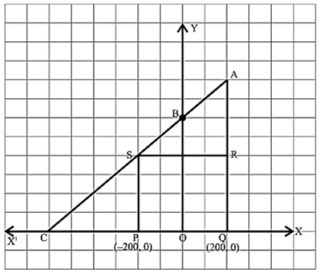
Jagdish has a field which is in the shape of a right angled triangle $\text{AQC.}$ He wants to leave a space in the form of a square $\text{PQRS}$ inside the field for growing wheat and the remaining for growing vegetables $($as shown in the figure$)$. In the field, there is a pole marked as $O.$
Image
$i.$ Taking $O$ as origin, coordinates of $P$ are $(-200, 0)$ and of $Q$ are $(200, 0). \text{PQRS}$ being a square, what are the coordinates of $R$ and $S\ ?$
$ii.$ What is the area of square $\text{PQRS}\ ?$
$iii.$ What is the length of diagonal $\text{PR}$ in square $\text{PQRS}\ ?$
OR
If $S$ divides $\text{CA}$ in the ratio $K : 1,$ what is the value of $K,$ where point $A$ is $(200, 800)\ ?$

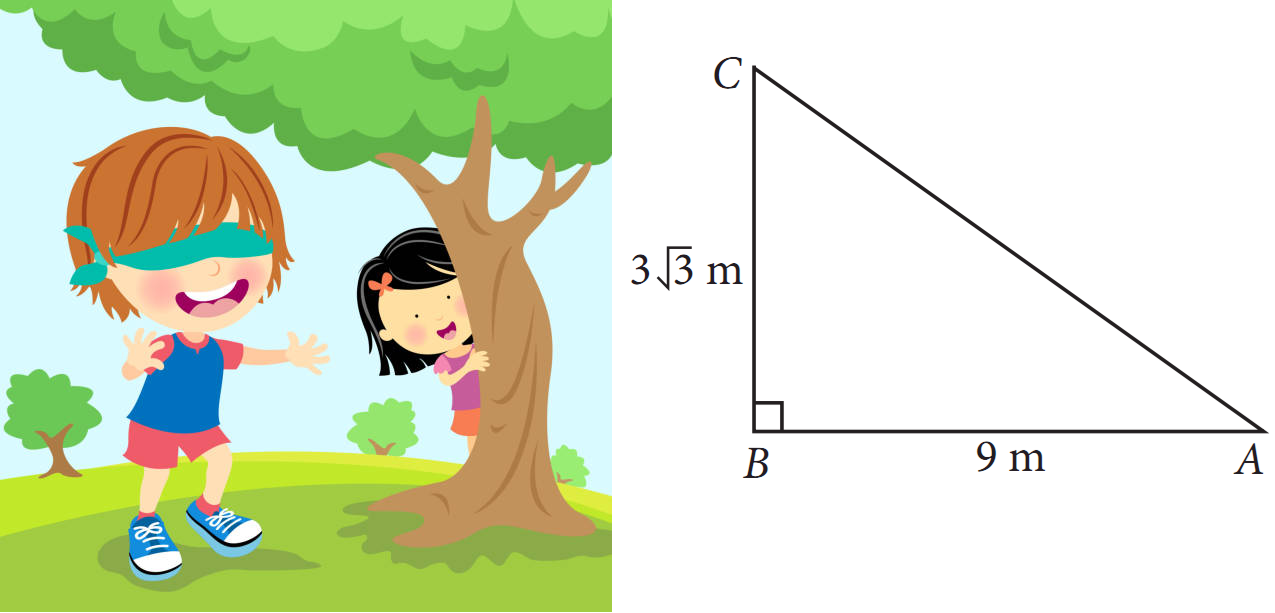
Three friends - Anshu, Vijay and Vishal are playing hide and seek in a park. Anshu and Vijay hide in the shrubs and Vishal have to find both of them. If the positions of three friends are at A, B and C respectively as shown in the figure and forms a right angled triangle such that AB = 9 m, BC $=\sqrt{3}\text{ m}$ and $\angle\text{B}=90^\circ$, then answer the following questions.
  1. The measure of $\angle\text{A}$ is:
  2. The length of AC is:
  3. $\cos 2\text{A} =$
    Or
    $\text{Sin}\Big(\frac{\text{C}}{2}\Big)=$
Read the following text carefully and answer the questions that follow:
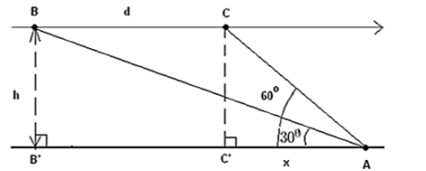
Mr. Vinod is a pilot in Air India. During the Covid $-19$ pandemic, many Indian passengers were stuck at Dubai Airport. The government of India sent special aircraft to take them. Mr. Vinod was leading this operation. He is flying from Dubai to New Delhi with these passengers. His airplane is approaching point $A$ along a straight line and at a constant altitude h. At $10:00 \ am$, the angle of elevation of the airplane is $30^\circ $ and at $10:01 am$, it is $60^\circ .$
Image
$i.$ What is the distance d is covered by the airplane from $10:00 \ am$ to $10:01 \ am$ if the speed of the airplane is constant and equal to $600$ miles/hour? 
$ii.$ What is the altitude h of the airplane? $($round answer to $2$ decimal places$)$ 
$iii.$ Find the distance between passenger and airplane when the angle of elevation is $30^\circ .$
OR
Find the distance between passenger and airplane when the angle of elevation is $60^\circ .$
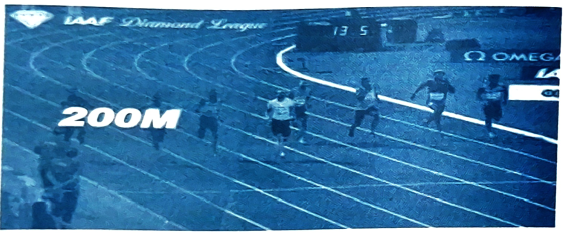
John wants to participate in a 200 m race. He can currently run that distance in 51 secons and with each day of practice it takes him 2 seconds less. He wants to do it in 31 seconds.
Image
(i) Which of the following are in A.P. for the given situation?
(a) 51,53,55,... $\qquad$ (b) 51,49,47,... $\qquad$ (c) -51,-53,-55, ... $\qquad$ (d) 51,55,59,...
(ii) The minimum number of days he needs to practice to achieve the goal is
(a) 10 $\qquad$ (b) 12 $\qquad$ (c) 11 $\qquad$ (d) 9
(iii) Which of the following terms is not in the A.P. of the given situation?
(a) 41 $\qquad$ (b) 30 $\qquad$ (c) 37 $\qquad$ (d) 39
(iv) The common difference of the A.P. having $a_n=2 n+3$ as $n^{\text {th }}$ term, is
(a) 2 $\qquad$ (b) 3 $\qquad$ (c) 5 $\qquad$ (d) 1