MCQ
To prepare a pure sample of $n-$ hexane using sodium metal as one reactant, the other reactant will be
  • $n-$ propyl bromide
  • B
    Ethyl bromide and  $ n-$  butyl bromide
  • C
    Ethyl chloride and $ n-$ butyl chloride
  • D
    Methyl bromide and  $ n -$ pentyl chloride
Answer

Correct option: A.
$n-$ propyl bromide
a
(a) According to wurtz reaction

$2C{H_3}C{H_2}C{H_2}Br + 2Na\xrightarrow{{ether}}$ $C{H_3}{(C{H_2})_4}C{H_3} + 2NaBr$

Need a full question paper?

Generate a complete, print-ready paper with questions like this in minutes — across 16+ boards, with answer keys.

Start Generating Free

Similar questions

For the given reactions

$Sn ^{2+}+2 e ^{-} \rightarrow Sn$

$Sn ^{4+}+4 e ^{-} \rightarrow Sn$

The electrode potentials are; $E _{ Sn ^{2+} / Sn }^{\circ}=-0.140\, V$ and $E _{ Sn ^{4+} / Sn }^{\circ}=0.010\, V$. The magnitude of standard electrode potential for $Sn ^{4+} / Sn ^{2+}$ i.e. $E _{ Sn ^{4+} / Sn ^{2+}}^{\circ}$ is $.....\times 10^{-2}\, V$. (Nearest integer)

Compound $‘A$’ reacts with $PC{l_5}$ to give ‘$B$ ’ which on treatment with $KCN$ followed by hydrolysis gave propanoic acid as the product. What is ‘$A$
A $20\, ml$ sample of a $0.1\, M$ solution of the weak monoprotic acid $HA$ is titrated  with $0.25\, M \,NaOH$, volume of $NaOH$ solution required till equivalent point is :- ............. $\mathrm{mL}$
The equivalent mass of a divalent metal is $31.82$ . The mass of single atom is ?
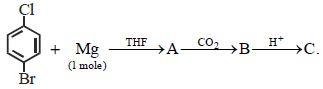
$C$ is ?
Which of the following statements are correct about $Zn , Cd$ and Hg ? ,
A. They exhibit high enthalpy of atomization as the d -subshell is full.
B. Zn and Cd do not show variable oxidation state while Hg shows + I and + II .
C. Compounds of $Zn , Cd$ and Hg are paramagnetic in nature.
D. $Zn , Cd$ and Hg are called soft metals.
Choose the most appropriate from the options given below:
Which of the following compounds gives carbondioxide with $NaHCO_3$ ?
Of the following which is diamagnetic in nature ?
The correct order of nucleophilicity is ..... .
$\begin{matrix}
   O\,\,\,\,\,\,\,\,\,\,\,\,\,\,\,\,\,\,\,\,\,\,\,\,\,\,\,\,\,\,\,\,\,\,\,\,\,\,\,\,\,\,\,  \\
   ||\,\,\,\,\,\,\,\,\,\,\,\,\,\,\,\,\,\,\,\,\,\,\,\,\,\,\,\,\,\,\,\,\,\,\,\,\,\,\,\,\,\,\,\,  \\
   Ph-CH=CH-C-C{{H}_{3}}\to Ph-CH=CH-C{{O}_{2}}H  \\
\end{matrix}$

Above conversion can be achieved by