Question
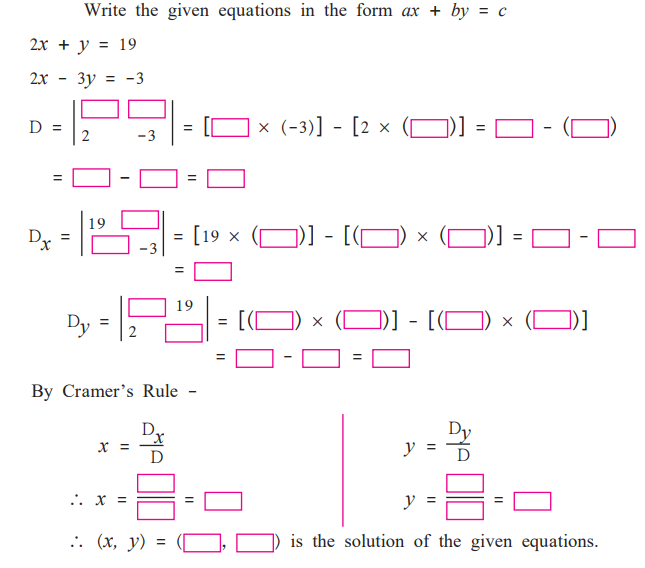
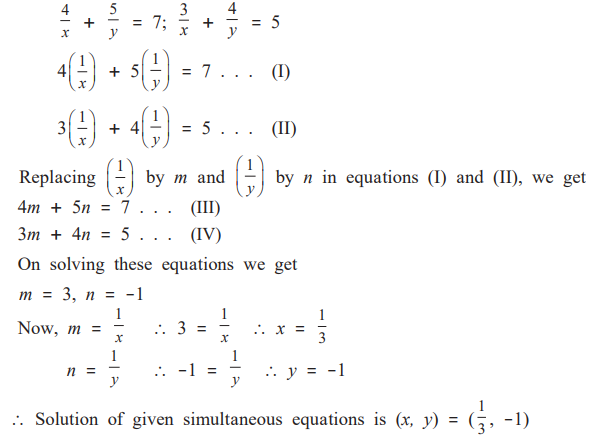
To solve the simultaneous equations by determinant method, fill in the blanks.
y + 2x - 19 = 0 ; 2x - 3y + 3 = 0
Image

Answer

Find the value of $D$.
$D=\left|\begin{array}{cc}2 & 1 \ 2 & -3\end{array}\right|=[2 \times(-3)]-[2 \times 1]$
$D=-6-2=-8$
Find the value of $D_x$.
$D_x=\left|\begin{array}{cc}19 & 1 \ -3 & -3\end{array}\right|=[19 \times(-3)]-[(-3) \times 1]$
$D_x=-57-(-3)=-54$
Find the value of $D_y$.
$D_y=\left|\begin{array}{cc}2 & 19 \ 2 & -3\end{array}\right|=[2 \times(-3)]-[2 \times 19]$
$D_y=-6-38=-44$
Find the values of $x$ and $y$ using Cramer's Rule.
$x=\frac{D_x}{D}=\frac{-54}{-8}=\frac{27}{4}$
$y=\frac{D_y}{D}=\frac{-44}{-8}=\frac{11}{2}$
$(x, y)=\left(\frac{27}{4}, \frac{11}{2}\right)$

Need a full question paper?

Generate a complete, print-ready paper with questions like this in minutes — across 16+ boards, with answer keys.
Start Generating Free

Similar questions


Image
$\tan ^2 \theta-\sin ^2 \theta=\tan ^2 \theta \times \sin ^2 \theta$. For proof of this complete the activity given below.
Activity:
L.H.S = $\square$
$ =\square\left(1-\frac{\sin ^2 \theta}{\tan ^2 \theta}\right)$
$=\tan ^2 \theta\left(1-\frac{\square}{\frac{\sin ^2 \theta}{\cos ^2 \theta}}\right)$
$=\tan ^2 \theta\left(1-\frac{\sin ^2 \theta}{1} \times \frac{\cos ^2 \theta}{\square}\right)$
$=\tan ^2 \theta(1-\square)$
$=\tan ^2 \theta \times \square \quad \ldots . .\left[1-\cos ^2 \theta=\sin ^2 \theta\right]$
$=\text { R.H.S } $
The following table shows the number of students and the time they utilized daily for their studies. Find the mean time spent by students for their studies by direct method.
Time (hrs.)0-2$2-4$$4-6$$6-8$$8-10$
No. of students71812103
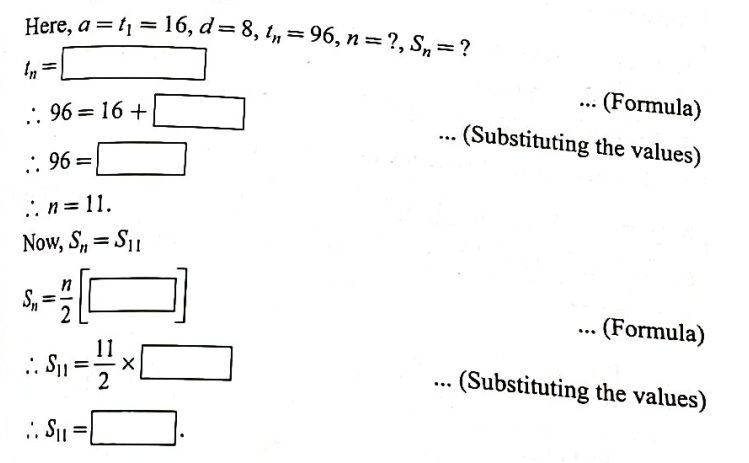
Complete the following activity to find the sum of all two-digit numbers divisible by 8.
Two-digit numbers divisible by 8 are 16, 24, 32, ..., 88, 96.

Image
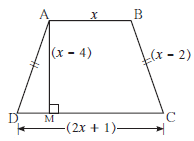
In the adjoining fig. ⬜ABCD is a trapezium AB||CD and its area is 33 cm2. From the information given in the figure find the lengths of all sides of the ⬜ABCD. Fill in the empty boxes to get the solution.
Image

⬜ $\square ABCD$ is a trapezium. $AB \| CD$
Area of trapezium
$=\frac{1}{2} \times($ Sum of parallel sides $) \times$ Height
$\therefore \quad A (⬜ABCD )=\frac{1}{2} \times( AB + CD ) \times$⬜
$\therefore \quad 33=\frac{1}{2}(x+2 x+1) \times$⬜
∴ ⬜$=(3 x+1) \times$ ⬜
$\therefore \quad 66=3 x^2-12 x+x-4$
$\therefore \quad 3 x^2$ - ⬜ - ⬜ = 0
$\therefore \quad 3 x^2-21 x+10 x-70=0$
$\therefore \quad 3 x(x-7)+10(x-7)=0$
$\therefore \quad(3 x+10)(x-7)=0$
By using the property, if the product of two numbers is zero, then at least one of them is zero, we get
$\therefore \quad(3 x+10)=0$ or ⬜ = 0
$\therefore \quad x=\frac{-10}{3}$ or $x=$ ⬜
But, length is never nagative.
∴ $x \neq \frac{-10}{3}$
∴ x = ⬜
AB = ⬜
CD = ⬜
AD = BC = ⬜
Solve the following word problems.
A two digit number and the number with digits interchanged add up to 143. In the given number the digit in unit’s place is 3 more than the digit in the ten’s place. Find the original number.
Let the digit in unit’s place is x
and that in the ten’s place is y
the number = ⬜y + x
The number obtained by interchanging the digits is ⬜x + y
According to first condition two digit number + the number obtained by interchanging the digits = 143
∴ 10y + x = 143
∴ ⬜x + ⬜y = 143
x + y = ⬜......(I)
From the second condition,
digit in unit’s place = digit in the ten’s place + 3
∴ X = ⬜ + 3
∴ X - Y= 3.....(II)
Adding equations (I) and (II)
2X = ⬜
X = 8
Putting this value of x in equation (I)
x + y = 13
8 + ⬜ = 13
∴ Y = ⬜
The original number is 10
= ⬜ + 8
= 58
₹ 1000 is invested at 10 percent simple interest. Check at the end of every year if the total interest amount is in A.P. If this is an A.P. then find interest amount after 20 years. For this complete the following activity.
Simple interest $=\frac{ P \times R \times N }{100}$
Simple interest after 1 year $=\frac{1000 \times 10 \times 1}{100}=$⬜
Simple interest after 2 year$=\frac{1000 \times 10 \times 2}{100}=$ ⬜
Simple interest after 3 year$=\frac{\square \times \square \times \square}{100}=300$
According to this the simple interest for 4, 5, 6 years will be 400,⬜,⬜ respectively.
From this d= ⬜ and a=⬜
Amount of simple interest after 20 years
tn + a + (n – 1) d
t20=⬜+(20-1)⬜
t20=⬜
Amount of simple interest after 20 years is = ⬜
Image
Image
If $\alpha$ and $\beta$ are the roots of $x^2+5 x-1=0$ then find :
1. $\alpha^3+\beta^3$
2. $\alpha^2+\beta^2$.
If $\tan \theta=\frac{7}{24}$, then to find value of $\cos \theta \operatorname{complete}$ the activity given below.
Activity:
$ \sec ^2 \theta=1+\square \quad \ldots . . .[\text { Fundamental tri. identity] }$
$\sec ^2 \theta=1+\square^2$
$\sec ^2 \theta=1+\frac{\square}{576}$
$\sec ^2 \theta=\frac{\square}{576}$
$\sec \theta=\square$
$\cos \theta=\square \quad \ldots \ldots . .\left[\cos \theta=\frac{1}{\sec \theta}\right] $