Question
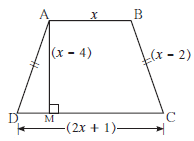
In the adjoining fig. ⬜ABCD is a trapezium AB||CD and its area is 33 cm2. From the information given in the figure find the lengths of all sides of the ⬜ABCD. Fill in the empty boxes to get the solution.
Image

⬜ $\square ABCD$ is a trapezium. $AB \| CD$
Area of trapezium
$=\frac{1}{2} \times($ Sum of parallel sides $) \times$ Height
$\therefore \quad A (⬜ABCD )=\frac{1}{2} \times( AB + CD ) \times$⬜
$\therefore \quad 33=\frac{1}{2}(x+2 x+1) \times$⬜
∴ ⬜$=(3 x+1) \times$ ⬜
$\therefore \quad 66=3 x^2-12 x+x-4$
$\therefore \quad 3 x^2$ - ⬜ - ⬜ = 0
$\therefore \quad 3 x^2-21 x+10 x-70=0$
$\therefore \quad 3 x(x-7)+10(x-7)=0$
$\therefore \quad(3 x+10)(x-7)=0$
By using the property, if the product of two numbers is zero, then at least one of them is zero, we get
$\therefore \quad(3 x+10)=0$ or ⬜ = 0
$\therefore \quad x=\frac{-10}{3}$ or $x=$ ⬜
But, length is never nagative.
∴ $x \neq \frac{-10}{3}$
∴ x = ⬜
AB = ⬜
CD = ⬜
AD = BC = ⬜
Answer

$\square ABCD$ is a trapezium. $AB \| CD$
Area of trapezium
$=\frac{1}{2} \times($ Sum of parallel sides $) \times$ Height
$\therefore \quad A (⬜ABCD )=\frac{1}{2} \times( AB + CD ) \times$AM
$\therefore \quad 33=\frac{1}{2}(x+2 x+1) \times$$(x-4)$
∴ 66$=(3 x+1) \times$ $(x-4)$
$\therefore \quad 66=3 x^2-12 x+x-4$
$\therefore \quad 3 x^2$ - 11x - 70 = 0
$\therefore \quad 3 x^2-21 x+10 x-70=0$
$\therefore \quad 3 x(x-7)+10(x-7)=0$
$\therefore \quad(3 x+10)(x-7)=0$
By using the property, if the product of two numbers is zero, then at least one of them is zero, we get
$\therefore \quad(3 x+10)=0$ or (x-7) = 0
$\therefore \quad x=\frac{-10}{3}$ or $x=$ 7
But, length is never nagative.
∴ $x \neq \frac{-10}{3}$
∴ x = 7
AB = $x=7 cm$
CD = $2 x+1=2(7)+1=15 cm$
AD = BC = $x-2=7-2=5 cm$

Need a full question paper?

Generate a complete, print-ready paper with questions like this in minutes — across 16+ boards, with answer keys.

Start Generating Free

Similar questions

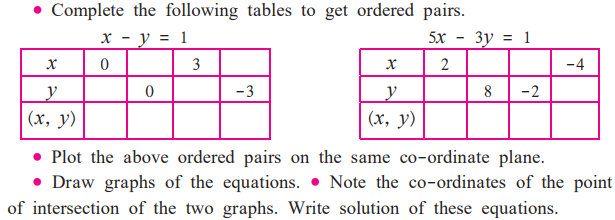
Solve the following simultaneous equations by graphical method.

Image

Image
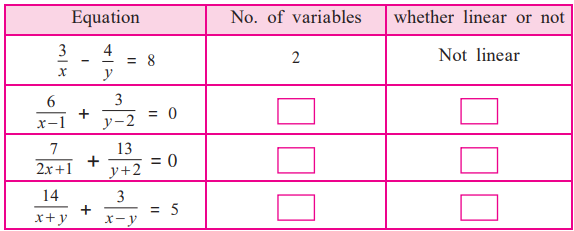
Complete the following table.

Image
Complete the following table to draw the graph of 3 𝑥 − 2 𝑦 = 18

X

0

4

2

-1

Y

-9

------

-------

------

x, y

(0,-9)

(--,--)

(--,--)

------

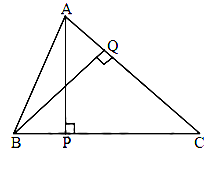
In $\triangle ABC, AP \perp BC$ and $BQ \perp AC, B−P−C, A−Q−C,$ then show that $\triangle CPA \sim \triangle CQB.$ If $AP = 7, BQ = 8, BC = 12,$ then $AC = ?$

In $\triangle C P A$ and $\triangle C Q B$
$\angle C P A \cong[\angle \ldots] \quad \ldots\left[\right.$ each $\left.90^{\circ}\right]$
$\angle A C P \cong[\angle \ldots] \quad \ldots[$ common angle $]$
$\triangle CPA \sim \triangle CQB \quad \ldots . . .[\ldots[\quad$ similarity test $]$
$\frac{ AP }{ BQ }=\frac{[}{\square BC } \quad \ldots . . . .[$ corresponding sides of similar triangles]
$\frac{7}{8}=\frac{[-[]}{12}$
$AC \times[\quad]=7 \times 12$
$A C=10.5$
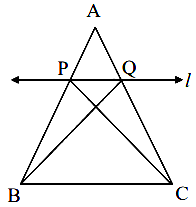
A line is parallel to one side of triangle which intersects remaining two sides in two distinct points then that line divides sides in same proportion.

Given: In $\triangle A B C$ line I || side $B C$ and line I intersect side $A B$ in $P$ and side $A C$ in $Q$.
To prove: $\frac{ AP }{ PB }=\frac{ AQ }{ QC }$
Construction: Draw $CP$ and $BQ$
Proof: $\triangle APQ$ and $\triangle PQB$ have equal height.
$\left.\frac{ A (\Delta APQ )}{ A (\Delta PQB )}=\frac{[}{ PB } \quad \ldots . . \text { (i) [areas in proportion of base }\right]$
$\frac{ A (\Delta APQ )}{ A (\Delta PQC )}=\frac{[}{ QC } \ldots . . . \text { (ii) [areas in proportion of base] }$
$\triangle P Q C$ and $\triangle P Q B$ have [____ ] is common base.
Seg PQ \| Seg BC, hence height of $\triangle A P Q$ and $\triangle P Q B$.
$A (\triangle PQC )= A (\Delta \ldots, \ldots \text {.....(iii) }$
$\frac{ A (\Delta APQ )}{ A (\Delta PQB )}=\frac{ A (\Delta \ldots)}{ A (\Delta \ldots \ldots[( i ) \text {, (ii), and (iii)] }}$
$\frac{ AP }{ PB }=\frac{ AQ }{ QC } \quad \ldots . . .[( i ) \text { and (iii)] }$
The following frequency table shows the demand for a sweet and the number of customers. Find the mode of demand of sweet.
Weight of sweet (gram)0-250250-500500-750750-10001000-1250
No. of customers1060252015
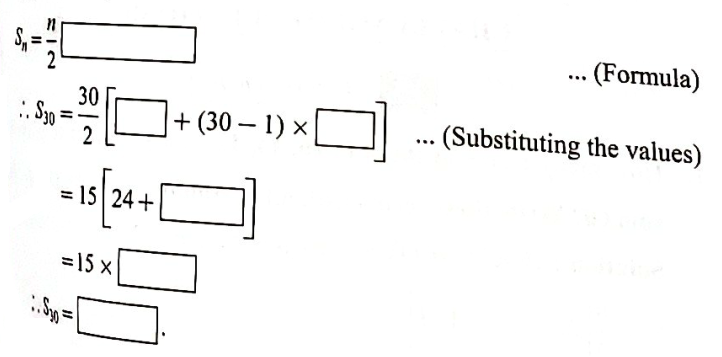
For an $A.P., a = 12$ and $d = 4$ Complete the following activity to find $S_{30}$ of the $A.P$
Here, $a = 12, d = 4, S_{30} = ?$
Image
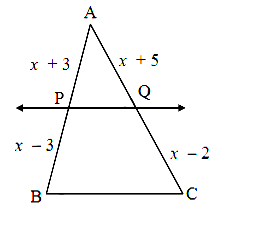
From fig., seg $PQ ||$ side $BC, AP = x + 3, PB = x – 3, AQ = x + 5, QC = x – 2,$ then complete the activity to find the value of $x.$

$\text { In } \triangle P Q B, P Q|| \text { side } B C$
$\frac{ AP }{ PB }=\frac{ AQ }{[} \quad \ldots[\ldots]$
$\frac{x+3}{x-3}=\frac{x+5}{[}$
$(x+3)[\quad]=(x+5)(x-3)$
$x^2+x-[\quad]=x^2+2 x-15$
$x=[$
The following frequency distribution table gives the ages of 200 patients treated in a hospital in a week. Find the mode of ages of the patients.
Age (Years)Less than 55-910-1415-1920-29
No. of patients3832503620