Question
Toricelli’s barometer used mercury. Pascal duplicated it using French wine of density $984kg m^{–3}$. Determine the height of the wine column for normal atmospheric pressure.

Answer

Density of mercury, $\rho_1= 13.6\times10\text{kg/m}$
Height of the mercury column, h = 0.76m.
Density of French wine, $\rho_2=984\text{kg/ m}^3$
Height of the French wine column = $h_2$
Acceleration due to gravity, $g = 9.8m/s^2​​​​​​​$
The pressure in both the columns is equal, i.e.,
Pressure in the mercury column.
= Pressure in the French wine column.
$\rho_1\text{h}_1\text{g}=\rho_2\text{h}_2\text{g}$
$\text{h}_2=\frac{\rho_1\text{h}_1}{\rho_2}$
$=\frac{13.6\times10^3\times0.76}{986}$
$10.5\text{m}$
Hence, the height of the French wine column for normal atmospheric pressure is 10.5m.

Need a full question paper?

Generate a complete, print-ready paper with questions like this in minutes — across 16+ boards, with answer keys.
Start Generating Free

Similar questions

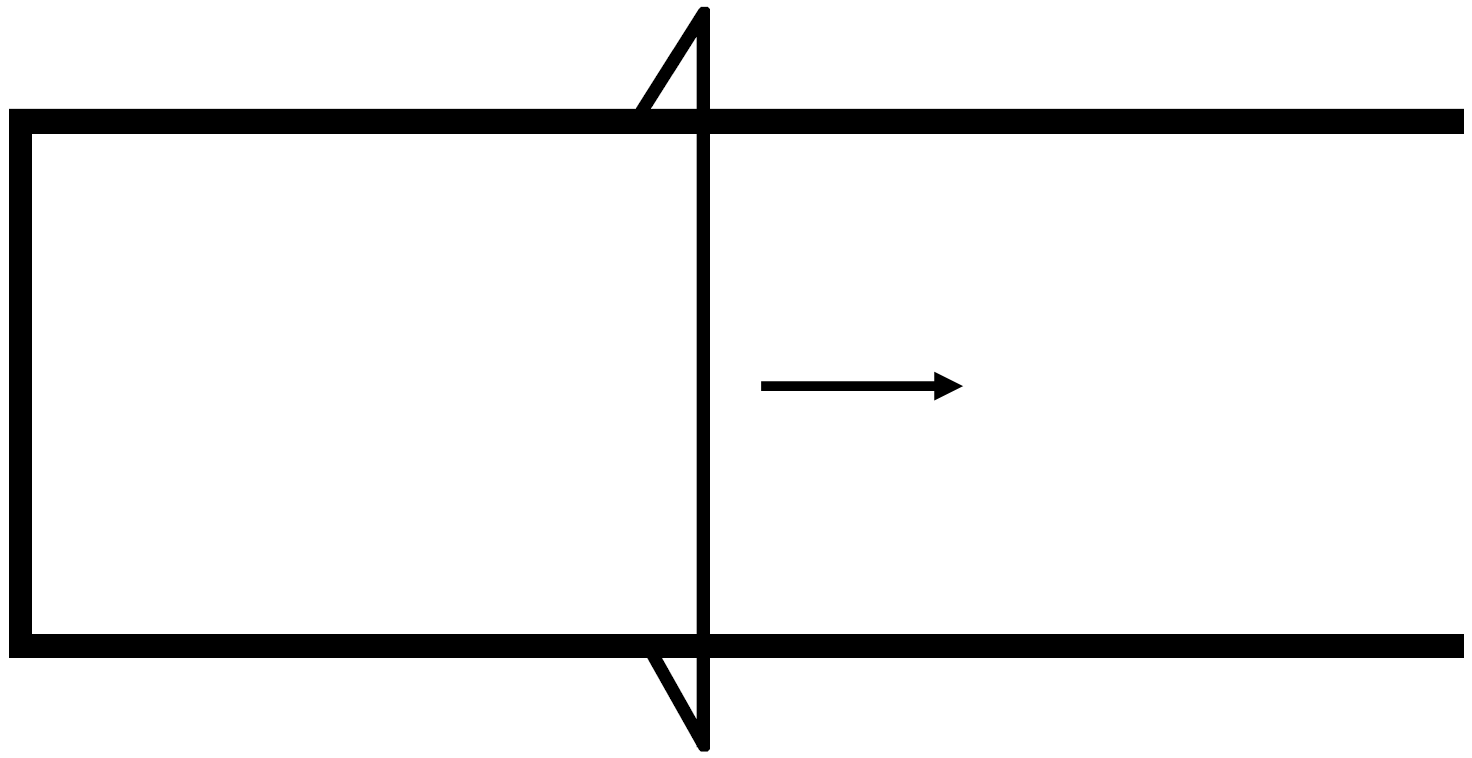
Figure shows a metallic wire of resistance $0.20\Omega$ sliding on a horizontal, U-shaped metallic rail. The separation between the parallel arms is $20cm$. An electric current of $2.0\mu\text{A}$ passes through the wire when it is slid at a rate of $20cms^{-1}$. If the horizontal component of the earth's magnetic field is $3.0 \times 10^{-5} T$, calculate the dip at the place.
A cylinder fitted with a movable piston contains hydrogen at a pressure of $3.5 \times 10^5 \mathrm{~N}-\mathrm{m}^2$ and temperature 366 K . Hydrogen expands adiabatically until the pressure in the cylinder falls to $0.7 \times 10^5 \mathrm{~N}-\mathrm{m}^{-2}$. The piston is then fixed and the gas is heated until the temperature becomes 366 K . The pressure in the cylinder is now found to be $1.1 \times$ $10^5 \mathrm{~N}-\mathrm{m}^{-2}$. Determine the specific heats of hydrogen. $\left(R=8.3 \mathrm{~J} \mathrm{~mol}^{-1} \mathrm{~K}^{-1}\right)$.
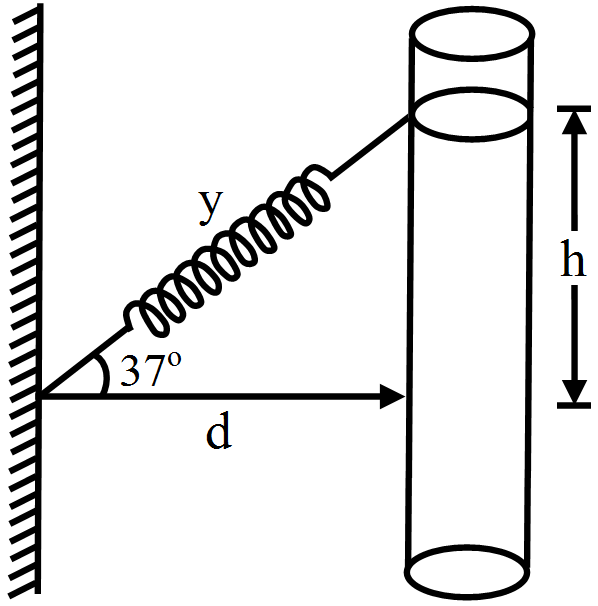
One end of a light spring of natural length d and spring constant k is fixed on a rigid wall and other end is fixed in a smooth ring of mass m as shown in figure. Initially, the spring is stretched such that it makes an angle of $37^\circ$ with the horizontal.
Now, the ring is stretched from rest, find the speed of the ring when it will become horizontal, assume that ring slides on the vertical wall without friction.
Does the escape speed of a body from the earth depend on (a) the mass of the body, (b) the location from where it is projected, (c) the direction of projection, (d) the height of the location from where the body is launched?
A satellite is projected vertically upwards from an earth station. At what height above the earth's surface will the force on the satellite due to the earth be reduced to half its value at the earth station? (Radius of the earth is 6400km.)
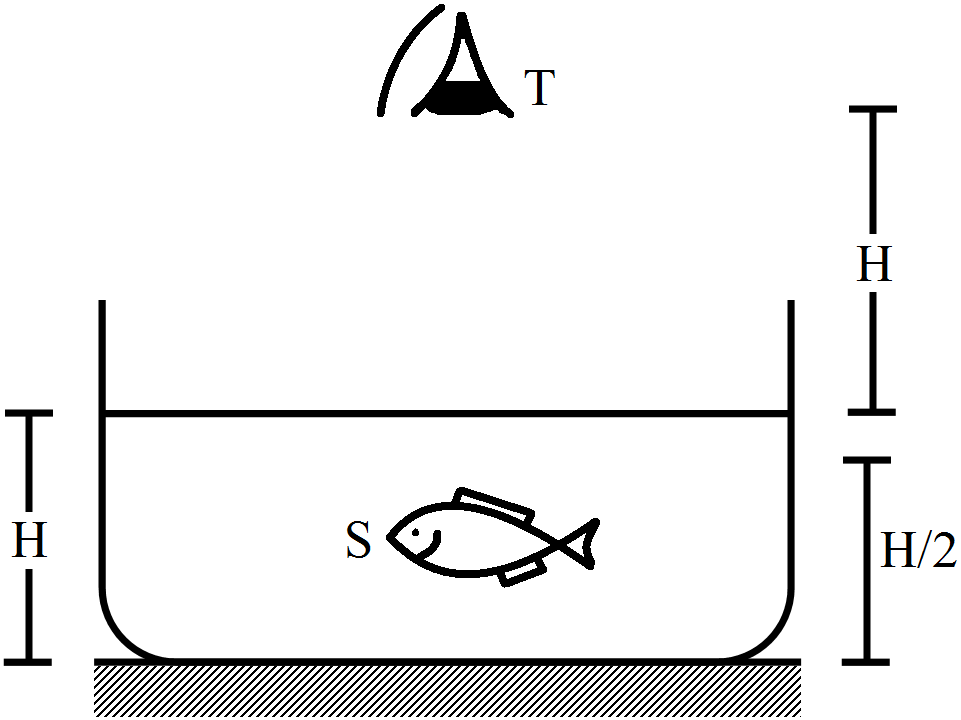
Consider the situation in figure. The bottom of the pot is a reflecting plane mirror, S is a small fish and T is a human eye. Refractive index of water is.
  1. At what distance(s) from itself will the fish see the image(s) of the eye?
  2. At what distance(s) from itself will the eye see the image(s) of the fish.
An atom is in its excited state. Does the probability of its coming to ground state depend on whether the radiation is already present or not? If yes, does it also depend on the wavelength of the radiation present?
A 5cm cube has its upper face displaced by 0.2cm by a tangential force of 8N. Calculate the shearing strain, shearing stress and modulus of rigidity of the material of cube.
A neutron initially at rest, decays into a proton, an electron and an antineutrino. The ejected electron has a momentum of $1.4 \times 10^{-26} kg- m / s$ and the antineutrino $6.4 \times 10^{-27} kg- m / s$. Find the recoil speed of the proton:
a. If the electron and the antineutrino are ejected along the same direction.
b. If they are ejected along perpendicular directions. Mass of the proton $=1.67 \times 10^{-27} kg$.
A U-tube having unequal arm-lengths has water in it. A tuning fork of frequency $440Hz$ can set up the air in the shorter arm in its fundamental mode of vibration and the same tuning fork can set up the air in the longer arm in its first overtone vibration. Find the length of the air columns. Neglect any end effect and assume that the speed of sound in air = $330m/s$.