MCQ
$'Torr'$ is the unit of
  • Pressure
  • B
    Volume
  • C
    Density
  • D
    Flux

Answer

Correct option: A.
Pressure
a
$Torr$ is the unit of pressure.

Need a full question paper?

Generate a complete, print-ready paper with questions like this in minutes — across 16+ boards, with answer keys.
Start Generating Free

Similar questions

An $L-R$ circuit has a cell of $e.m.f$. $E$, which is switched on at time $t = 0$. The current in the circuit after a long time will be
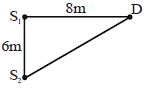
In the figure the intensity of waves arriving at $D$ from two coherent sources $S_1$ and $S_2$ is $2I_0$. The wave length of the wave is $\lambda  = 8\,m$. Resultant intensity at $D$ will be
Which is the correct relation for forbidden energy gap in conductor, semi conductor and insulator
In a Wheatstone's bridge, three resistances $P, Q$ and $R$ connected in the three arms and the fourth arm is formed by two resistances $S_1$ and $S_2$ connected in parallel. The condition for the bridge to be balanced will be
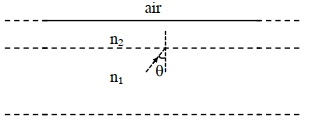
A wide slab consisting of two media of refractive indices $n_1$ and $n_2$ is placed in air as shown in the figure. A ray of light is incident from medium $n_1$ to $n _2$ at an angle $\theta$, where $\sin \theta$ is slightly larger than $1 / n _1$. Take refractive index of air as $1$ . Which of the following statement($s$) is(are) correct?

$(A)$ The light ray enters air if $n _2= n _1$

$(B)$ The light ray is finally reflected back into the medium of refractive index $n_1$ if $n_2< n _1$

$(C)$ The light ray is finally reflected back into the medium of refractive index $n _1$ if $n _2> n _1$

$(D)$ The light ray is reflected back into the medium of refractive index $n_1$ if $n_2=1$
A closed organ pipe of length $1.2 \,\,m$ vibrates in its first overtone mode. The pressure variation is maximum at:
If Fresnel’s biprism experiment as held in water inspite of air, then what will be the effect on fringe width
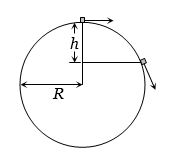
A particle originally at rest at the highest point of a smooth vertical circle is slightly displaced. It will leave the circle at a vertical distance $h$ below the highest point such that
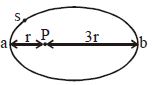
A satellite $S$ moves around a planet $P$ in an elliptical orbit as shown in figure. The ratio the speed of the satellite at point $a$ to that at point $b$ is
Carbon-$11$ decays to boron-$11$ according to the following formula.

${ }_6^{11} C \rightarrow{ }_5^{11} B +e^{+}+ v _e+0.96 \,MeV$

Assume that, positrons $\left(e^{+}\right)$produced in the decay combine with free electrons in the atmosphere and annihilate each other almost immediately. Also, assume that the neutrinos $\left(v_e\right)$ are massless and do not interact with the environment. At $t=0$, we have $1 \mu g$ of ${ }_6^{12} C$. If the half-life of the decay process is $t_0$, the net energy produced between time $t=0$ and $t=2 t_0$, will be nearly ........... $MeV$