In a Wheatstone's bridge, three resistances $P, Q$ and $R$ connected in the three arms and the fourth arm is formed by two resistances $S_1$ and $S_2$ connected in parallel. The condition for the bridge to be balanced will be
AIEEE 2006, Medium


Download our appand get started for free
Experience the future of education. Simply download our apps or reach out to us for more information. Let's shape the future of learning together!No signup needed.*
Similar Questions
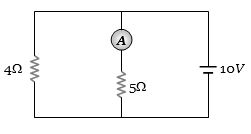
- 1if the internal resistance of the battery is $1\, ohm$, then what is the reading of ammeterView Solution
- 2To get maximum current through a resistance of $2.5\,\Omega $, one can use $m$ rows of cells, each row having $n$ cells. The internal resistance of each cell is $0.5\,\Omega $. What are the values of $n$ and $m$ if the total number of cells is $45$ ?View Solution
- 3A cell having an emf $\varepsilon$ and internal resistance $r$ is connected across a variable external resistance $R.$ As the resistance $R$ is increased, the plot of potential difference $V$ across $R$ is given byView Solution
- 4$A$ potentiometer wire has length $10\, m$ and resistance $10\,\Omega$ . It is connected to a battery of $EMF$ $11\, volt$ and internal resistance $1\, \Omega$ , then the potential gradient in the wire is ............... $V/m$View Solution
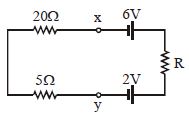
- 5The current flowing in the given circuit is $0.1\,A$ . The potential difference between the points $X$ and $Y$ is ................ $\mathrm{V}$View Solution
- 6Four wires $AB,\,\,BC,\,\,CD,\,\,DA$ of resistance $4\, \Omega$ each and a fifth wire $BD$ of resistance $8\, \Omega$ are joined to form a rectangle $ABCD$ of which $BD$ is a diagonal. The effective resistance between the points $A$ and $B$ isView Solution
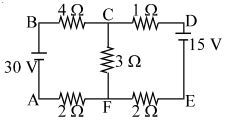
- 7View SolutionThe figure shows a network of five resistances and two batteries Which of the batteries is getting charged.
- 8A filament bulb $(500 \,W,\,\, 100 \,V)$ is to be used in a $230\, V$ main supply. When a resistance $R$ is connected in series, it works perfectly and the bulb consumes $500\,W.$ The value of $R$ is .................. $\Omega$View Solution
- 9If you are provided a set of resistances $2\, \Omega, 4\, \Omega$ $6\, \Omega$ and $8\, \Omega$. Connect these resistances so as to obtain an equivalent resistance of $\frac{46}{3}\, \Omega$.View Solution
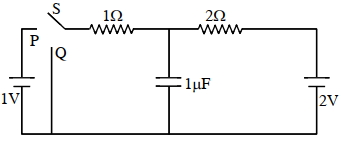
- 10In the circuit shown below, the switch $S$ is connected to position $P$ for a long time so that the charge on the capacitor becomes $q _1 \mu C$. Then $S$ is switched to position $Q$. After a long time, the charge on the capacitor is $q _2 \mu C$.View Solution
($1$) The magnitude of $q_1$ is
($2$) The magnitude of $q _2$ is
Give the answer of question ($1$) and ($2$)