Question
Total Debt ₹ 60,00,000; Shareholders' Funds ₹ 10,00,000; Reserves and Surplus ₹ 2,50,000; Current Assets ₹ 25,00,000; Working Capital ₹ 5,00,000. Calculate Total Assets to Debt Ratio.
[Hint: Reserves and Surplus are already included in Shareholders' Funds.]
Answer

Total Assets Debt Ratio $=\frac{\text{Total Assets}}{\text{Long-term Debt}}$
Working Capital = Current Assets - Current Liabilities
5,00,000 = 25,00,000 - Current Liabilities
Current Liabilities = ₹ 20,00,000
Long Term Debts = Total Debt - Current Liabilities
= 60,00,000 - 20,00,000 = ₹ 40,00,000
Total Assets = Total Liabilities = Total Debt + Shareholders’ Funds
= 60,00,000 + 10,00,000 = ₹ 70,00,000
Total Assets Debt Ratio $=\frac{70,00,000}{40,00,000}=7:4\text{ or }1.75:1$

Need a full question paper?

Generate a complete, print-ready paper with questions like this in minutes — across 16+ boards, with answer keys.

Start Generating Free

Similar questions

What is Comparative Balance Sheet? How is it prepared?
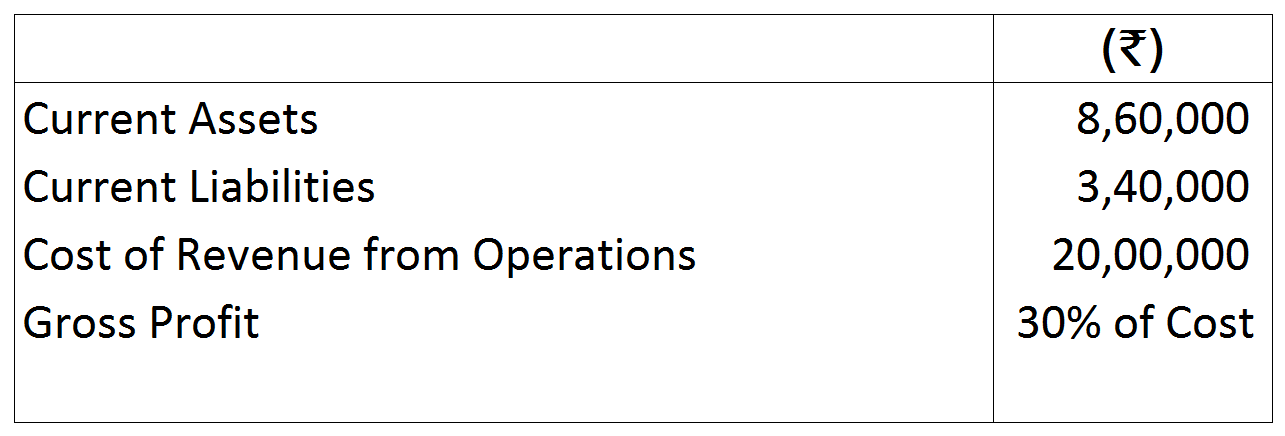
Calculate Working Capital Turnover Ratio from the following information:
Calculate Proprietary Ratio From the following:
 
Equity Share Capital.
4,50,000
10% Perference Share Cpital.
3,20,000
Reserves and Surplus.
65,000
Creditors.
1,10,000
9% Debentures. 3,00,000
Fixed Assets. 7,00,000
Trade Investment. 2,45,000
Current Assets. 3,00,000
‘Scooters India Ltd.’ is registered with an authorized capital of ₹ $50,00,000$, divided into $5,00,000$ shares of ₹ $10$ each. The company issued $1,00,000$ shares for subscriptions to the public at par. The amount was payable as follows:
On application and allotment – ₹ $3$ per share.
On $1^{st}$ call – ₹ $2$ per share.
On $2^{nd}$ and final call – ₹ $5$ per share.
The issue was fully subscribed. All calls were made and were duly received except the $2^{nd}$ and final call on $1,000$ shares held by Rohan. His shares were forfeited and afterwards re-issued at ₹ $8$ per share as fully paid up.
Present ‘Share Capital’ in the Balance Sheet of the company as per Schedule VI Part I of the Companies Act, $1956$. Also prepare Notes to accounts for the same.
Nav Lakshmi Ltd. invited applications for issuing 3000, 12% Debentures of ₹ 100 each at a premium of ₹ 50 per Debenture. The full amount was payable on application.
Applications were received for 4000 debentures. Applications for 1000 debentures were rejected and application money was refunded. Debentures were allotted to the remaining applicants.
Pass necessary Journal entriesforthe above transactionsin the books of Nav Lakshmi Ltd.
X Ltd. redeemed 1000, 6% Debentures of ₹ 100 each by converting them into Equity shares of ₹ 100 each. The 6% Debentures were redeemable at a premium of 5% for which the Equity shares were issued at a premium of 25%. Pass the necessary journal entries for the redemption of the above mentioned Debentures in the books of X Ltd.
Explain how common size statements are prepared giving an example.
Current Liabilities of a company were ₹ 1,75,000 and its Current Ratio was 2 : 1. It paid ₹ 30,000 to a Creditor. Calculate Current Ratio after payment.
Anand Ltd., arrived at a net income of ₹ 5,00,000 for the year ended March 31, 2017. Depreciation for the year was ₹ 2,00,000. There was a profit of ₹ 50,000 on assets sold which was transferred to Statement of Profit and Loss account. Trade Receivables increased during the year ₹ 40,000 and Trade Payables also increased by ₹ 60,000. Compute the cash flow from operating activities by the indirect approach.
A firm had current assets of ₹ 7,20,000. It then purchased goods for ₹ 30,000 on credit. After this purchase, the current ratio was 3 : 1. Ascertain the amount of Current Liabilities and Working Capital after the purchase