MCQ
Towards the centre of sun
  • A
    Density decreases
  • B
    Pressure decreases
  • C
    Temperature decreases
  • Density and pressure increases

Answer

Correct option: D.
Density and pressure increases
d
(d)As we move towards the centre of the sun, the density and pressure increases.

Need a full question paper?

Generate a complete, print-ready paper with questions like this in minutes — across 16+ boards, with answer keys.

Start Generating Free

Similar questions

In vacuum the speed of light depends upon
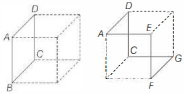
The current in flowing along the path $A B C D$ of a cube (shown in the left figure) produces a magnetic field at the centre of cube of magnitude $B$. Dashed line depicts the non-conducting part of the cube. Consider a cubical shape shown to the right which is identical in size and shape to the left. If the same current now flows in along the path $D A E F G C D$, then the magnitude of magnetic field at the centre will be
$........$ Charge is produced by friction
Two electrons are separated by a distance of $1\,\mathop A\limits^o $. What is the coulomb force between them
The time period of rotation of the sun is 25 days and its radius is $7\times 10^8$ m. The Doppler shift for the light of wavelength 6000 Å emitted from the surface of the sun will be
Magnetic field does not cause deflection in:
The width of fringe is $2\,mm$ on the screen in a double slits experiment for the light of wavelength of $400\,nm$. The width of the fringe for the light of wavelength $600\,nm$ will be $..............\,mm$
Each atom of an iron bar (5cm × 1 cm × 1 cm) has a magnetic moment $1.8\times 10^{-23}Am^2$ . Knowing that the density of iron is $7.78\times 10^3 kg^{-3}m,$  atomic weight is 56 and Avogadro's number is $6.02\times 10^{23}$  the magnetic moment of bar in the state of magnetic saturation will be
Which of the following quantities do not depend on the choice of zero potential or zero potential energy?
Consider a solid insulating sphere of radius $R$ with charge density varying as $\rho = \rho_0r^2$  ($\rho_0$  is a constant and r is measure from centre).Consider two points $A$ and $B$ at distance $x$ and $y$ respectively ($x < R, y > R$) from the centre. If magnitudes of electric fields at points $A$ and $B$ are equal, then