MCQ
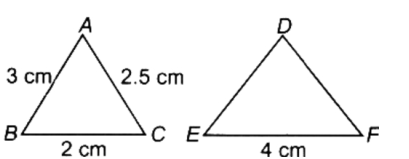
$\triangle \text{ABC}$ is such that $\text{AB} =3 \ cm, \text{BC} =2 \ cm$ and $\text{CA}=2.5 \ cm$. If $\triangle \text{DEF} \sim \triangle \text{ABC}$ and $\text{EF} =4 \ cm$, then perimeter of $\triangle \text{DEF}$ is
  • A
    $30 \ cm$
  • B
    $7.5 \ cm$
  • C
    $22.5 \ cm$
  • $15 \ cm$

Answer

Correct option: D.
$15 \ cm$
Image
Since, $\triangle \text{DEF} \sim \triangle \text{ABC} [$Given$]$
$\Rightarrow \frac{A B}{D E}=\frac{B C}{E F}$
$\Rightarrow \frac{3}{D E}=\frac{2}{4}$
$\Rightarrow DE =6 \ cm$
Also, $\frac{A C}{D F}=\frac{B C}{E F}$
$\Rightarrow \frac{2.5}{D F}=\frac{2}{4}$
$\Rightarrow DF =5 \ cm$
$\therefore$ Perimeter of $\triangle \text{DEF=DE+EF+FD}$
$=6 \ cm+4 \ cm+5 \ cm$
$=15 \ cm$

Need a full question paper?

Generate a complete, print-ready paper with questions like this in minutes — across 16+ boards, with answer keys.

Start Generating Free

Similar questions

If two positive integers $'a\ ’$ and $'b\ ’$ are written as $a=pq^2$ and $b=p^3q^2,$ where $'p\ ’$ and $'q\ ’ $ are prime numbers, then $\text{LCM} \ (a, b) =$
$\triangle ABC \sim \triangle DEF$ such that $\operatorname{ar}(\triangle ABC )=64 cm^2$ and $\operatorname{ar}(\triangle DEF )=81 cm^2$. Then, the ratio of their corresponding sides is
Choose the correct answer from the given four options in the following questions : Which of the following is a quadratic equation?
An unbiased die is thrown once. The probability of getting a number between $2$ and $6$ is :
Two dice are tossed simultaneuously. The probability of getting odd numbers on both the dice is
If $S_1$ is the sum of an arithmetic progression of ' $n$ ' odd number of terms and $S_2$ the sum of the terms of the series in odd places, then $\frac{S_1}{S_2}=$
Sides of two similar triangles are in the ratio $4: 9$. Areas of these triangles in the ratio.
Directions : In the following questions, the Assertions $(A)$ and Reason $(s) \ (R)$ have been put forward. Read both the statements carefully and choose the correct alternative from the following:
Assertion : Both the roots of the equation $x^2- x + 1 = 0$ are real.
Reason : The roots of the equation $ax^2+ bx + c = 0$ are real if and only if $b^2 - 4ac \geq 0.$
$\triangle A B C$ is such that $A B=3 cm, B C=2 cm, C A=2.5 cm$. If $\triangle A B C \sim \triangle D E F$ and $E F=4 cm$, then perimeter of $\triangle D E F$ is
Which of the following numbers has non $-$ terminating repeating decimal expansion ?