Questions

M.C.Q (1 Marks)

🎯

Test yourself on this topic

18 questions · timed · auto-graded

MCQ 11 Mark
$\frac{\text { Upper class limit }+ \text { Lower class limit }}{2}=$
  • A
    frequency
  • class mark
  • C
    Class interval
  • D
    class size
Answer
Correct option: B.
class mark
(B) class mark
Explanation:  In each class interval of grouped data, there are two limits or boundaries (upper limit and lower limit) while the mid-value is equal to $\frac{\text { Upper class limit }+ \text { Lower class limit }}{2}$. These mid-values are also known as Classmark.
View full question & answer
MCQ 21 Mark
A cylindrical vessel $32 \ cm$ high and $18 \ cm$ as the radius of the base, is filled with sand. This bucket is emptied on the ground and a conical heap of sand is formed. If the height of the conical heap is $24 \ cm ,$ the radius of its base is
  • $36 \ cm$
  • B
    $24 \ cm$
  • C
    $12 \ cm$
  • D
    $48 \ cm$
Answer
Correct option: A.
$36 \ cm$
Radius of a cylindrical vessel $\left( r _1\right)=18 \ cm$ and height $\left( h _1\right)=32 \ cm$
$\therefore$ Volume of sand filled in it $=\pi r_1^2 h_1$
$=\pi(18)^2 \times 32=\pi \times 324 \times 32 \ cm^3$
$=10368 \pi \ cm^3$
Now height of the conical heap $\left( h _2\right)=24 \ cm$
Let $r_2$ be the its radius, then
$\frac{1}{3} \pi r_2^2 h_2=10368 \pi$
$\Rightarrow \frac{1}{3} \pi r_2^2 \times 24=10368 \pi$
$\Rightarrow 8 \pi r_2^2=10368 \pi$
$r_2^2=\frac{10368 \pi}{8 \pi}=1296$
$\therefore r_2=\sqrt{1296}=36$
Hence radius of the base of the heap $=36 \ cm$
View full question & answer
MCQ 31 Mark
Median $=$ ?
  • A
    $l+\left\{h \times \frac{\left(c f-\frac{N}{2}\right)}{f}\right\}$
  • B
    $l-\left\{h \times \frac{\left(\frac{N}{2}-c f\right)}{f}\right\}$
  • $l+\left\{h \times \frac{\left(\frac{N}{2}-c f\right)}{f}\right\}$
  • D
    $l+\left\{h \times \frac{\left(\frac{N}{2}+c f\right)}{f}\right\}$
Answer
Correct option: C.
$l+\left\{h \times \frac{\left(\frac{N}{2}-c f\right)}{f}\right\}$
(C) $l+\left\{h \times \frac{\left(\frac{N}{2}-c f\right)}{f}\right\}$
Explanation: $l+\left\{h \times \frac{\left(\frac{N}{2}-c f\right)}{f}\right\}$
View full question & answer
MCQ 41 Mark
A bag contains 3 white, 4 red and 5 black balls. One ball is drawn at random. What is the probability that the ball drawn is neither black nor white?
  • $\frac{1}{3}$
  • B
    $\frac{1}{4}$
  • C
    $\frac{1}{2}$
  • D
    $\frac{4}{3}$
Answer
Correct option: A.
$\frac{1}{3}$
(A) $\frac{1}{3}$
Explanation:  Total number of balls in the bag $=3+4+5=12$.
Number of non-black and non-white balls $=4$.
$\therefore P ($ getting a ball which is neither black nor white $)=\frac{4}{12}=\frac{1}{3}$
View full question & answer
MCQ 51 Mark
If the area of a sector of a circle bounded by an arc of length $5 \pi \ cm$ is equal to $20 \pi \ cm^2$, then find it's radius
  • A
    $10 \ cm$
  • B
    $16 \ cm$
  • C
    $17 \ cm$
  • $8 \ cm$
Answer
Correct option: D.
$8 \ cm$
We have given length of the arc and area of the sector bounded by that arc and we are asked to find the radius of the circle.
We know that area of the sector $=\frac{\theta}{360} \times \pi r^2$.
Length of the arc $=\frac{\theta}{360} \times 2 \pi r$
Now we will substitute the values.
Area of the sector $=\frac{\theta}{360} \times \pi r^2$
$20 \pi=\frac{\theta}{360} \times \pi r^2$
Length of the arc $=\frac{\theta}{360} \times 2 \pi r$
$5 \pi=\frac{\theta}{360} \times 2 \pi r$
$\frac{20 \pi}{5 \pi}=\frac{\frac{\theta}{360} \times \pi r^2}{\frac{\theta}{360} \times 2 \pi r}$
$\frac{20}{5}=\frac{r^2}{2 r}$
$\therefore 4=\frac{r}{2}$
$\therefore r=8$
Therefore, radius of the circle is $8 \ cm.$
View full question & answer
MCQ 61 Mark
The perimeter of a certain sector of a circle of radius 6.5 cm is 31 cm . The area of the sector will be
  • $58.5 cm^2$
  • B
    $45 cm^2$
  • C
    $49 cm^2$
  • D
    $48.5 cm^2$
Answer
Correct option: A.
$58.5 cm^2$
(A) $58.5 cm^2$
Explanation: Perimeter of a sector of circle $=31 cm$
Radius $=6.5 cm$
Arc length $=31-(6.5+6.5)=18 cm$
Now, Area of sector $=\frac{1}{2} \times$ Arc length $\times$ radius $=\frac{1}{2} \times 18 \times 6.5=58.5 cm^2$
View full question & answer
MCQ 71 Mark
$2 \cos ^2 \theta\left(1+\tan ^2 \theta\right)$ is equal to:
  • A
    3
  • 2
  • C
    1
  • D
    $0$
Answer
Correct option: B.
2
(B) 2
Explanation: 2
View full question & answer
MCQ 81 Mark
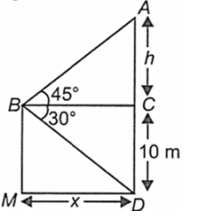
A man is standing on the deck of a ship, which is 10 m above water level. He observes the angle of elevation of the top of a hill as $45^{\circ}$ and the angle of depression of the base of the hill as $30^{\circ}$. Calculate the distance of the hill from the ship and the height of the hill. (use $\sqrt{3}=1.732$ )
  • A
    $17.89 m, 28.32 m$
  • B
    $17.32 m, 27.32 m$
  • C
    $18.32 m, 28.32 m$
  • D
    $8.32 m, 29.22 m$
View full question & answer
MCQ 91 Mark
$\left(\frac{1-\tan ^2 30^{\circ}}{1+\tan ^2 30^{\circ}}\right)$ is equal to:
  • A
    $\sin 60^{\circ}$
  • B
    $\tan 60^{\circ}$
  • C
    $\cos 30^{\circ}$
  • $\cos 60^{\circ}$
Answer
Correct option: D.
$\cos 60^{\circ}$
$\frac{1-\tan ^2 30^{\circ}}{1+\tan ^2 30^{\circ}}=\frac{1-\left(\frac{1}{\sqrt{3}}\right)^2}{1+\left(\frac{1}{\sqrt{3}}\right)^2}$
$=\frac{1-\frac{1}{3}}{1+\frac{1}{3}}$
$=\frac{\frac{2}{3}}{\frac{4}{3}}$
$=\frac{1}{2}$
$=\cos 60^{\circ}$
View full question & answer
MCQ 101 Mark
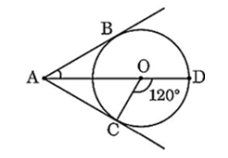
In the given figure $, AC$ and $AB$ are tangents to a circle centered at $O$ . If $\angle COD =120^{\circ}$, then $\angle BAO$ is equal to:
Image
  • $30^{\circ}$
  • B
    $45^{\circ}$
  • C
    $90^{\circ}$
  • D
    $60^{\circ}$
Answer
Correct option: A.
$30^{\circ}$
Explanation:
$\angle ACO =90^{\circ} \ ($angle between radius and tangent$)$
$\angle OAC +\angle ACO =120^{\circ}. \{$Sum of two interior opposite angle is equal to exterior angle $\}$
$\angle OAC+90^{\circ}=120^{\circ}$
$\angle OAC=30^{\circ}$
Now, In $\triangle ACO$ and $\triangle ABO$
$OC=OB \ ($radius$)$
$\angle ACO=\angle ABO=90^{\circ}$
$AC = AB \ ($Length of tangent from external Point$) $
$\therefore \triangle ACO \cong \triangle ABO\ ($by $\text{SAS})$
hence $\angle BAO =\angle CAO =30^{\circ}$
$\therefore \angle BAO=30^{\circ}$
View full question & answer
MCQ 111 Mark
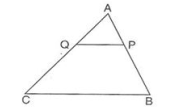
In the adjoining figure $P$ and $Q$ are points on the sides $AB$ and $AC$ respectively of $\triangle \text{ABC}$ such that $\text{AP} =3.5$
$cm , PB =7 \ cm, AQ =3 \ cm, QC =6 \ cm$ and $PQ =4.5 \ cm$. The measure of $BC$ is equal to
Image
  • A
    $9 \ cm$
  • B
    $15 \ cm$
  • C
    $12.5 \ cm$
  • $13.5 \ cm$
Answer
Correct option: D.
$13.5 \ cm$
In $\triangle \text{ABC}$,
$\Rightarrow \frac{AQ}{QC}=\frac{AP}{PB}$
$\Rightarrow \frac{3}{9}=\frac{3.5}{10.5}$
$\Rightarrow \frac{1}{3}=\frac{1}{3}$
Since $\frac{ AQ }{ QC }=\frac{ AP }{ PB }$,
therefore, $\ce{QP \| BC}$
$\therefore \frac{AQ}{AC}=\frac{QP}{BC}$
$\Rightarrow \frac{3}{9}=\frac{4.5}{BC}$
$\Rightarrow BC=13.5 \ cm$
View full question & answer
MCQ 121 Mark
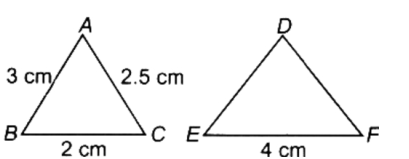
$\triangle \text{ABC}$ is such that $\text{AB} =3 \ cm, \text{BC} =2 \ cm$ and $\text{CA}=2.5 \ cm$. If $\triangle \text{DEF} \sim \triangle \text{ABC}$ and $\text{EF} =4 \ cm$, then perimeter of $\triangle \text{DEF}$ is
  • A
    $30 \ cm$
  • B
    $7.5 \ cm$
  • C
    $22.5 \ cm$
  • $15 \ cm$
Answer
Correct option: D.
$15 \ cm$
Image
Since, $\triangle \text{DEF} \sim \triangle \text{ABC} [$Given$]$
$\Rightarrow \frac{A B}{D E}=\frac{B C}{E F}$
$\Rightarrow \frac{3}{D E}=\frac{2}{4}$
$\Rightarrow DE =6 \ cm$
Also, $\frac{A C}{D F}=\frac{B C}{E F}$
$\Rightarrow \frac{2.5}{D F}=\frac{2}{4}$
$\Rightarrow DF =5 \ cm$
$\therefore$ Perimeter of $\triangle \text{DEF=DE+EF+FD}$
$=6 \ cm+4 \ cm+5 \ cm$
$=15 \ cm$
View full question & answer
MCQ 131 Mark
Two vertices of $\triangle A B C$ are $A(-1,4)$ and $B(5,2)$ and its centroid is $G(0,-3)$. Then, the coordinates of $C$ are
  • A
    $(4,3)$
  • B
    $(4,15)$
  • $(-4,-15)$
  • D
    $(-15,-4)$
Answer
Correct option: C.
$(-4,-15)$
(C) $(-4,-15)$
Explanation: Let the vertex C be $C ( x , y )$. Then $\frac{-1+5+x}{1}=0$ and $\frac{4+2+y}{3}=-3 \Rightarrow x+4=0$ and $6+y=-9$
$\therefore \quad x=-4$ and $y=-15$
so, the coordinates of $C$ are $(-4,-15)$.
View full question & answer
MCQ 141 Mark
$9x^2+12x+4= 0$ have
  • A
    Real and Distinct roots
  • B
    No real roots
  • C
    Distinct roots
  • Real and Equal roots
Answer
Correct option: D.
Real and Equal roots
Comparing the given equation to the below equation
$a x^2+b x+c=0$
$a=9, b=12, c=4$
$D=b^2-4 a c$
$D=12^2-4 \times 9 \times 4$
$D=144-144$
$D=0$
If $b^2-4 a c=0$ then equation have equal and real roots.
View full question & answer
MCQ 151 Mark
The graphs of the equations 6x - 2y +90 and 3x - y + 12 = 0 are two lines which are
  • A
    perpendicular to each other
  • parallel
  • C
    coincident
  • D
    intersecting exactly at one point
Answer
Correct option: B.
parallel
(B) parallel
Explanation: We have,
$
6 x-2 y+9=0
$
And, $3 x - y +12=0$
Here, $a_1=6, b_1=-2$ and $c_1=9$
$a _2=3, b_2=-1$ and $c _2=12$
$\frac{a 1}{a 2}=\frac{6}{3}=\frac{2}{1}, \frac{b 1}{b 2}=\frac{-2}{-1}=\frac{2}{1} \quad$ and $\frac{c_1}{c_2}=\frac{9}{12}=\frac{3}{4}$
Clearly, $\frac{a_1}{a_2}=\frac{b_1}{b_2} \neq \frac{c_1}{c_2}$
Hence, the given system has no solution and the lines are parallel.
View full question & answer
MCQ 161 Mark
The sum of reciprocals of Sharma's age $3$ years ago and $5$ years from now is $\frac{1}{3},$ then his present age is
  • $7$ years
  • B
    $10$ years
  • C
    $6$ years
  • D
    $8$ years
Answer
Correct option: A.
$7$ years
Explanation:
Let Sharma's present age be $x$ years
then, his age $3$ years ago is $(x-3)$ years and $5$ years from now is $(x+5)$ years.
According to question,
$\frac{1}{x-3}+\frac{1}{x+5}=\frac{1}{3}$
$\Rightarrow \frac{x+5+x-3}{(x-3)(x+5)}=\frac{1}{3}$
$\Rightarrow \frac{2 x+2}{x^2+5 x-3 x-15}=\frac{1}{3}$
$\Rightarrow 6 x+6=x^2+2 x-15$
$\Rightarrow x^2-4 x-21=0$
$\Rightarrow x^2-7 x+3 x-21=0$
$\Rightarrow x(x-7)+3(x-7)=0$
$\Rightarrow(x+3)(x-7)=0$
$\Rightarrow x+3=0 $ and $ x-7=0$
$\Rightarrow x=-3 $ and $ x=7$
But $x=-3$ does not satisfy the given condition.
Therefore, Sharma's present age is $7$ years.
View full question & answer
MCQ 171 Mark
If p and q are natural numbers and p is the multiple of q, then what is the HCF of p and q?
  • A
    p
  • q
  • C
    pq
  • D
    p + q
Answer
Correct option: B.
q
(B) q
Explanation:  q is a factor of p . In this case, the highest common factor (HCF) of p and q is q itself because it is the largest number that can evenly divide both $p$ and $q$. Therefore, if $p$ is a multiple of $q$, the HCF of $p$ and $q$ is $q$.
View full question & answer
MCQ 181 Mark
The HCF of the smallest 2-digit number and the smallest composite number is
  • A
    4
  • B
    10
  • C
    20
  • 2
Answer
Correct option: D.
2
(D) 2
Explanation:  Smallest two digit number is 10 and smallest composite number is 4 .
Clearly, 2 is the greatest factor of 4 and 10 , so their H.C.F. is 2 .
View full question & answer
M.C.Q (1 Marks) - Maths STD 10 Questions - Vidyadip