MCQ
$\triangle\text{PQR}\sim\triangle\text{XYZ}$ and the perimeters $\triangle\text{PQR}\sim\triangle\text{XYZ}$ are $30\ cm$ and $18\ cm$ respectively. If $QR = 9\ cm,$ then $,YZ$ is equal to :
  • $5.4\ cm.$
  • B
    $12.5\ cm.$
  • C
    $9.5\ cm.$
  • D
    $4.5\ cm.$

Answer

Correct option: A.
$5.4\ cm.$
Given : $\triangle\text{PQR}\sim\triangle\text{XYZ}$
$\therefore\frac{\text{Permeter of }\triangle\text{PQR}}{\text{Permeter of }\triangle\text{XYZ}}=\frac{\text{QR}}{\text{YZ}}$
$\Rightarrow\frac{30}{18}=\frac{9}{\text{YZ}}$
$\Rightarrow\text{YZ}=5.4\text{ cm}$

Need a full question paper?

Generate a complete, print-ready paper with questions like this in minutes — across 16+ boards, with answer keys.
Start Generating Free

Similar questions

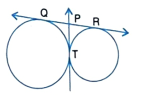
In Fig. $Q R$ is a common tangent to the given circles touching externally at the point $T$. The tangent at $T$ meets $Q R$ at $P$. If $P T=3.8 cm$, then the length of $Q R( in cm )$ is
Image
The distance between the points $(\cos\theta,\sin\theta)$ and $(\sin\theta,-\cos\theta)$ is:
The pair of linear equations $3 x+5 y=3$ and $6 x+k y=8$ do not have a solution, if $k$
Choose the correct answer from the given four options in the following questions: Values of $k$ for which the quadratic equation $2x^2 - kx + k = 0$ has equal roots is:
If in a $ \triangle\text{ABC}, \angle\text{C}=90^\circ$ and $\angle\text{B}=45^\circ,$ then state which of the following is true?
For what value of $k$, do the equations $3 x-y$ $+8=0$ and $6 x-k y=-16$ represent coincident lines?
Choose the correct answer from the given four options:
The abscissa of the point of intersection of the less than type and of the more than type cumulative frequency curves of a grouped data gives its:
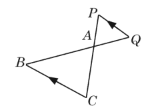
In the given figure, $\triangle \text{ACB} \sim \triangle \text{APQ}$. If $A B=6$
$cm , \text{BC}=8 \ cm$ and $\text{PQ}=4 \ cm$, then $\text{AQ}$ is equal to
Image
If the mean and mode of a frequency distribution be $53.4$ and $55.2$ respectively, then find the median.
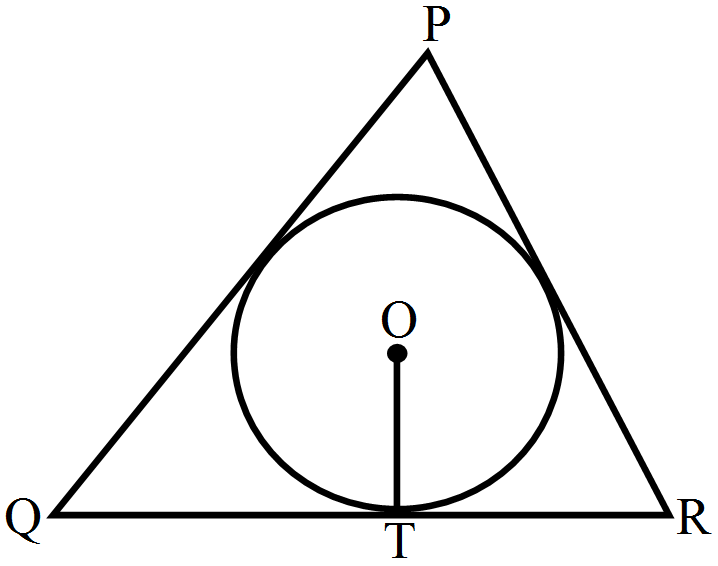
In the given figure, a triangle $\text{PQR}$ is drawn to circumscribe a circle of radius $6\ cm$ such that the segments $QT$ and $TR$ into which $QR$ is divided by the point of contact $T$ are of lengths $12\ cm$ and $9\ cm$ respectively. If the area of $\triangle\text{PQR} = 189 \text{ cm}^2 $ then the length of side $PQ$ is :​​​​​​​