MCQ
True order of bond angle is
  • ${H_2}O > {H_2}S > {H_2}Se > {H_2}Te$
  • B
    ${H_2}Te > {H_2}Se > {H_2}S > {H_2}O$
  • C
    ${H_2}S > {H_2}O > {H_2}Se > {H_2}Te$
  • D
    ${H_2}O > {H_2}S > {H_2}Te > {H_2}Se$

Answer

Correct option: A.
${H_2}O > {H_2}S > {H_2}Se > {H_2}Te$
a
(a) Bond angle decreases from ${H_2}O$ to ${H_2}Te$.

Need a full question paper?

Generate a complete, print-ready paper with questions like this in minutes — across 16+ boards, with answer keys.

Start Generating Free

Similar questions

The concentration of potassium ions inside a biological cell is at least twenty times higher than the outside. The resulting potential difference across the cell is important in several processes such as transmission of nerve impulses and maintaining the ion balance. A simple model for such a concentration cell involving a metal $\mathrm{M}$ is:

$\mathrm{M}(\mathrm{s}) \mid \mathrm{M}^{+}$(aq; $0.05$ molar) || $\mathrm{M}^{+}(\mathrm{aq}), 1$ molar) $\mid \mathrm{M}(\mathrm{s})$

For the above electrolytic cell the magnitude of the cell potential $\left|E_{\text {cell }}\right|=70 \mathrm{mV}$.

$1.$ For the above cell

$(A)$ $\mathrm{E}_{\text {cell }}<0 ; \Delta \mathrm{G}>0$ $(B)$ $\mathrm{E}_{\text {cell }}>0 ; \Delta \mathrm{G}<0$

$(C)$ $\mathrm{E}_{\text {cell }}<0 ; \Delta \mathrm{G}^{\circ}>0$ $(D)$ $\mathrm{E}_{\text {cell }}>0 ; \Delta \mathrm{G}^{\circ}>0$

$2.$ If the $0.05$ molar solution of $\mathrm{M}^{+}$is replaced by $0.0025$ molar $\mathrm{M}^{+}$solution, then the magnitude of the cell potential would be

$(A)$ $35 \mathrm{mV}$ $(B)$ $70 \mathrm{mV}$ $(C)$ $140 \mathrm{mV}$ $(D)$ $700 \mathrm{mV}$

Give the answer question $1,2.$ 
$C{H_3} - C{H_2} - CH = O\,\xrightarrow[{(2)\,\,{H^ \oplus }}]{{(1)\,\,{\text{Tollen's reagent}}}}X$ $\,\xrightarrow[{(2)\,\,{\text{drydistillation}}}]{{(1)\,Ca{{(OH)}_2}}}\,Y$ ; $Y$ is
In a nucleotide the phosphate linkage is generally attached to -
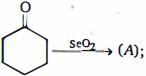
Product $(A)$ of the reaction is
$ \wedge _m^o$ for $NaCl,\,HCl$ and $NaA$ are $126.4,\,425.9$ and $100.5\,\,S\,cm^2\,mol^{-1},$ respectively. If the conductivity of $0.001\,M\,HA$ is $5\times 10^{-5}\,S\,cm^{-1},$  degree of dissociation of $HA$ is
The reaction of phenol with benzoyl chloride to give phenyl benzoate is known as
Using the data given in find out in which option the order of reducing power is correct.
$\text{E}^\ominus_{\text{cr}_2\text{O}^{2-}_7/\text{cr}^{3+}}=1.33\text{V}\ \ \ \text{E}^\ominus_{\text{Cl}_2/\text{Cl}^-}=1.36\text{V}$
$\text{E}^\ominus_{\text{MnO}^-_4/\text{Mn}^{2+}}=1.51\text{V}\ \ \ \ \text{E}^\ominus_{\text{Cr}^{3+}/\text{Cr}}=-0.74\text{V}$
Which of the following represents heat of formation of the product
Reaction by which benzaldehyde cannot be prepared
The process by which synthesis of protein takes place based on the genetic information present in $m - RNA$ is called