MCQ
Trunbull's blue is a compound
  • A
    Ferricyanide
  • Ferrous ferricyanide
  • C
    Ferrous cyanide
  • D
    Ferriferrocyanide

Answer

Correct option: B.
Ferrous ferricyanide
b
(b) Turnbull’s blue is $K\{ F{e^{{\rm{II}}}}[F{e^{{\rm{III}}}}{(CN)_6}]\} $.

Need a full question paper?

Generate a complete, print-ready paper with questions like this in minutes — across 16+ boards, with answer keys.

Start Generating Free

Similar questions

Which of the following is non-ionizable ?
Acetic anhydride is obtained from acetyl chloride by the reaction of
Consider the van der Waals constants, $a$ and $b$, for the following gages,

gas $Ar$ $Ne$ $Kr$ $Xe$
$a /\left( atm \,dm ^{6} \,mol ^{-2}\right)$ $1.3$ $0.2$ $5.1$ $4.1$
$b /\left(10^{-2} \,dm ^{3}\, mol ^{-1}\right)$ $3.2$ $1.7$ $1.0$ $5.0$

Which gas is expected to have the highest critical temperature? 
Given below are two statement one is labeled as 
Assertion (A) and the other is labeled as Reason (R). 
Assertion (A): $CH _2$. = CH – CH2 – Cl is an example of allyl halide 
Reason (R): Allyl halides are the compounds in which the halogen atom is attached to $sp ^2$ hybridised carbon atom.
In the light of the two above statements, choose the most appropriate answer from the options given below: 
The tetrahedral $[CoI_4]^{2-}$ and square planar $[PdBr_4]^{2-}$ complex ions are respectively
Given that bond energies of $H - H$ and $Cl - Cl$ are $430\ kJ\ mol^{-1}$ and $240\ kJ\ mol^{-1}$ respectively and $\Delta H_f$ for $HCl$ is $-90\ kJ\ mol^{-1},$ bond enthalpy of $HCl$ is ............... $\mathrm{kJ \,mol}^{-1}$
Which of the following is dependent on temperature ?
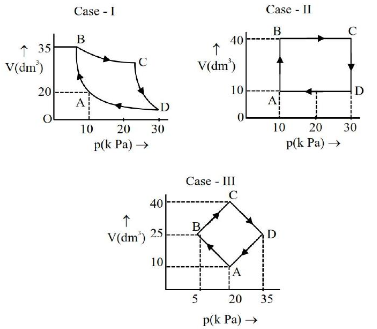
Image
An ideal gas undergoes a cyclic transformation starting from the point A and coming back to the same point by tracing the path $\mathrm{A} \rightarrow \mathrm{B} \rightarrow \mathrm{C} \rightarrow \mathrm{D} \rightarrow \mathrm{A}$ as shown in the three cases above.
Choose the correct option regarding $\Delta \mathrm{U}$.
How many mole of helium gas occupy $22.4\;L$ at ${0^o}C$ at $1$ atm. pressure
Number of unpaired electrons in $M{n^{2 + }}$ is