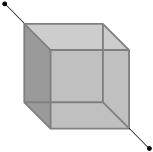
Twelve wires of equal length and same cross-section are connected in the form of a cube. If the resistance of each of the wires is $R$, then the effective resistance between the two diagonal ends would be
Medium


Download our appand get started for free
Experience the future of education. Simply download our apps or reach out to us for more information. Let's shape the future of learning together!No signup needed.*
Similar Questions
- 1A galvanometer of resistance, $G,$ is connected in a circuit. Now a resistance $R$ is connected in series of galvanometer. To keep the main current in the circuit unchanged, the resistance to be put in parallel with the series combination of $G$ and $R$ isView Solution
- 2A horizontal conductor is oriented north south and carries some current. $A$ positively charged particle located vertically above it and having a velocity directed north ward experiences an upward force.What is the direction of the force if this charged particle were located to the east of the conductor and had a velocity directed towards the conductorView Solution
- 3An electric current is passed through a circuit containing two wires of the same material, connected in parallel. If the lengths and radii of the wires are in the ratio of $4/3$ and $2/3$, then the ratio of the currents passing through the wire will beView Solution
- 4View SolutionWhich of the following is vector quantity
- 5The electric resistance of a certain wire of iron is $R$. If its length and radius are both doubled, thenView Solution
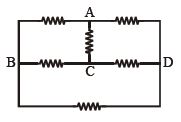
- 6View SolutionIn the following circuit composed of identical resistors, across which terminals would you connect a battery in order to dissipate energy in all resistors
- 7A $1\,m$ long wire is broken into two unequal parts $X$ and $Y$ The $X$ part of the wire is streched into another wire $W$. Length of $W$ is twice the length of $X$ and the resistance of $W$ is twice that of $Y$. Find the ratio of length of $X$ and $Y$.View Solution
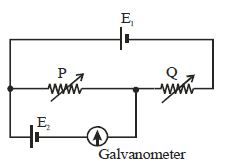
- 8Two cells of $e.m.f.$ $s\, E_1$ and $E_2$ and of negligible internal resistances are connected with two variable resistors as shown in Fig. When the galvanometer shows no deflection, the values of the resistances are $P$ and $Q$. What is the value of the ratio $E_2/E_1$ ?View Solution
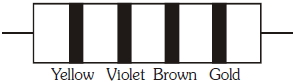
- 9View SolutionThe color code of a resistance is given below
The values of resistance and tolerance, respectively, are :
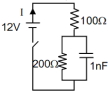
- 10Find the charge in steady state of the capacitor. (in $nC)$View Solution