Question
Two arithmetic progression have the same common difference. The difference between their $100^{\text {th }}$ terms is 100 , What is the difference between their $1000^{\text {th }}$ terms?

Answer

Let the two A.P. is be $a _1, a _2, a _3, \ldots .$. and $b _1, b_2, b_3, \ldots .$.
$a_n=a_1+(n-1) d \text { and } b_n=b_1+(n-1) d$
Since common difference of two equations is same given difference between $100^{\text {th }}$ terms is $100$
$a_{100} - b_{100} = 100$
$a_1 + (99) d - b_1 - 99d = 100$
$a_1 - b_1 = 100 .....(i)$
Difference between. 1000th terms is
$a_{1000} - b_{1000} = a_1 + (1000 - 1)d - (b_1 + (1000 - 1)d)$
$= a_1 + 999d - b_1 - 999d$
$= a_1 - b_1$
$= 100$ (from (1))
$\therefore$ Hence difference between $1000^{\text {th }}$ terms of two $A.P$. is $100.$

Need a full question paper?

Generate a complete, print-ready paper with questions like this in minutes — across 16+ boards, with answer keys.
Start Generating Free

Similar questions

All the vertices of a rhombus lie on a circle. Find the area of the rhombus$,$ if area of the circle is $1256\ cm^2. (\text{Use }\pi=3.14)$
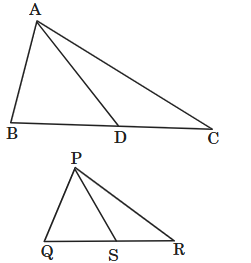
In the given figure $\triangle A B D \sim \triangle P Q S$ when $A D$ and $P S$ are medians. Prove that $\triangle A B C \sim \triangle P Q R$.
Image
A group consists of 12 persons, of which 3 are extremely patient, other 6 are extremely honest and rest are extremely kind. A person from the group is selected at random. Assuming that each persion is equally likely to be selected, find the probability of selecting a person who is:
  1. Extermely patient.
  2. Extremely kind or honest. Which of the above values you prefer more.
Find the value of a and b for which the following systems of linear equations has an infinite number of solutions:
$2x + 3y = 7,$
$(a + b + 1)x + (a + 2b + 2)y = 4(a + b) + 1$

Find the sum of $7 + 10\frac{1}{2} + 14..... + 84$.

Compute the arithmetic mean for the following data:
Marks ObtainedNumber of students
Below 1014
Below 2022
Below 3037
Below 4058
Below 5067
Below 6075
Two cubes each of volume $27cm^3$​​​​​​​ are joined end to end to form a solid. Find the surface area of the resulting cuboid.
A bag contains 5 black, 7 red and 3 white balls. A ball is drawn from the bag at random. Find the probability that the ball drawn is:
  1. Red.
  2. Black or white.
  3. Not black.
Prove that: $\frac{1}{\operatorname{cosec} A-\cot A}-\frac{1}{\sin A}=\frac{1}{\sin A}-\frac{1}{\operatorname{cosec} A+\cot A}$.
Verify that each of the following is an AP, and then write its next three terms: $0,\frac{1}{4},\frac{1}{2},\frac{3}{4},.....$