Question
Two audio speakers are kept some distance apart and are driven by the same amplifier system. A person is sitting at a place 6.0m from one of the speakers and 6.4m from the other. If the sound signal is continuously varied from 500Hz to 5000Hz, what are the frequencies for which there is a destructive interference at the place of the listener? Speed of sound in air = 320m/s.

Answer

The path difference of the two sound waves is given by

$\triangle\text{L}=6.4-6.0=0.4\text{m}$

The wavelength of either wave = $\lambda=\frac{\text{V}}{\rho}=\frac{320}{\rho}(\text{m/s})$

For destructive interference $\triangle\text{L}=\frac{(2\text{n}+1)\lambda}{2}$ where n is an integers.

Or $0.4\text{m}=\frac{2\text{n}+1}{2}\times\frac{320}{\rho}$

$\Rightarrow\rho=\text{n}=\frac{320}{0.4}=800\frac{2\text{n}+1}{2}\text{Hz}=(2\text{n}+1)400\text{Hz}$

Thus the frequency within the specified range which cause destructive interference are 1200Hz, 2000Hz, 2800Hz, 3600Hz and 4400Hz.

Need a full question paper?

Generate a complete, print-ready paper with questions like this in minutes — across 16+ boards, with answer keys.

Start Generating Free

Similar questions

Two pendulums with identical bobs and lengths are suspended from a common support such that in rest position the two bobs are in contact. One of the bobs is released after being displaced by 10° so that it collides elastically head-on with the other bob.

  1. Describe the motion of two bobs.
  2. Draw a graph showing variation in energy of either pendulum with time, for  where T is the period of each pendulum.
Two cylindrical hollow drums of radii R and 2R, and of a common height h, are rotating with angular velocities $\omega$ (anti-clockwise) and $\omega$ (clockwise), respectively. Their axes, fixed are parallel and in a horizontal plane separated by $(3\text{R}+\delta).$ They are now brought in contact $(\delta\rightarrow0){:}$
  1. Show the frictional forces just after contact.
  2. Identify forces and torques external to the system just after contact.
  3. What would be the ratio of final angular velocities when friction ceases?
Define surface tension and surface energy. Write units and dimensions of surface tension. Also prove that surface energy numerically equal to the surface tension.
Find the centre of mass of a uniform:
  1. Half-disc.
  2. Quarter-disc.
An artificial satellite is revolving around a planet of mass M and radius R, in a circular orbit of radius r. From Kepler’s Third law about the period of a satellite around a common central body, square of the period of revolution T is proportional to the cube of the radius of the orbit r. Show using dimensional analysis, that $\text{T}=\frac{\text{k}}{\text{R}}\sqrt{\frac{\text{r}^3}{\text{g}}},$ where k is a dimensionless constant and g is acceleration due to gravity.
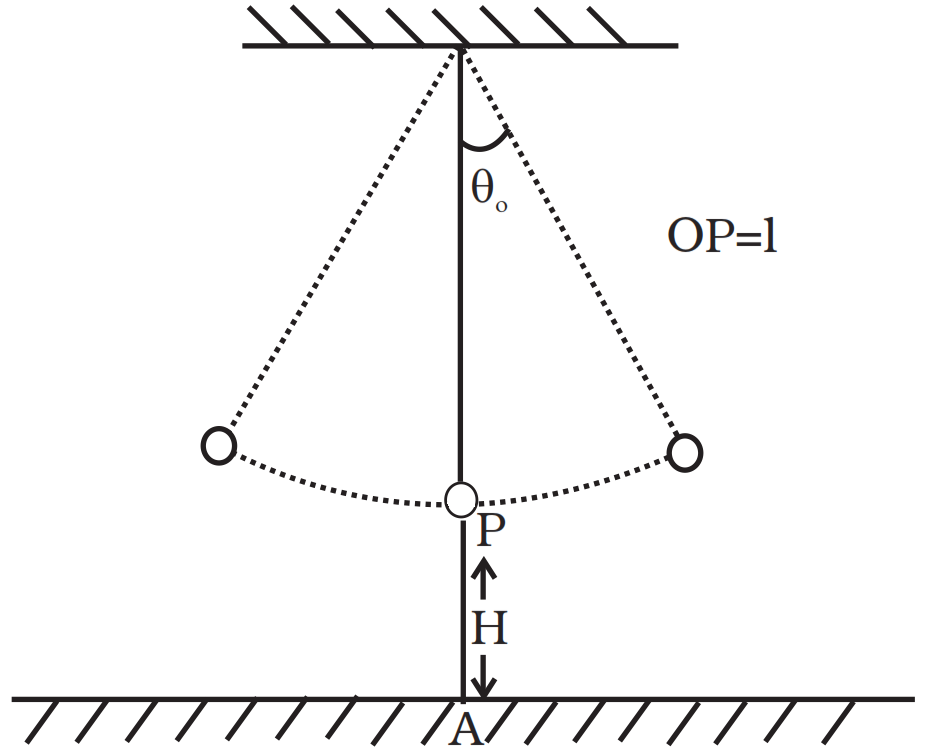
A simple pendulum of time period 1s and length l is hung from a fixed support at O, such that the bob is at adistance H vertically above A on the ground The amplitude is $\theta$ The string snaps at $\theta=\frac{\theta_0}{2}$ Find the time taken by the bob to hit the ground. Also find distance from A where bob hits the ground. Assume θ to be small so that $\sin\theta_0\ \text{and}\ \cos\theta_0=1.$

Consider the situation of the previous problem. Suppose the block of mass m1 is pulled by a constant force F1 and the other block is pulled by a constant force F2. Find the maximum elongation that the spring will suffer.
What do you mean by the term "equilibrium"? What are equilibrium of rest and equilibrium of motion? State the conditions for complete equilibrium of a body.
Consider a uniformly charged ring of radius R. Find the point on the axis where the electric field is maximum.
A faulty barometer contains certain amount of air and saturated water vapour. It reads 74.0cm when the atmospheric pressure is 76.0cm of mercury and reads 72.10cm when the atmospheric pressure is 74.0cm of mercury. Saturation vapour pressure at the air temperature = 1.0cm of mercury. Find the length of the barometer tube above the mercury level in the reservoir