Question
Two bad eggs are accidently mixed up with ten good ones. Three eggs are drawn at random with replacement from this lot. Compute the mean for the number of bad eggs drawn.

Answer

Let X denote the number of bad eggs in a sample of 3 eggs drawn from a lot containing 2 bad eggs and 10 good eggs. Then, X can take the values 0, 1 and 2. P(X = 0) = P(no bad egg) $=\frac{\text{}^{10}\text{C}_3}{\text{}^{12}\text{C}_3}$ $=\frac{120}{220}$ $=\frac{6}{11}$ P(X = 1) = P(1 bad egg) $=\frac{\text{}^{2}\text{C}_1\times\text{}^{10}\text{C}_2}{\text{}^{12}\text{C}_3}$ $=\frac{90}{220}$ $=\frac{9}{22}$ P(X = 2) = P(2 bad eggs) $=\frac{\text{}^{2}\text{C}_2\times\text{}^{10}\text{C}_1}{\text{}^{12}\text{C}_3}$ $=\frac{10}{220}$ $=\frac{1}{22}$ Thus, the probability distribution of X is given by
$\text{X}$ $\text{P}(\text{X})$
$0$ $\frac{6}{11}$
$1$ $\frac{9}{22}$
$2$ $\frac{1}{22}$
Computation of mean
$\text{x}_\text{i}$ $\text{p}_\text{i}$ $\text{x}_\text{i}\text{p}_\text{i}$
$0$ $\frac{6}{11}$ $0$
$1$ $\frac{9}{22}$ $\frac{9}{22}$
$2$ $\frac{1}{22}$ $\frac{1}{11}$
    $\sum\text{p}_\text{i}\text{x}_\text{i}=\frac{1}{2}$
Mean $=\sum\text{p}_\text{i}\text{x}_\text{i}=\frac{1}{2}$

Need a full question paper?

Generate a complete, print-ready paper with questions like this in minutes — across 16+ boards, with answer keys.
Start Generating Free

Similar questions

Prove that:
$\begin{vmatrix}\text{a}+\text{b}+2\text{c}&\text{a}&\text{b}\\\text{c}&\text{b}+\text{c}+2\text{a}&\text{b}\\\text{c}&\text{a}&\text{c}+\text{a}+2\text{b} \end{vmatrix}=2(\text{a}+\text{b}+\text{c})^3$
Evaluate the following integrals:$\int\frac{5\text{x}-2}{1+2\text{x}+3\text{x}^2}\text{ dx}$
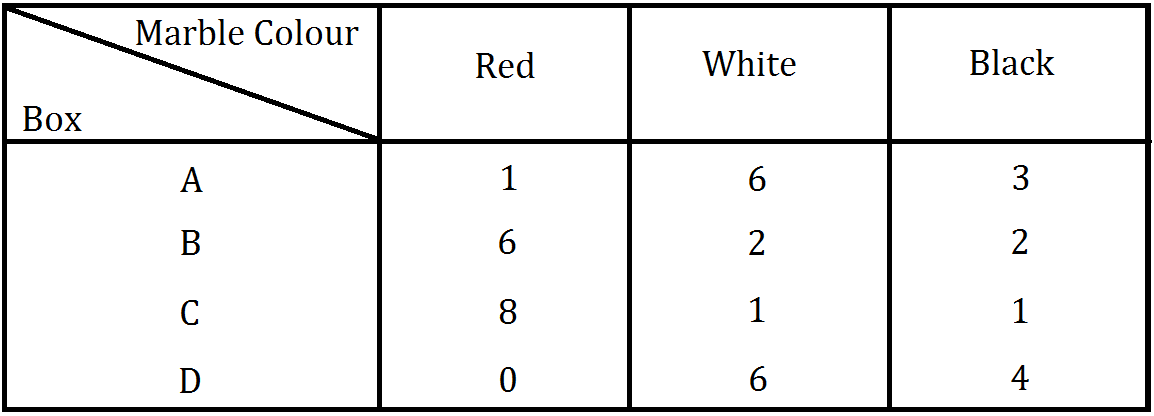
Suppose we have four boxes A, B, C, D containing coloured marbles as given below:
One of the boxes has been selected at random and a single marble is drawn from it. If the marble is red, what is the probability that it was drawn from,
  1. Box A?
  2. Box B?
  3. Box C?
Solve the following differential equation:
$\text{x}\frac{\text{dy}}{\text{dx}}-\text{y}=2\sqrt{\text{y}^2-\text{x}^2}$
Prove that:
$\begin{vmatrix}\text{z}&\text{x}&\text{y}\\\text{z}^2&\text{x}^2&\text{y}^2\\\text{z}^4&\text{x}^4&\text{y}^4 \end{vmatrix}=\begin{vmatrix}\text{x}&\text{y}&\text{z}\\\text{x}^2&\text{y}^2&\text{z}^2\\\text{x}^4&\text{y}^4&\text{z}^4 \end{vmatrix}=\begin{vmatrix}\text{x}^2&\text{y}^2&\text{z}^2\\\text{x}^4&\text{y}^4&\text{z}^2\\\text{x}&\text{y}&\text{z}\end{vmatrix}$
$=\text{xyz}(\text{x}-\text{y})(\text{y}-\text{z})(\text{z}-\text{x})(\text{x}+\text{y}+\text{z}).$
Find the particular solution of the following differential equations:

$y(1+\log x)=(\log x x) \frac{d y}{d x}$, when $y(e)= e ^2$

Solve the following system of equations by matrix method:
$3x + y = 7$
$5x + 3y = 12$
Show that $\text{f(x)}=|\cos\text{x}|$ is a continuous function.
If $x \sqrt{1-y^2}+y \sqrt{1-x^2}=1$, then show that $\frac{d y}{d x}=-\sqrt{\frac{1-y^2}{1-x^2}}$
Evaluate the following integrals:$\int^\limits{\frac{\pi}{6}}_{0}\cos^{-3}2\theta\sin2\theta\text{ d}\theta$