Question
Two balls at same temperature collide. What is conserved

Answer

(d) When two balls at the same temprature collide, some fraction of their $K E$ appears in other forms of energy, like heat energy, second energy. Hence neither temparture, nor velocity or $K E$ will remain conserved. The only quantity which will remain conserved. The only quantity which will remain conserved. The only quantity which will remain conserved is their momentum.

Need a full question paper?

Generate a complete, print-ready paper with questions like this in minutes — across 16+ boards, with answer keys.

Start Generating Free

Similar questions

If the magnetic field of a plane electromagnetic wave is given by (The speed of light $ = 3 \times {10^8}\,m/s$ )

$B = 100 \times {10^{ - 6}}\,\sin \,\left[ {2\pi  \times 2 \times {{10}^{15}}\,\left( {t - \frac{x}{c}} \right)} \right]$ 

then the maximum electric field associated with it is
A cylindrical capacitor has two co-axial cylinders of length $20 \,cm$ and radii $2 r$ and $r$. Inner cylinder is given a charge $10 \,\mu C$ and outer cylinder a charge of $-10 \,\mu C$. The potential difference between the two cylinders will be
In case of hydrogen and oxygen at $N.T.P.$, which of the following quantities is $/$ are the same?
Two vessels $A$ and $B$ are of the same size and are at same temperature. A contains $1 \mathrm{~g}$ of hydrogen and $B$ contains $1 \mathrm{~g}$ of oxygen. $\mathrm{P}_{\mathrm{A}}$ and $\mathrm{P}_{\mathrm{B}}$ are the pressures of the gases in $A$ and $\mathrm{B}$ respectively, then $\frac{\mathrm{P}_{\mathrm{A}}}{\mathrm{P}_{\mathrm{B}}}$ is:
A laser is a coherent source because it contains
An automobile moves on a road with a speed of $54 \,km h^{-1}.$ The radius of its wheels is $0.45\, m$ and the moment of inertia of the wheel about its axis of rotation is $3\, kg m^2$. If the vehicle is brought to rest in $15\, s,$ the magnitude of average torque transmitted by its brakes to the wheel is .......... $kg \,m^2\, s^{-2}$.
Train A is moving along two parallel rail tracks towards north with speed $72 \mathrm{~km} / \mathrm{h}$ and train B is moving towards south with speed $108 \mathrm{~km} / \mathrm{h}$. Velocity of train $B$ with respect to $A$ and velocity of ground with respect to $B$ are (in $\mathrm{ms}^{-1}$ ):
In an industrial process $10\, kg$ of water per hour is to be heated from $20°C$ to $80°C$. To do this steam at $150°C$ is passed from a boiler into a copper coil immersed in water. The steam condenses in the coil and is returned to the boiler as water at $90°C.$ how many $kg$ of steam is required per hour. $($Specific heat of steam $= 1$ $calorie \,per\, gm°C,$ Latent heat of vaporisation $= 540 \,cal/gm)$
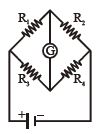
The resistances in $WSB$ circuit shown in the diagram all are different and the current through the galvanometer is zero. If all thermal effects are negligible, the current through the galvanometer will not be zero, when
The density of a material in $SI\, units$ is $128\, kg\, m^{-3}$. In certain units in which the unit of length is $25\, cm$ and the unit of mass $50\, g$, the numerical value of density of the material is