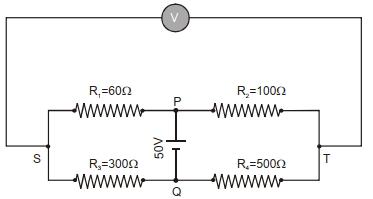
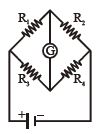
The resistances in $WSB$ circuit shown in the diagram all are different and the current through the galvanometer is zero. If all thermal effects are negligible, the current through the galvanometer will not be zero, when
Easy
Download our app for free and get started

Download our appand get started for free
Experience the future of education. Simply download our apps or reach out to us for more information. Let's shape the future of learning together!No signup needed.*
Similar Questions
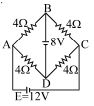
- 1The given figure shows $a$ network of resistances and $a$ battery. Identify the correct statement $(s)$View Solution
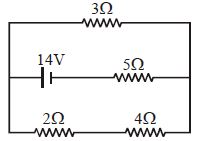
- 2Find out current in $3\,\Omega $ resistance in given circuitView Solution
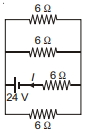
- 3Current $I$ in the network shown in figure is .......... $A$View Solution
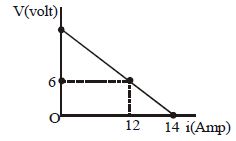
- 4$10\, Cells$, each of $emf$ $'E'$ and internal resistance $'r'$, are connected in series to a variable external resistance. Figure shows the variation of terminal potential difference of their combination with the current drawn from the combination.$Emf$ of each cell is ................ $V$View Solution
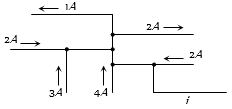
- 5The figure here shows a portion of a circuit. What are the magnitude and direction of the current i in the lower right-hand wire .................... $A$View Solution
- 6View SolutionThe net resistance of a voltmeter should be large to ensure that
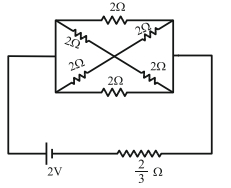
- 7In the following circuit, the battery has an emf of $2\mathrm{V}$ and an internal resistance of $\frac{2}{3}\ \Omega$. The power consumption in the entire circuit is$..... W.$View Solution
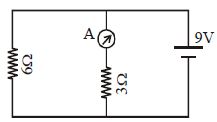
- 8In the figure shown, if the internal resistance of the battery is $1\, ohm$ , the reading of the ammeter will be ................. $\mathrm{A}$View Solution
- 9A battery has $e.m.f.$ $4\, V$ and internal resistance $r$. When this battery is connected to an external resistance of $2\, ohms$, a current of $1\, amp$. flows in the circuit. How much current will flow if the terminals of the battery are connected directly .......... $amp$View Solution
- 10In the balanced condition, the values of the resistances of the four arms of a Wheatstone bridge are shown in the figure below. The resistance $R_3$ has temperature coefficient $0.0004{ }^{\circ} C ^{-1}$. If the temperature of $R_3$ is increased by $100{ }^{\circ} C$, the voltage developed between $S$ and $T$ will be. . . . . . . volt.View Solution