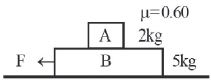
Two block $(A)\,2\,kg$ and $(B)\,5\,kg$ rest one over the other on a smooth horizontal plane. The cofficient of static and dynamic friction between $(A)$ and $(B)$ is the same and equal to $0.60$. The maximum horizontal force that can be applied to $(B)$ in order that both $(A)$ and $(B)$ do not have any relative motion : $(g = 10\,m/s^2)$
Medium


Download our appand get started for free
Experience the future of education. Simply download our apps or reach out to us for more information. Let's shape the future of learning together!No signup needed.*
Similar Questions
- 1A block of mass $2 kg$ slides down an incline plane of inclination $30^o$. The coefficient of friction between block and plane is $0.5$. The contact force between block and plank is :View Solution
- 2A particle has initial velocity $10\,\, m/s$. It moves due to constant retarding force along the line of velocity which produces a retardation of $5\,\, m/s^2$. ThenView Solution
- 3A block of mass $m$ is moving with a constant acceleration a on a rough plane. If the coefficient of friction between the block and ground is $\mu $, the power delivered by the external agent after a time $t$ from the beginning is equal toView Solution
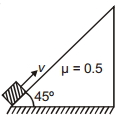
- 4A block of mass $1 \,kg$ is projected from the lowest point up along the inclined plane. If $g=10 \,ms ^{-2}$, the retardation experienced by the block is ............. $ms ^ {-2}$View Solution
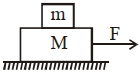
- 5Two blocks $( m =0.5\, kg$ and $M =4.5\, kg$ ) are arranged on a horizontal frictionless table as shown in figure. The coefficient of static friction between the two blocks is $\frac{3}{7} .$ Then the maximum horizontal force that can be applied on the larger block so that the blocks move together is ......... $N.$ (Round off to the Nearest Integer) [Take g as $9.8\, ms ^{-2}$ ]View Solution
- 6A stone of mass of $16\, kg$ is attached to a string $144 \,m$ long and is whirled in a horizontal circle. The maximum tension the string can withstand is $16$ Newton. The maximum velocity of revolution that can be given to the stone without breaking it, will be ....... $ms^{-1}$View Solution
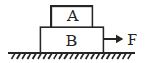
- 7In figure, the coefficient of friction between the floor and the block $B$ is $0.1$. The coefficient of friction between the blocks $B$ and $A$ is $0.2$. The mass of $A$ is $\frac{m}{2}$ and of $B$ is $m$. ........ $mg$ is the maximum horizontal force $F$ can be applied to the block $B$ so that two blocks move together ?View Solution
- 8A train is moving with a speed of $12 \mathrm{~m} / \mathrm{s}$ on rails which are $1.5 \mathrm{~m}$ apart. To negotiate a curve radius $400 \mathrm{~m}$, the height by which the outer rail should be raised with respect to the inner rail is (Given, $g=$ $10 \mathrm{~m} / \mathrm{s}^2$ ) :View Solution
- 9A particle is moving along the circle $x^2 + y^2 = a^2$ in anti clock wise direction. The $x-y$ plane is a rough horizontal stationary surface. At the point $(a\, cos\theta , a\, sin\theta )$, the unit vector in the direction of friction on the particle is:View Solution
- 10A body is pulled along a rough horizontal surface with a velocity $6\,m/s$. If the body comes to rest after travelling $9\,m$ , then coefficient of sliding friction, is- (Take $g = 10\,m/s^2$ )View Solution