A train is moving with a speed of $12 \mathrm{~m} / \mathrm{s}$ on rails which are $1.5 \mathrm{~m}$ apart. To negotiate a curve radius $400 \mathrm{~m}$, the height by which the outer rail should be raised with respect to the inner rail is (Given, $g=$ $10 \mathrm{~m} / \mathrm{s}^2$ ) :
JEE MAIN 2024, Difficult
Download our app for free and get started
$\tan \theta=\frac{\mathrm{v}^2}{\mathrm{Rg}}=\frac{12 \times 12}{10 \times 400}$
$ \tan \theta=\frac{\mathrm{h}}{1.5} $
$ \Rightarrow \frac{\mathrm{h}}{1.5}=\frac{144}{4000} $
$ \mathrm{~h}=5.4 \mathrm{~cm}$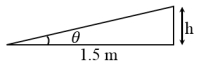

Download our appand get started for free
Experience the future of education. Simply download our apps or reach out to us for more information. Let's shape the future of learning together!No signup needed.*
Similar Questions
- 1A road is banked at an angle of $30^o$ to the horizontal for negotiating a curve of radius $10\sqrt 3 m$. At what velocity will a car experience no friction while negotiating the curve? ............... $km/hr$View Solution
- 2A box of mass $m\, kg$ is placed on the rear side of an open truck accelerating at $4\, m/s^2$. The coefficient of friction between the box and the surface below it is $0.4$. The net acceleration of the box with respect to the truck is zero. The value of $m$ is :- $[g = 10\,m/s^2]$View Solution
- 3A block of wood resting on an inclined plane of angle $30^o$, just starts moving down. If the coefficient of friction is $0.2$, its velocity (in $ms^{-1}$) after $5\, seconds$ is : $(g = 10\, ms^{-2})$View Solution
- 4A sphere of mass $m$ is set in motion with initial velocity $v_o$ on a surface on which $kx^n$ is the frictional force with $k$ and $n$ as the constants and $x$ as the distance from the point of start. Find the distance in which sphere will stopView Solution
- 5View SolutionOn a railway curve, the outside rail is laid higher than the inside one so that resultant force exerted on the wheels of the rail car by the tops of the rails will
- 6A block is kept on an inclined plane of inclination $\theta$ of length l. The velocity of particle at the bottom of inclined is (the coefficient of friction is $\mu$)View Solution
- 7A boy on a cycle pedals around a circle of $20\, metres$ radius at a speed of $20\,metres/\sec .$ The combined mass of the boy and the cycle is $90\, kg$. The angle that the cycle makes with the vertical so that it may not fall is ......... $^o$ $(g = 9.8\,m/{\sec ^2})$View Solution
- 8An isolated rail car originally moving with speed $v_0$ on a straight, frictionles, level track contains a large amount of sand. $A$ release valve on the bottom of the car malfunctions, and sand begins to pour out straight down relative to the rail car. What happens to the speed of the rail car as the sand pours out?View Solution
- 9The normal reaction $'{N}^{\prime}$ for a vehicle of $800\, {kg}$ mass, negotiating a turn on a $30^{\circ}$ banked road at maximum possible speed without skidding is $...\,\times 10^{3}\, {kg} {m} / {s}^{2}$ [Given $\left.\cos 30^{\circ}=0.87, \mu_{{s}}=0.2\right]$View Solution
- 10A block weighs $W$ is held against a vertical wall by applying a horizontal force $F$. The minimum value of $F$ needed to hold the block is $[\mu < 1]$View Solution