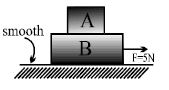
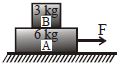
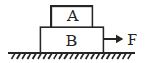
Two blocks $A$ and $B$ of masses $6\, kg$ and $3\, kg$ rest on a smooth horizontal surface as shown in the figure. If coefficient of friction between $A$ and $B$ is $0.4$, the maximum horizontal force which can make them without separation is ........ $N$
Medium
Download our app for free and get started
Frictional force on block $B$
$=\mu \mathrm{m}_{\mathrm{B}} \mathrm{g}=0.4 \times 3 \times 10=12 \mathrm{N}$
Hence, acceleration $=\frac{12}{3}=4 \mathrm{ms}^{-2}$
Hence, maximum force
$\mathrm{F}=\left(\mathrm{m}_{\mathrm{A}}+\mathrm{m}_{\mathrm{B}}\right) \mathrm{a}=(6+3) \times 4=36 \mathrm{N}$

Download our appand get started for free
Experience the future of education. Simply download our apps or reach out to us for more information. Let's shape the future of learning together!No signup needed.*
Similar Questions
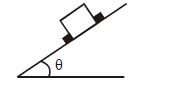
- 1A railway line is taken round a circular arc of radius $1000\ m$, and is banked by raising the outer rail $h\ m$ above the inner rail. If the lateral force on the inner rail when a train travels round the curve at $10 \ ms^{-1}$ is equal to the lateral force on the outer rail when the train's speed is $20\ ms^{-1}$. The value of $4g\ tan\theta$ is equal to : (The distance between the rails is $1.5 \ m$).View Solution
- 2A body of mass $1\, kg$ tied to one end of string is revolved in a horizontal circle of radius $0.1\, m$ with a speed of $3$ revolution/sec, assuming the effect of gravity is negligible, then linear velocity, acceleration and tension in the string will beView Solution
- 3View SolutionThe force required to keep a body in uniform circular motion is
- 4$Assertion$ : Mountain roads rarely go straight up the slope.View Solution
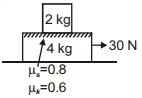
$Reason$ : Slope of mountains are large, therefore more chances of vehicle to slip from roads - 5Figure shows two block system, $4 \,kg$ block rests on a smooth horizontal surface, upper surface of $4 \,kg$ is rough. A block of mass $2 \,kg$ is placed on its upper surface. The acceleration of upper block with respect to earth when $4 \,kg$ mass is pulled by a force of $30 \,N$, is ......... $m / s ^2$View Solution
- 6A vehicle of mass $200\,kg$ is moving along a levelled curved road of radius $70\,m$ with angular velocity of $0.2\,rad / s$. The centripetal force acting on the vehicle is $.........\,N$View Solution
- 7A rope of length $L$ and mass $M$ is being pulled on a rough horizontal floor by a constant horizontal force $F$ = $Mg$ . The force is acting at one end of the rope in the same direction as the length of the rope. The coefficient of kinetic friction between rope and floor is $1/2$ . Then, the tension at the midpoint of the rope isView Solution
- 8In figure, the coefficient of friction between the floor and the block $B$ is $0.1$. The coefficient of friction between the blocks $B$ and $A$ is $0.2$. The mass of $A$ is $\frac{m}{2}$ and of $B$ is $m$. ........ $mg$ is the maximum horizontal force $F$ can be applied to the block $B$ so that two blocks move together ?View Solution
- 9A body of mass $10$ kg slides along a rough horizontal surface. The coefficient of friction is $1/\sqrt 3 $. Taking $g = 10\,m/{s^2}$, the least force which acts at an angle of $30^o $ to the horizontal is ...... $N$View Solution
- 10In the shown arrangement mass of $A = 1\,\,kg$ mass of $B = 2\,\,kg.$ Coefficient of friction between $A $ and $B = 0.2.$ There is no friction between $B$ and ground. The frictional force exerted by $A$ on $B$ equals toView Solution