A rope of length $L$ and mass $M$ is being pulled on a rough horizontal floor by a constant horizontal force $F$ = $Mg$ . The force is acting at one end of the rope in the same direction as the length of the rope. The coefficient of kinetic friction between rope and floor is $1/2$ . Then, the tension at the midpoint of the rope is
Difficult
Download our app for free and get started
$a=\frac{F-\mu N}{M}=\frac{M g-0.5 M g}{M}=g / 2$
$\mathrm{T}-\mu \mathrm{Mg} / 2=\mathrm{Ma} / 2$
$\mathrm{T}-\mathrm{mg} / 4=\mathrm{Mg} / 4 \Rightarrow \mathrm{T}=\mathrm{Mg} / 2$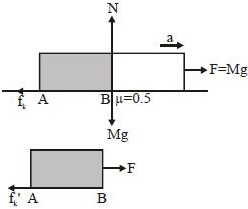

Download our appand get started for free
Experience the future of education. Simply download our apps or reach out to us for more information. Let's shape the future of learning together!No signup needed.*
Similar Questions
- 1A block of mass $10\, kg$ is placed on an inclined plane. When the angle of inclination is $30°$, the block just begins to slide down the plane. The force of static friction is ....... $kg\, wt$View Solution
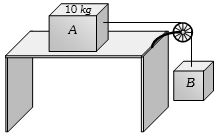
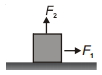
- 2In the figure shown, horizontal force $F_1$ is applied on a block but the block does not slide. Then as the magnitude of vertical force $F_2$ is increased from zero the block begins to slide; the correct statement isView Solution
- 3A force $F = Kt$ (where $t$ is the time in seconds and $K = 2\, N/s$) is applied on $2 \,kg$ block at $t = 0$ as shown in the figure. The displacement of $8\ kg$ block till the time when $2\, kg$ block start slipping on $8\,kg$ block will be (coefficient of friction between $2\,kg$ block and $8\, kg$ block is $0.2$ and between $8\, kg$ block and surface is zero,View Solution
$g = 10m/s^2)$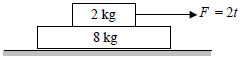
- 4If the radius of curvature of the path of two particles of same masses are in the ratio $1 : 2$, then in order to have constant centripetal force, their velocity, should be in the ratio ofView Solution
- 5The maximum tension which an inextensible ring of mass $0.1\, kg/m$ can bear is $10\,N$. The maximum velocity in $m/s$ with which it can be rotated is ........ $m/s.$View Solution
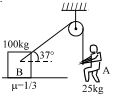
- 6Block $B$ of mass $100 kg$ rests on a rough surface of friction coefficient $\mu = 1/3$. $A$ rope is tied to block $B$ as shown in figure. The maximum acceleration with which boy $A$ of $25 kg$ can climbs on rope without making block move is:View Solution
- 7A body of mass $40\,kg$ resting on rough horizontal surface is subjected to a force $P$ which is just enough to start the motion of the body. If $\mu_{ s }=5, \mu_{ x }=0.4$, $g =10\,m / s ^2$ and the force $P$ is continuously applied on the body, then the acceleration of the body is $.........m/s^{2}$View Solution
- 8View SolutionTo avoid slipping while walking on ice, one should take smaller steps because of the
- 9The maximum speed of a car on a road-turn of radius $30\, m$, if the coefficient of friction between the tyres and the road is $0.4$, will be .......... $m/sec$View Solution
- 10If mass of $A = 10\,\,kg$, coefficient of static friction $= 0.2$, coefficient of kinetic friction = $0.2$. Then mass of $B$ to start motion isView Solution