MCQ
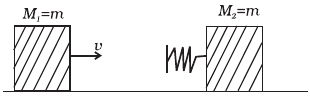
Two blocks $M _1$ and $M _2$ having equal mass are free to move on a horizontal frictionless surface. $M _2$ is attached to a massless spring as shown in. Initially $M _2$ is at rest and $M _1$ is moving toward $M _2$ with speed $v$ and collides head$-$on with $M _2$.
Image
  • A
    While spring is fully compressed all the $KE$ of $M_1$ is stored as $PE$ of spring.
  • B
    If the surface on which blocks are moving has friction, then collision cannot be elastic.
  • C
    If spring is massless, the final state of the $M_1$ is state of rest.
  • Both $B$ and $C$

Answer

Correct option: D.
Both $B$ and $C$
If there is not specified we always consider the collision elastic. When two bodies of equal masse collides elastically, their velocities are interchanged in these types of collision.
Kinetic energy and linear momentum remain conserved. According to the above diagram when $m _1$ comes in contact with the spring, $m_1$ is retarded by the spring force and $m_2$ is accelerated by the spring force.
$a.$ The spring will continue $*$to compress until the two blocks acquire common velocity. So some of kinetic energy of block $M_x$ store into $P.E$ and some part of it stores into $K.E$ of block $M_2$. So option $(a)$ is incorrect.
$b.$ As surfaces are frictionalless momentum of the system will be conserved. So option $(b)$ is also incorrect.
$c.$ The two bodies of equal mass exchange their velocities in a head on elastic collision between them. So, if spring is massless, the final state of the $M _1$ is state of rest.
$d.$ Since there is a loss of $K.E$ when the blocks collides on the rough surface. Hence, the collision is inelastic.

Need a full question paper?

Generate a complete, print-ready paper with questions like this in minutes — across 16+ boards, with answer keys.

Start Generating Free

Similar questions

Which of the following is not a postulate of kinetic theory of gases:
The dimensions of resistivity in terms of $M,\,L,\,T$ and $Q$ where $Q$ stands for the dimensions of charge, is
Asufficiently long close organ pipe has a small hole at its bottom. Initially the pipe is empty. Water is poured into the pipe at a constant rate. The fundamental frequency of the air column in the pipe
$\vec{A}$ is a vector of magnitude $2.7$ units due east. What is the magnitude and direction of vector $4 \vec{A}$ ?
A train is moving at a constant speed $V$. When its driver observes another train in front of him on the same track and moving in the same direction with constant speed $u$. If the distance between the trains be $x$, then what should be the minimum retardation of the train so as to avoid collision?
What is the velocity of the bob of a simple pendulum at its mean position, if it is able to rise to vertical height of $10\,cm$ ($g = 9.8\, m/s^2$) ..... $m/s$
The modulus of elasticity is dimensionally equivalent to
Two bodies $A$and $B$ have thermal emissivities of $0.01$ and $0.81$ respectively. The outer surface areas of the two bodies are the same. The two bodies emit total radiant power at the same rate. The wavelength ${\lambda _B}$ corresponding to maximum spectral radiancy in the radiation from $B$ is shifted from the wavelength corresponding to maximum spectral radiancy in the radiation from $A$, by $1.00\mu m$. If the temperature of $A$ is $5802\;K$
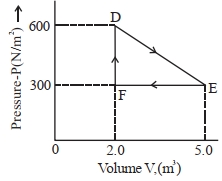
A thermodynamic system is taken from an original state $D$ to an intermediate state $E$ by the linear process shown in the figure. Its volume is then reduced to the original volume from $E$ to $F$ by an isobaric process. The total work done by the gas from $D$ to $E$ to $F$ will be $......J$
Three particles$ A$, $B$ and $C$ are thrown from the top of a tower with the same speed. $A$ is thrown up, $B$ is thrown down and $C$ is horizontally. They hit the ground with speeds ${V_A},\,\,{V_B}$ and ${V_C}$ respectively.