MCQ
Two blocks of masses $10 \; kg$ and $30 \; kg$ are placed on the same straight line with coordinates $(0,0) \; cm$ and $( x , 0) \; cm$ respectively. The block of $10 \; kg$ is moved on the same line through a distance of $6 \; cm$ towards the other block. The distance through which the block of $30 \; kg$ must be moved to keep the position of centre of mass of the system unchanged is
  • A
    $4 \; cm$ towards the $10 \; kg$ block
  • B
    $2 \; cm$ away from the $10 \; kg$ block
  • $2 \; cm$ towards the $10 \; kg$ block
  • D
    $4 \; cm$ away from the $10 \; kg$ block
Answer

Correct option: C.
$2 \; cm$ towards the $10 \; kg$ block
c
$\Delta x_{G}=\frac{m_{1} \Delta x_{1}+m_{2} \Delta x_{2}}{m_{1}+m_{2}}$

$0=\frac{10 \times 6+30\left(\Delta x_{2}\right)}{40}$

$\Delta x_{2}=-2 \; c m$

Block of mass $30 \; kg$ will to move towards $10 \; kg$.

Need a full question paper?

Generate a complete, print-ready paper with questions like this in minutes — across 16+ boards, with answer keys.

Start Generating Free

Similar questions

A diatomic ideal gas is compressed adiabatically to $\frac{1}{32}$ of its initial volume. If the initial temperature of the gas is $T_1$ (in Kelvin) and the final temperature is $a T_1$, the value of $a$ is
A man sitting in a lift feel his weight is zero, when:
A cricket ball of mass $0.15\, kg$ is thrown vertically up by a bowling machine so that it rises to a maximum height of $20 \;m$ after leaving the machine. If the part pushing the ball applies a constant force $F$ on the ball and moves horizontally a distance of $0.2\, m$ while launching the ball, the value of $F($ in $N)$ is 

$\left(g=10\, m s^{-2}\right)$

A sinusoidal wave of frequency $500 \,Hz$ has a speed of $350 \,m / s$. The phase difference between two displacements at a certain point at times $1 \,m$ apart is ...........
If the tension on a wire is removed at once, then
A body falling vertically downwards under gravity breaks in two parts of unequal masses. The centre of mass of the two parts taken together shifts horizontally towards:
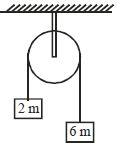
If the system is released, then the acceleration of the centre of mass of the system is
The potential energy of a particle of mass $m$ at a distance $r$ from a fixed point $O$ is given by $\mathrm{V}(\mathrm{r})=\mathrm{kr}^2 / 2$, where $\mathrm{k}$ is a positive constant of appropriate dimensions. This particle is moving in a circular orbit of radius $\mathrm{R}$ about the point $\mathrm{O}$. If $\mathrm{v}$ is the speed of the particle and $\mathrm{L}$ is the magnitude of its angular momentum about $\mathrm{O}$, which of the following statements is (are) true?

$(A)$ $v=\sqrt{\frac{k}{2 m}} R$

$(B)$ $v=\sqrt{\frac{k}{m}} R$

$(C)$ $\mathrm{L}=\sqrt{\mathrm{mk}} \mathrm{R}^2$

$(D)$ $\mathrm{L}=\sqrt{\frac{\mathrm{mk}}{2}} \mathrm{R}^2$

When a body thrown vertically upward from the earth's surface is at its maximum height, then its :
Diatomic molecule $($rigid rotator$)$ has: