Question
Two blocks of masses $10kg$ and $30kg$ are placed along a vertical line. The first block is raised through a height of $7cm$. By what distance should the second mass be moved to raise the centre of mass by $1cm$?

Answer

Two masses $m_1$ & $m_2$ are kept in a vertical line.$m_1 = 10kg, m_2 = 30kg$
The first block is raised through a height of 7cm.
The centre of mass is raised by 1cm.
$\therefore1=\frac{\text{m}_1\text{y}_1+\text{m}_2\text{y}_2}{\text{m}_1+\text{m}_2}=\frac{10\times7+\text{30y}_2}{40}$
$\Rightarrow1=\frac{70+30\text{y}_2}{40}$
$\Rightarrow70+30\text{y}_2=40$
$\Rightarrow30\text{y}_2=-30$
$\Rightarrow\text{y}_2=-1$
The 30kg body should be displaced 1cm downward inorder to raise the centre of mass through 1cm.

Need a full question paper?

Generate a complete, print-ready paper with questions like this in minutes — across 16+ boards, with answer keys.
Start Generating Free

Similar questions

Show that the area of the triangle contained between the vectors a and b is one half of the magnitude of a × b.
A tuning fork A, marked 512Hz, produces 5 beats per second, where sounded with another unmarked tuning fork B. If B is loaded with wax the number of beats is again 5 per second. What is the frequency of the tuning fork B when not loaded?
Taking the moon's orbit around earth to be r and mass of earth 81 times the mass of the moon. Find the position of the point from the earth, where the net gravitational field is zero.
Prove that the torque acting due to a force F in the xy plane is, $\tau_{\text{z}}=\text{x}\text{F}_{\text{y}}-\text{y}\text{F}_{\text{x}'}$
Determine a unit vector which is perpendicular to both $\vec{\text{A}}=2\hat{\text{i}}+\hat{\text{j}}+\hat{\text{k}}$ and $\vec{\text{B}}=\hat{\text{i}}-\hat{\text{j}}+2\hat{\text{k}}.$
Assume that each atom in a copper wire contributes one free electron. Estimate the number of free electrons in a copper wire having a mass of 6.4g (take the atomic weight of copper to be $64g ~mol^{-1}$.
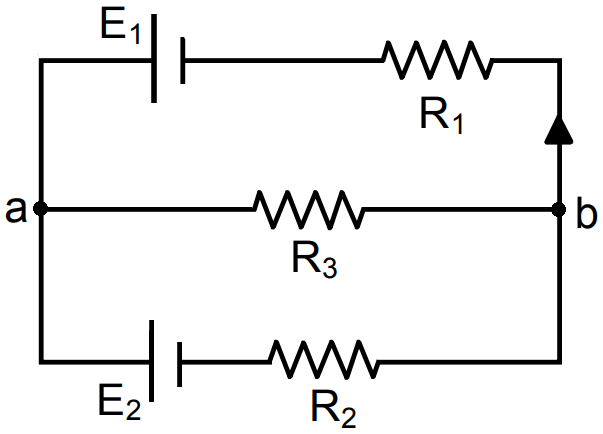
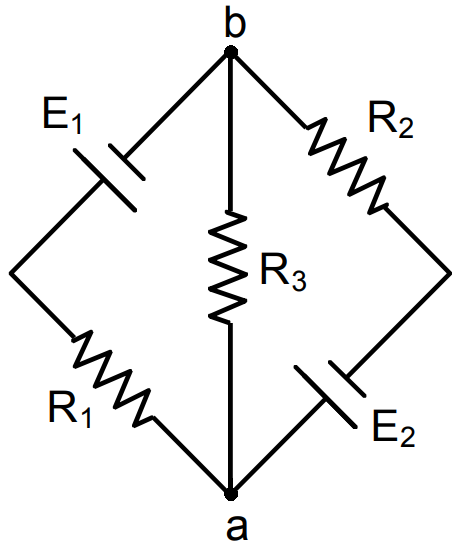
Find the potential difference $V_a - V_b$ in the circuits shown in figure.

Pressure decreases as one ascends the atmosphere. If the density of air is $\rho,$ what is the change in pressure dp over a differential height dh?
Why is electrical power required at all when the elevator is descending? Why should there be a limit on the number of passengers in this case?
An ideal gas has a specific heat at constant pressure $\text{C}_{\text{p}}=\frac{5\text{R}}{2}.$ The gas is kept in a closed vessel of volume $0.0083m^3$ at a temperature of 300K and a pressure of $1.6 \times 10^6Nm^{-2}$. An amount of $2.49 \times 10^4J$ of heat energy is supplied to the gas. Calculate the final temperature and pressure of the gas.