Two blocks of masses $3 \,{kg}$ and $5\, {kg}$ are connected by a metal wire going over a smooth pulley. The breaking stress of the metal is $\frac{24}{\pi} \times 10^{2}\, {Nm}^{-2}$. What is the minimum radius of the wire? (Take $\left.g=10\, {ms}^{-2}\right)$ (in $cm$)
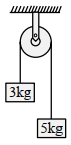
JEE MAIN 2021, Diffcult
Download our app for free and get started
${T}=\frac{2 {m}_{1} {m}_{2} {g}}{{m}_{1}+{m}_{2}}=\frac{2 \times 3 \times 5 \times 10}{8}$
$=\frac{75}{2}$
Stress $=\frac{{T}}{{A}}$
$\frac{24}{\pi} \times 10^{2}=\frac{75}{2 \times \pi {R}^{2}}$
${R}^{2}=\frac{75}{2 \times 24 \times 100}=\frac{3}{8 \times 24}$
$\Rightarrow {R}=0.125\, {m}$
${R}=12.5\, {cm}$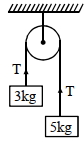

Download our appand get started for free
Experience the future of education. Simply download our apps or reach out to us for more information. Let's shape the future of learning together!No signup needed.*
Similar Questions
- 1Two wires are made of the same material and have the same volume. However wire $1$ has crosssectional area $A$ and wire $2$ has cross-section area $3A$. If the length of wire $1$ increases by $\Delta x$ on applying force $F$, how much force is needed to stretch wire $2$ by the same amount?View Solution
- 2View SolutionThere is no change in the volume of a wire due to change in its length on stretching. The poisson's ratio of the material of the wire is
- 3A metal rod of cross-sectional area $10^{-4} \,m ^{2}$ is hanging in a chamber kept at $20^{\circ} C$ with a weight attached to its free end. The coefficient of thermal expansion of the rod is $2.5 \times 10^{-6} \,K ^{-1}$ and its Young's modulus is $4 \times 10^{12} \,N / m ^{2}$. When the temperature of the chamber is lowered to $T$, then a weight of $5000 \,N$ needs to be attached to the rod, so that its length is unchanged. Then, $T$ is ............ $^{\circ} C$View Solution
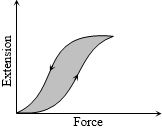
- 4The diagram shows a force-extension graph for a rubber band. Consider the following statementsView Solution
$I.$ It will be easier to compress this rubber than expand it
$II.$ Rubber does not return to its original length after it is stretched
$III.$ The rubber band will get heated if it is stretched and released
Which of these can be deduced from the graph
- 5Four identical hollow cylindrical columns of mild steel support a big structure of mass $50 \times 10^{3} {kg}$, The inner and outer radii of each column are $50\; {cm}$ and $100 \;{cm}$ respectively. Assuming uniform local distribution, calculate the compression strain of each column. [Use $\left.{Y}=2.0 \times 10^{11} \;{Pa}, {g}=9.8\; {m} / {s}^{2}\right]$View Solution
- 6$A$ and $B$ are two wires. The radius of $A$ is twice that of $B.$ They are stretched by the some load. Then the stress on $B$ isView Solution
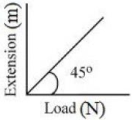
- 7As shown in the figure, in an experiment to determine Young's modulus of a wire, the extension-load curve is plotted. The curve is a straight line passing through the origin and makes an angle of $45^{\circ}$ with the load axis. The length of wire is $62.8\,cm$ and its diameter is $4\,mm$. The Young's modulus is found to be $x \times$ $10^4\,Nm ^{-2}$. The value of $x$ isView Solution
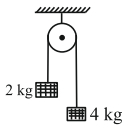
- 8Two blocks of mass $2 \mathrm{~kg}$ and $4 \mathrm{~kg}$ are connected by a metal wire going over a smooth pulley as shown in figure. The radius of wire is $4.0 \times 10^{-5}$ $\mathrm{m}$ and Young's modulus of the metal is $2.0 \times 10^{11} \mathrm{~N} / \mathrm{m}^2$. The longitudinal strain developed in the wire is $\frac{1}{\alpha \pi}$. The value of $\alpha$ is [Use $\mathrm{g}=10 \mathrm{~m} / \mathrm{s}^2$ )View Solution
- 9The stress-strain curves are drawn for two different materials $X$ and $Y$. It is observed that the ultimate strength point and the fracture point are close to each other for material $X$ but are far apart for material $Y$. We can say that materials $X$ and $Y$ are likely to be (respectively)View Solution
- 10A wire $2 \,m$ in length suspended vertically stretches by $10 \,mm$ when mass of $10 \,kg$ is attached to the lower end. The elastic potential energy gain by the wire is $...... J ($take $g=10 \,m / s ^2 )$View Solution