MCQ
Two bodies $A$ and $B$ start from rest from the same point with a uniform acceleration of $2\,m / s ^2$. If $B$ starts one second later, then the two bodies are separated, at the end of the next second, by $.............\,m$
  • A
    $1$
  • B
    $2$
  • $3$
  • D
    $4$

Answer

Correct option: C.
$3$
c
(c)

$s_B=\frac{1}{2} \times 2 \times(1)^2=1\,m$

$s_A=\frac{1}{2} \times 2 \times(2)^2=4\,m$

$s_A-s_B=3\,m$

Need a full question paper?

Generate a complete, print-ready paper with questions like this in minutes — across 16+ boards, with answer keys.

Start Generating Free

Similar questions

The magnitude of pairs of displacement vectors are given. Which pair of displacement  vectors cannot be added to give a resultant vector of magnitude $13\, cm$?
A man raises a box of mass $50\ kg$ to a height of $2m$ in $2\ \text{min}$ , while another man raises the same box to the same height in $5$ minthes. What is the ratio of work done by them?
Velocity $-$ time graph of a body with uniform velocity is a straight line:
Two cars $S_1$ and $S_2$ are moving in coplanar concentric circular tracks in the opposite sense with the periods of revolution $3 \,min$ and $24 \,min$, respectively. At time $t=0$, the cars are farthest apart. Then, the two cars will be 
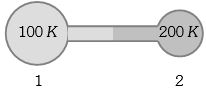
Figure shows two flasks connected to each other. The volume of the flask $1$ is twice that of flask $2.$ The system is filled with an ideal gas at temperature $100\, K$ and $200 \,K $ respectively. If the mass of the gas in $1$ be $m$ then what is the mass of the gas in flask $2$
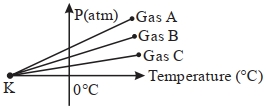
For three low density gases $A, B, C$ pressure versus temperature graphs are plotted while keeping them at constant volume, as shown in the figure.

The temperature corresponding to the point ' $K$ ' is $...........\,{}^{\circ}\,C$

Which of the following statements is true
When a ceiling fan is switched off its angular velocity reduces to $50\%$ while it makes $ 36$ rotations. How many more rotation will it make before coming to rest (Assume uniform angular retardation)
Two sound waves with wavelength $5.0m$ and $5.5m$ respectively, each propagate in a gas with velocity $330\ m/s.$ We expect the following number of beats/sec:
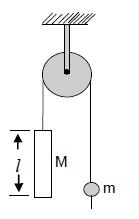
Figure shows an arrangement of a rod of length $l$ and mass $M$ and a bead of mass $m$ attached to a weightless string passing over a frictionless pulley. At $t = 0$ , the bead is in level with the lower end of the rod. The bead slides down the string with considerable friction and is opposite to the other end of the rod after $T\ second$ . Assuming friction between the beadand the string to be constant all through, the frictional force is