Question
Two bodies are thrown with same velocities at angles $\alpha$ and $(90^\circ-\alpha)$ with the horizontal. What will be the ratio of $(i)$ maximum heights attained by them $(ii)$ their horizontal ranges?

Answer

  1. $\frac{\text{h}_1}{\text{h}_2}=\frac{\frac{\text{v}^2_0\sin^2\alpha}{2\text{g}}}{\frac{\text{v}^2_0\sin^2(90-\alpha)}{2\text{g}}}$
$=\frac{\sin^2\alpha}{\cos^2\alpha}=\tan^2\alpha$
  1. Horizontal ranges in both the cases are same, i.e.,
$\text{R}_1=\text{R}_2,\ \frac{\text{R}_1}{\text{R}_2}=1$

Need a full question paper?

Generate a complete, print-ready paper with questions like this in minutes — across 16+ boards, with answer keys.
Start Generating Free

Similar questions

How does the mass vary when the velocity is varied? What is mass-energy equivalence? Give an example.
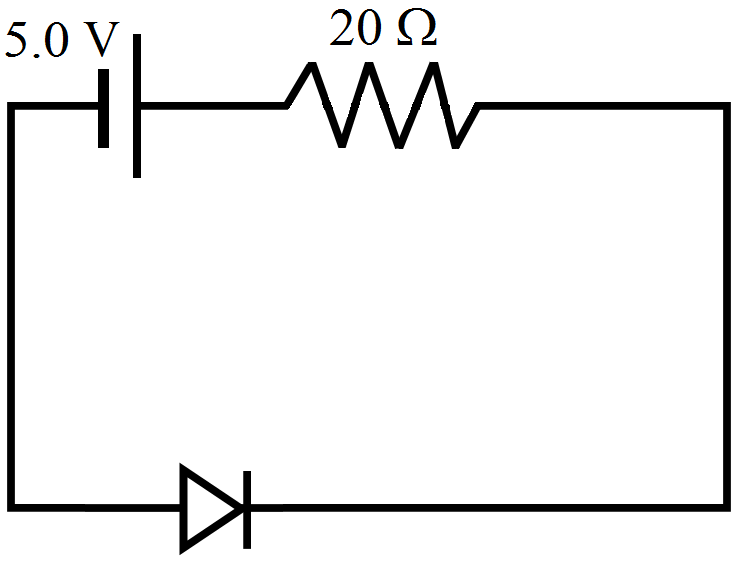
Calculate the current through the circuit and the potential difference across the diode shown in figure. The drift current for the diode is $20\mu\text{A}.$
Is viscosity a vector?
When two waves of almost equal frequencies $n_1$ and $n_2$ reach at a point simultaneously, what is the time interval between successive maxima?
Protons with kinetic energy K emerge from an accelerator as a narrow beam. The beam is bent by a perpendicular magnetic field, so that it just misses a plane target kept at a distance l in front of the accelerator. Find the magnetic field.
An electric heater supplies heat to system at a rate 100W. If system performs work at a rate of 75 joules/ sec, at what rate is the internal energy increased?
A long narrow horizontal slit is placed 1mm above a horizontal plane mirror. The interference between the light coming directly from the slit and that after reflection is seen on a screen 1.0m away from the slit. Find the fringe-width if the light used has a wavelength of 700nm.
Write the factors affecting surface tension?
The magnetic field inside a tightly wound, long solenoid is $\text{B}=\mu_0\text{ni}.$ It suggests that the field does not depend on the total length of the solenoid, and hence if we add more loops at the ends of a solenoid the field should not increase. Explain qualitatively why the extra-added loops do not have a considerable effect on the field inside the solenoid.
Draw displacement-time graph for a uniformly accelerated motion. What is its shape?