Question
Two bodies are thrown with the same initial velocity at angles $\alpha$ and $(90^\circ-\alpha)$ with and is of horizontal. What will be the ratio of (i) maximum heights attained by them and (ii) of horizontal ranges?

Answer

Horizontal range, $\text{R}=\frac{\text{u}^2}{\text{g}}\sin2\theta$
and Max. height, $\text{H}=\frac{\text{u}^2\sin^2\theta}{2\text{g}}$
Case (i): When $\theta=\alpha;$
$\text{R}_1=\frac{\text{u}^2}{\text{g}}\sin2\alpha$
and $\text{H}_1=\frac{\text{u}^2\sin^2\alpha}{2\text{g}}$
Case (ii): When $\theta=(90^\circ-\alpha);$
$\text{R}_2=\frac{\text{u}^2\sin2(90^\circ-\alpha)}{\text{g}}=\frac{\text{u}^2\sin2\alpha}{\text{g}}$
and $\text{H}_2=\frac{\text{u}^2\sin^2(90^\circ-\alpha)}{\text{g}}=\frac{\text{u}^2\cos^2\alpha}{\text{g}}$
$\therefore\ \frac{\text{H}_1}{\text{H}_2}=\frac{\sin^2\alpha}{\cos^2\alpha}=\tan^2\alpha$ and $\frac{\text{R}_1}{\text{R}_2}=1.$

Need a full question paper?

Generate a complete, print-ready paper with questions like this in minutes — across 16+ boards, with answer keys.
Start Generating Free

Similar questions

For a particle in S.H.M., the displacement x of the particle as a function of time t is given as $\text{x = A}\sin(2\pi\text{t}).$ Here x is in cm and t is in seconds.
Let the time taken by the particle to travel from x = 0 to $\text{x}=\frac{\text{A}}{2}$ be T1 and the time taken to travel from $\text{x}=\frac{\text{A}}{2}$ to x = A be T2. Find $\frac{\text{T}_1}{\text{T}_2}.$
A satellite orbits the earth at a height of 400 km above the surface. How much energy must be expended to rocket the satellite out of the earth’s gravitational influence? Mass of the satellite = 200 kg ; mass of the earth $=6.0 \times 10^{24} kg$; radius of the earth $=6.4 \times 10^6 m ; G =6.67 \times 10^{-11} Nm ^2 kg^{-2}$.
Given below are some examples of wave motion. State in each case if the motion is transverse, longitudinal or a combination of both.
  1. Motion of a kink in a long coil spring produced by displacing one end of the spring sideways.
  2. Wave produced in a cylinder containing water by moving its piston back and forth.
  3. Wave produced by a motorboat sailing in water.
  4. Ultrasonic waves in air produced by a vibrating crystal.
A body of mass 2kg suspended through a vertical spring executes simple harmonic motion of period 4s. If the oscillations are stopped and the body hangs in equilibrium, find the potential energy stored in the spring.
Two blocks of masses 10kg and 30kg are placed along a vertical line. The first block is raised through a height of 7cm. By what distance should the second mass be moved to raise the centre of mass by 1cm?
A player throws a ball upwards with an initial speed of 29.4m s–1.
Choose the x = 0m and t = 0s to be the location and time of the ball at its highest point, vertically downward direction to be the positive direction of x-axis, and give the signs of position, velocity and acceleration of the ball during its upward, and downward motion.
Two equal and opposite forces act on a rigid body. Under what conditions will the body (i) rotate (ii) not rotate?
Two Carnot engines A and B are operated in series. The first one A receives heat at 800K and rejects to a reservoir at temperature T K The second engine B receives the heat rejected by the first engine and in turn rejects to a heat reservoir at 300K. Calculate the temperature T K for the following cases.
  1. When the outputs of the two engines are equal.
  2. When the efficiencies of the two engines are equal.
A bat emitting an ultrasonic wave of frequency 4.5 × 104Hz flies at a speed of 6m/s between two parallel walls. Find the two frequencies heard by the bat and the beat frequency between the two. The speed of sound is 330m/s.
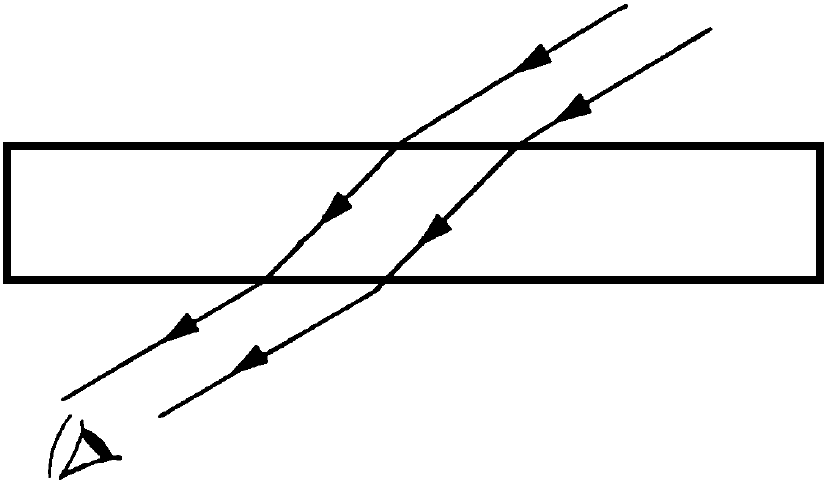
A narrow beam of light passes through a slab obliquely and is then received by an eye. The index of refraction of the material in the slab fluctuates slowly with time. How will it appear to the eye? The twinkling of stars has a similar explanation.