Question
Two bodies make an elastic head-on collision on a smooth horizontal table kept in a car. Do you expect a change in the result if the car is accelerated on a horizontal road because of the noninertial character of the frame? Does the equation "Velocity of separation = Velocity of approach" remain valid in an accelerating car? Does the equation "Final momentum = Initial momentum" remain valid in the accelerating car?


Answer

In case car is accelerated it would affect velocity of both bodies,
  1. In this case the change in velocity would affect velocity of both bodies. (body moving in direction of car would slow down and other one moving in opposite direction would speed up in case car is accelerated)
  2. Velocity of separation would be equal to velocity of approach. As only change would be in velocity but everything would remain same.
  3. Yes final momentum would be still equal to initial momentum as with increase in velocity of one body the velocity of other body does decrease.

Need a full question paper?

Generate a complete, print-ready paper with questions like this in minutes — across 16+ boards, with answer keys.

Start Generating Free

Similar questions

$i.$ Draw a plot showing the variation of photoelectric current with collector potential for different frequencies but same intensity of incident radiation.
$ii.$ Use Einstein’s photoelectric equation to explain the observations from this graph.
$iii.$ What change will you observe if intensity of incident radiation is changed but the frequency remains the same?
A number of identical cells, n, each of emf E, internal resistance r connected in series are charged by a d.c. source of emf E', using a resistor R.
  1. Draw the circuit arrangement.
  2. Deduce the expressions for (a) the charging current and (b) the potential difference across the combination of the cells.
Define the term work function of a metal. The threshold frequency of a metal is $2f_0$. When the light of frequency $2f_0$ is incident on the metal plate, the maximum velocity of electrons emitted is $v_1$ When the frequency of the incident radiation is increased to $5f_0$ the maximum velocity of electrons emitted is $v_2$. Find the ratio of $v_1$ to $v_2$.
Explain the principle and working of a cyclotron with the help of a schematic diagram. Write the expression for cyclotron frequency.
Double $-$ convex lenses are to be manufactured from a glass of refractive index $1.55,$ with both faces of the same radius of curvature. What is the radius of curvature required if the focal length is to be $20\ cm$?
An ammeter and a milliammeter are converted from the same galvanometer. Out of the two, which current measuring instrument has a higher resistance?
You are given two circuits as shown in Fig. 14.46, which consist of NAND gates. Identify the logic operation carried out by the two circuits.
  1.  
  1.  
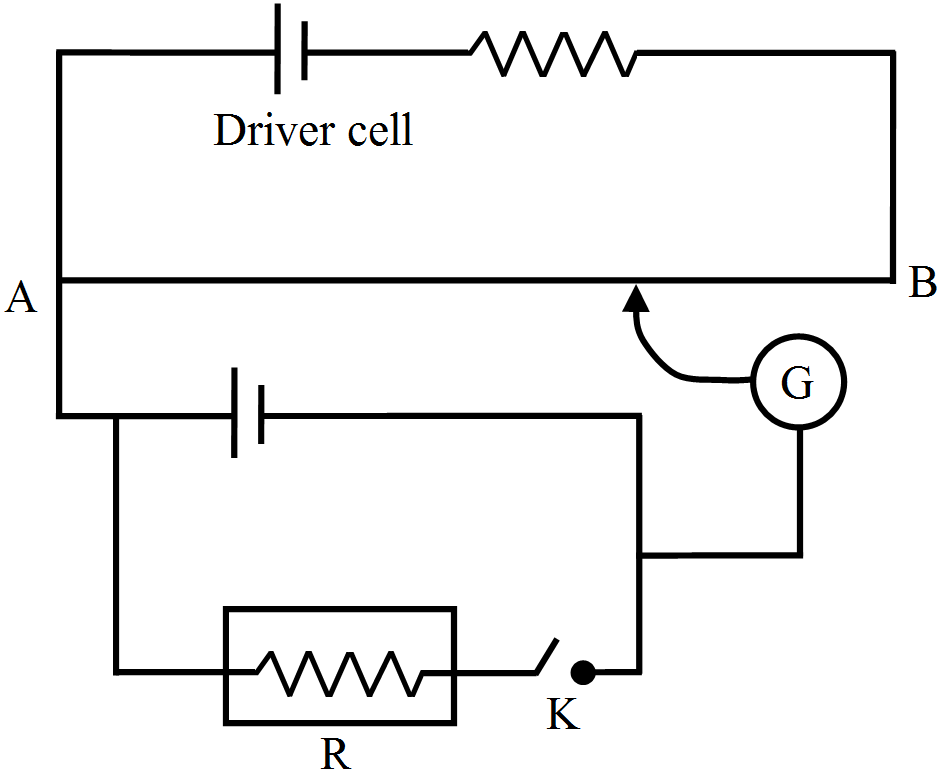
The following circuit shows the use of potentiometer to measure the internal resistance of a cell:
  1. When the key is open, how does the balance point change, if the current from the driver cell decreases?
  2. When the key K is closed, how does the balance point change if R is increased keeping current from the driver cell constant?
Draw a circuit diagram for use of NPN transistor as an amplifier in common emitter configuration. The input resistance of a transistor is $1000 \Omega$. On changing its base current by $10\mu\text{A}$ the collector current increases by 2mA. If a load resistance of $5\text{K}\Omega$. Is used in the circuit, calculate:
  1. The current gain.
  2. Voltage gain of the amplifier.
A uniform rod of mass 300g and length 50cm rotates at a uniform angular speed of 2rad/s about an axis perpendicular to the rod through an end. Calculate:
  1. The angular momentum of the rod about the axis of rotation.
  2. The speed of the centre of the rod.
  3. Its kinetic energy.