The following circuit shows the use of potentiometer to measure the internal resistance of a cell: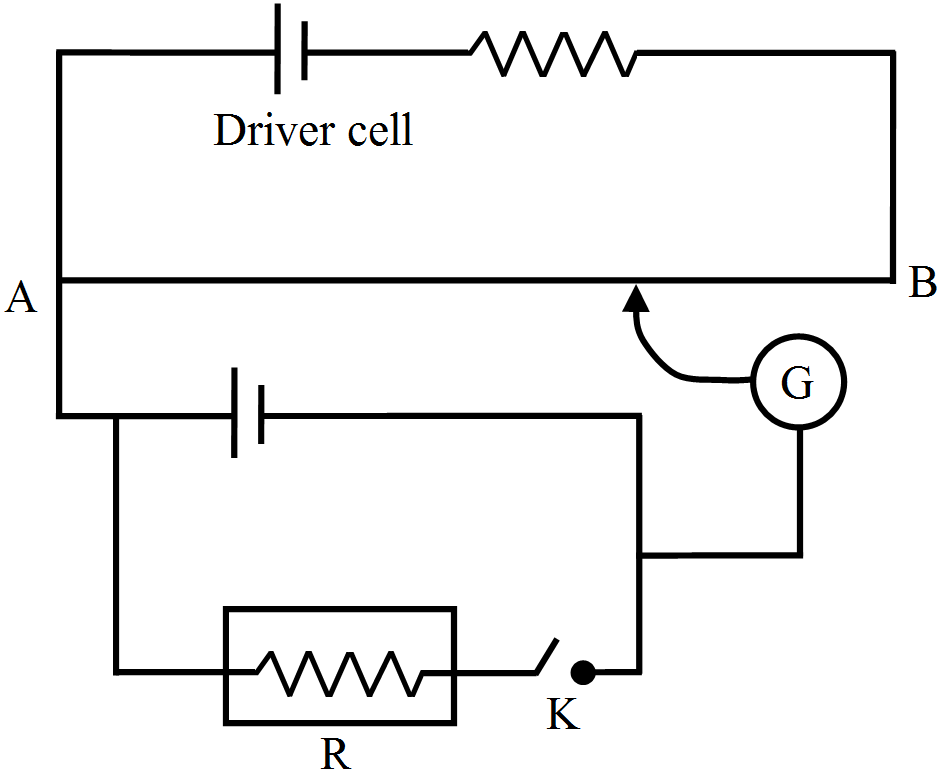
- When the key is open, how does the balance point change, if the current from the driver cell decreases?
- When the key K is closed, how does the balance point change if R is increased keeping current from the driver cell constant?
Download our app for free and get started
- When current through driver cell decreases, the potential gradient across potentiometer wire decreases; so the balancing length $\text{l}=\frac{\text{E}}{\text{k}}$ increases, so balance point is shifted to the right.
- With increase of R, the terminal p.d. across cell E increases and hence balancing length $\text{l}=\frac{\text{V}}{\text{k}}\propto\text{V}$ increases. So the balance point is shifted to the right.

Download our appand get started for free
Experience the future of education. Simply download our apps or reach out to us for more information. Let's shape the future of learning together!No signup needed.*
Similar Questions
- 1The current through a wire depends on time as $\text{i}=\text{i}_0+\alpha\text{t},$View Solution
Where $\text{i}_0=10\text{A}$ and $\alpha=4\text{A/ s}.$ Find the charge that crosses through a section of the wire in 10 seconds. - 2View SolutionName the charge carriers of electric current in:
- Silver foil.
- Hydrogen discharge tube.
- Germanium semiconductor.
- Wire made of alloy nichrome.
- Superconductor.
- 3View SolutionDo all the thermocouples have a neutral temperature?
- 4View SolutionA cylindrical metallic wire is stretched to increase its length by 10%. Calculate the percentage increase in its resistance.
- 5View Solution
- Three resistors $2\ \Omega,\ 4\ \Omega\ \text{and}\ 5\ \Omega$ are combined in parallel. What is the total resistance of the combination?
- If the combination is connected to a battery of emf 20 V and negligible internal resistance, determine the current through each resistor, and the total current drawn from the battery.
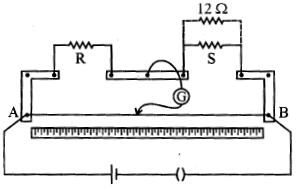
- 6View SolutionIn a meter bridge, the null point is found at a distance of 40 cm from A. If a resistance of 12 Ω is connected in parallel with S, the null point occurs at 50.0 cm from. Determine the values of R and S.
- 7View SolutionTwo wires A and B of the same material and having same length, have their cross sectional areas in the ratio 1 : 6. What would be the ratio of heat produced in these wires when same voltage is applied across each?
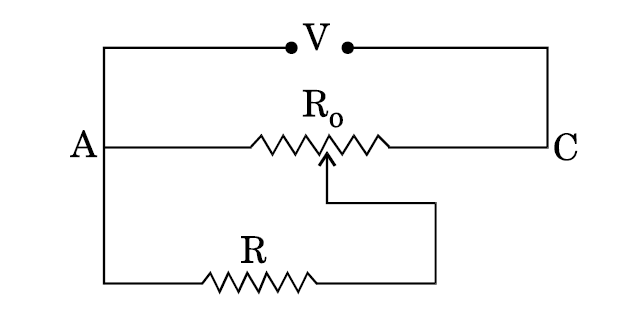
- 8A resistance of $R \Omega$ draws current from a potentiometer as shown in the figure. The potentiometer has a total resistance $R_o\Omega$ . A voltage $V$ is supplied to the potentiometer. Derive an expression for the voltage across $R$ when the sliding contact is in the middle of the potentiometer.View Solution
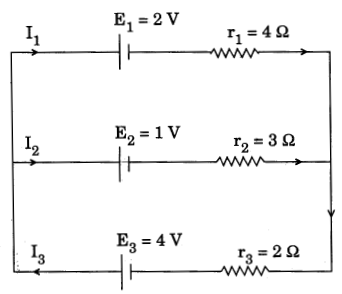
- 9State Kirchhoff’s rules. Use these rules to write the expressions for the currents $I_1, I_2$ and $I_3$ in the circuit diagram shown.View Solution
- 10A wire $AB$ is carrying a steady current of $12 A$ and is lying on the table. Another wire $CD$ carrying $5A$ is held directly above $AB$ at a height of $1 mm.$ Find the mass per unit length of the wire $CD$ so that it remains suspended at its position when left free. Give the direction of the current flowing in $CD$ with respect to that in $AB.$ $[$Take the value of $g = 10 ms^{–2}]$View Solution